
- FHDN7032, Prince Faisal bin Fahd Rd, Al Ahsa, Eastern Province, KSA
- Sat to Thu : 8:00 am - 5:00 pm

Looking for reliable and professional VRF installation services for your home, office, commercial building, hotel, or other property? Our professional VRF installation services are designed to provide efficient, flexible, and reliable air conditioning solutions for buildings with multiple rooms and temperature zones.A Variable Refrigerant Flow (VRF) system is an advanced air conditioning solution that allows multiple indoor units to operate with one or more outdoor units. With proper system design and installation, VRF technology can provide individual temperature control, efficient operation, and flexible cooling for different areas of a building.Our VRF AC installation service covers the complete installation process, including site inspection, system planning, indoor and outdoor unit installation, refrigerant piping, drainage, electrical connections, controls, testing, and commissioning.Whether you are installing a new system in a commercial building or replacing an existing air conditioning system, professional installation is essential for reliable long-term performance.
We provide complete VRF AC installation solutions from initial site assessment through final commissioning.
Before starting a VRF system installation, the property is inspected to understand the building layout, room sizes, ceiling conditions, outdoor unit location, electrical requirements, and available piping routes.A proper site assessment helps determine the practical installation requirements and identify potential challenges before work begins.
The system is planned according to the cooling requirements and building layout. Indoor unit positions, outdoor unit locations, refrigerant piping routes, drainage, controls, and electrical connections are considered during the planning stage.Proper planning helps create an installation that is suitable for the building and easier to operate and maintain.
VRF systems can use different types of indoor units depending on the application. These may include cassette units, ducted units, concealed units, and other compatible indoor configurations.Indoor units are positioned according to room layout, airflow requirements, ceiling conditions, and the overall system design.
Outdoor VRF units require an appropriate location with sufficient ventilation, structural support, service access, and clearance.The outdoor unit location is carefully considered because accessibility and airflow are important for operation and future maintenance.
Refrigerant piping is one of the most important parts of a VRF installation. The piping connects the outdoor unit with the indoor units and must be installed according to the system design and manufacturer requirements.Pipe routing, joints, insulation, support, and connection quality are important considerations during installation.
Indoor air conditioning units can produce condensate during operation. Proper drainage arrangements are therefore required to safely remove condensate from the indoor units.Drainage routes should be planned to prevent leakage, water accumulation, and other installation-related problems.
VRF systems require appropriate electrical connections and communication wiring between system components.Electrical work and control connections are checked as part of the installation process to ensure that the system components can communicate and operate correctly.
After installation, the complete system is inspected and tested. This can include checking indoor units, outdoor units, controls, piping, drainage, and system operation.Commissioning helps verify that the installed system is operating according to its intended configuration before handover.
VRF air conditioning systems can be designed for a wide range of commercial, residential, and institutional applications.
Offices often contain multiple rooms and zones with different cooling requirements. A VRF system can provide flexible temperature control for cabins, meeting rooms, workspaces, reception areas, and other suitable spaces.
Hotels require comfortable indoor conditions across guest rooms and common areas. VRF systems can be planned to provide individual control across suitable zones while maintaining a centralized system design.
Retail properties may have different areas that require different cooling levels. VRF systems can provide flexible air conditioning for customer areas, offices, display areas, and other spaces.
Restaurants can have varying cooling requirements across dining areas, private rooms, offices, and other conditioned spaces. A properly designed VRF system can help provide suitable temperature control.
Large homes, villas, apartments, and multi-room residences can use VRF systems where centralized air conditioning with individual room control is required.
VRF systems may also be considered for suitable schools, healthcare-related administrative spaces, corporate buildings, showrooms, and other properties depending on their design and air conditioning requirements.
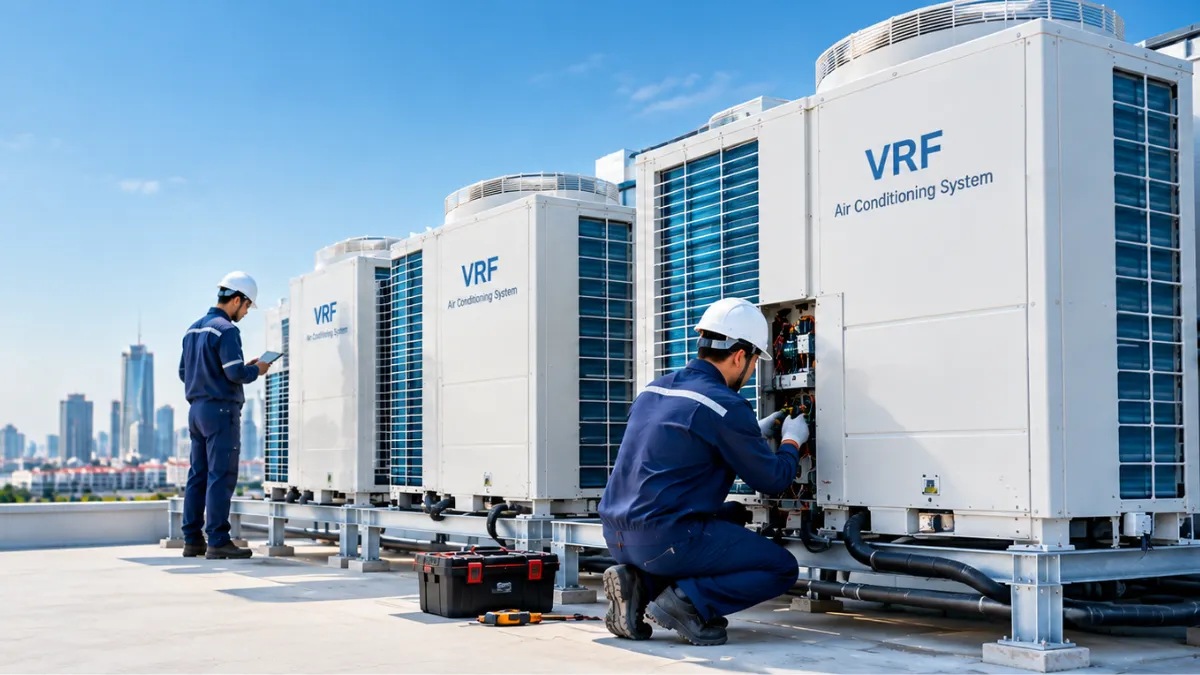
A professional VRF air conditioning installation generally follows a structured process.
The property is inspected to understand the building layout, cooling requirements, electrical conditions, available installation space, and piping routes.
Indoor and outdoor unit locations are determined along with refrigerant piping, drainage, electrical connections, and control requirements.
The indoor units, outdoor units, refrigerant piping, drainage system, electrical connections, and controls are installed according to the approved system design.
The installation is inspected to identify any issues with connections, piping, drainage, electrical work, or system components.
The system is operated and tested to verify that the installed components are functioning correctly.
After successful testing, the system is commissioned and handed over for operation according to the applicable project requirements.
Professional installation is important because VRF systems contain multiple interconnected components. Correct installation can help the system operate according to its intended design.
VRF technology can adjust refrigerant flow according to the cooling demand of connected zones. This can support efficient operation when the system is properly designed and installed.
Different rooms or areas can have their own temperature settings, depending on the type of VRF system and controls used.
Multiple indoor units can be connected to a suitable outdoor system according to the manufacturer's specifications and system design.
A centralized VRF solution can reduce the need for multiple individual outdoor air conditioning units, depending on the application.
Properly designed and installed VRF systems can provide consistent temperature control across different areas of a building.
Suitable VRF systems can support centralized management and monitoring, making them practical for larger buildings with multiple zones.
VRF installation requires attention to refrigerant piping, electrical connections, drainage, communication wiring, indoor unit placement, outdoor unit positioning, and system controls. Incorrect installation can affect system operation and may lead to performance issues, refrigerant problems, drainage issues, or additional maintenance requirements. Professional installation focuses on following the system design, manufacturer requirements, and appropriate installation practices. A professional installation can also make future servicing easier because system components, piping routes, controls, and connections are properly organized.
VRF systems can be planned for both new construction and suitable existing buildings. For new construction projects, VRF installation can be incorporated into the building design from the beginning. Indoor unit locations, refrigerant piping, drainage, electrical requirements, and outdoor unit locations can be coordinated with other building services. For existing buildings, installation requires additional consideration of the current structure, ceiling space, electrical capacity, outdoor unit location, and available routes for refrigerant piping and drainage. A site inspection is therefore recommended before finalizing the installation plan.
The cost of VRF installation varies from project to project. There is no single fixed installation price because each property has different requirements.Factors that can affect the overall cost include:Number of indoor unitsOutdoor unit capacityBuilding size and layoutRefrigerant piping lengthNumber of floorsElectrical work requirementsDrainage requirementsInstallation height and accessibilityCeiling and structural conditionsExisting building modificationsProject complexityRequired controls and accessoriesA site inspection and project assessment can provide a more accurate installation estimate.
Regular maintenance is important for maintaining the performance of a VRF air conditioning system.Maintenance requirements depend on the system, operating conditions, usage, and manufacturer recommendations. Routine servicing may include inspection and cleaning of filters, indoor and outdoor coils, drainage systems, electrical connections, controls, and other system components.Regular inspection can also help identify potential issues before they develop into larger problems.Following the manufacturer's recommended maintenance schedule is an important part of keeping the system operating properly.
Choosing an experienced installation team can make a significant difference when installing a complex air conditioning system.
Our approach focuses on:
We understand that every property has different cooling requirements. Our goal is to provide a VRF installation solution that is appropriate for the building and its intended use.
If you are planning a new air conditioning system for an office, hotel, commercial building, residential property, retail store, or other suitable application, professional VRF installation can provide a flexible solution for multiple cooling zones.
Our team can help with site assessment, VRF system planning, indoor and outdoor unit installation, refrigerant piping, electrical connections, testing, and commissioning.