

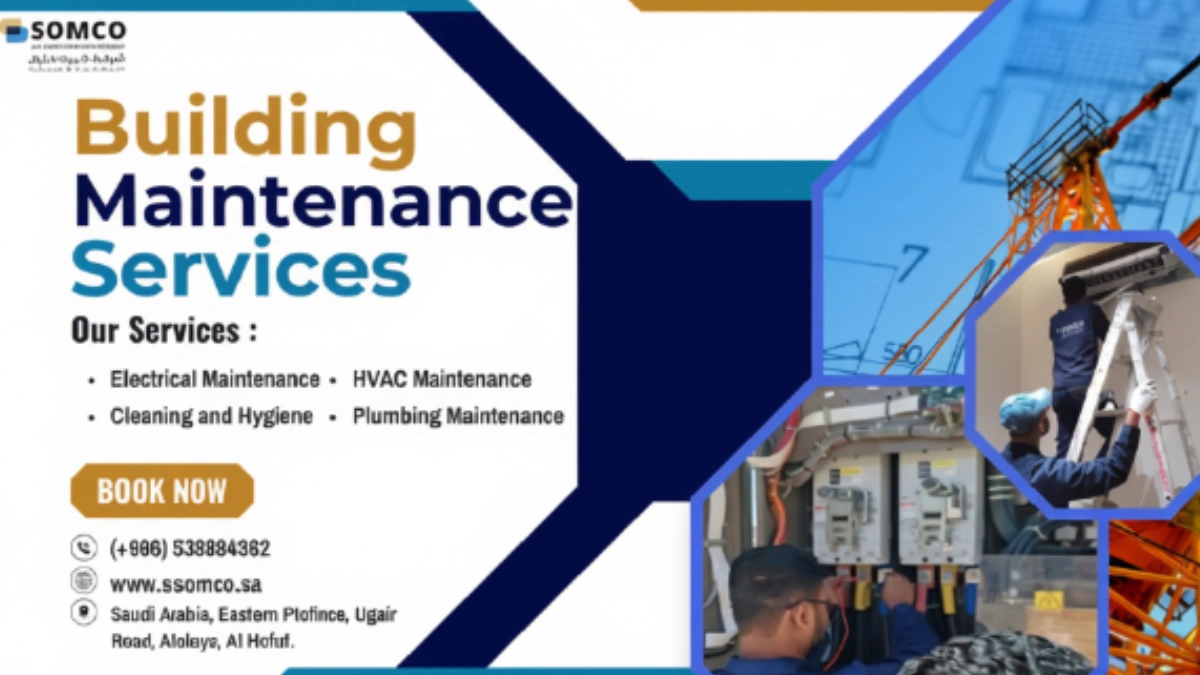
 Maintenance
Buildings require continuous attention to remain functional, comfortable and well maintained. In Saudi Arabia, the demanding climate, extended air-conditioning requirements and different operating conditions of commercial and residential properties make planned building maintenance particularly important.
For property owners, facility managers and businesses, choosing the right Building Maintenance Company in Saudi Arabia is not simply about finding someone to fix problems when they occur. A professional maintenance approach should help identify requirements early, organize recurring inspections, maintain important building systems and reduce avoidable disruption.
Building maintenance can include a combination of planned inspections, preventive activities, corrective work and ongoing operational support. The exact requirements depend on the building type, age, usage, equipment and maintenance history.
SSOMCO provides building maintenance support for properties that require organized and reliable maintenance planning across Saudi Arabia.
What Is Building Maintenance?
Building maintenance refers to the planned activities required to keep a property and its operational systems in suitable working condition.
Rather than waiting for equipment or building systems to fail, a structured maintenance program focuses on identifying potential issues and addressing them at the appropriate stage.
Depending on the property, building maintenance can involve:
- Routine inspections
- Preventive maintenance
- HVAC maintenance
- Air-conditioning maintenance
- Building operation and maintenance
- Facility maintenance
- Air duct cleaning
- Air balancing
- Chiller maintenance
- VRF-related maintenance requirements
- Cleaning and janitorial support
- Kitchen hood cleaning
- General building condition monitoring
The exact maintenance plan should be developed according to the property’s actual requirements.
A small commercial building and a large industrial facility will not necessarily need the same maintenance strategy.
Why Building Maintenance Matters in Saudi Arabia
Saudi Arabia’s climate creates demanding conditions for many properties.
High temperatures can increase dependence on air-conditioning systems, while dust and environmental conditions can influence building operations and HVAC performance.
At the same time, commercial properties may operate for long hours, increasing the workload placed on building systems.
A planned maintenance strategy can help property managers stay ahead of these challenges.
Maintaining Building Performance
Regular inspection helps property teams understand how building systems are performing.
Instead of relying entirely on occupant complaints, maintenance teams can monitor equipment and identify potential requirements earlier.
Reducing Unexpected Disruption
Unexpected equipment problems can interrupt business operations.
Planned maintenance does not eliminate every possible failure, but it can help identify developing issues before they become larger maintenance concerns.
Supporting Property Longevity
Buildings represent major investments.
Consistent maintenance can help protect the condition of equipment and other building assets over the long term.
Improving Maintenance Planning
When maintenance activities are documented, property managers can make better decisions about future inspections, repairs and service requirements.
Building Maintenance Should Be Planned Around the Property
One of the biggest mistakes in building maintenance is using exactly the same maintenance plan for every property.
Each building has different requirements.
A maintenance program can be influenced by:
- Building size
- Property type
- Occupancy
- Operating hours
- HVAC configuration
- Equipment age
- Environmental conditions
- Previous maintenance
- Usage patterns
- Existing maintenance contracts
For example, an office building operating five days a week may have different requirements from a facility operating continuously.
A professional Building Maintenance Company should therefore begin by understanding the property before defining the maintenance scope.
Preventive Maintenance vs Reactive Maintenance
There are two broad ways businesses often approach maintenance.
Reactive Maintenance
Reactive maintenance occurs after a problem has already developed.
For example, a cooling system may receive attention only after it stops providing adequate performance.
This approach can sometimes result in:
- Operational disruption
- Emergency service requirements
- Higher repair pressure
- Unplanned expenditure
- Reduced occupant comfort
Preventive Maintenance
Preventive maintenance is planned in advance.
Inspections and maintenance activities are scheduled according to equipment requirements and property conditions.
The objective is to identify potential problems before they develop into larger issues.
For commercial properties, preventive maintenance can provide a more organized way of managing building systems.
The Role of HVAC in Building Maintenance
HVAC systems are particularly important in Saudi Arabian buildings.
Air-conditioning systems can operate for long periods, especially during hot weather.
Because HVAC directly affects indoor comfort and building operations, it should be an important part of a building maintenance strategy.
Maintenance planning may involve:
- HVAC inspections
- AC maintenance
- Equipment condition checks
- Airflow observations
- Filter-related maintenance
- Preventive maintenance
- Performance monitoring
- Troubleshooting
- Corrective maintenance
SSOMCO provides HVAC Maintenance Services for properties that require ongoing HVAC maintenance support.
Building Maintenance and Air Conditioning
Air-conditioning maintenance deserves separate attention because of its importance to properties across Saudi Arabia.
A building may contain multiple air-conditioning units or larger centralized systems.
Regular maintenance can help property teams monitor system condition and identify issues such as:
- Reduced cooling performance
- Unusual operating behaviour
- Airflow concerns
- Dirty components
- Maintenance requirements
- Developing equipment problems
Businesses can also coordinate their wider maintenance planning with Air Conditioning Maintenance requirements.
Building Operation and Maintenance
Maintenance is only one part of keeping a building functional.
Building operation also requires organized monitoring of how systems are being used and maintained.
A building operation and maintenance approach can help facility teams coordinate:
- Routine inspections
- Maintenance schedules
- Equipment monitoring
- Service records
- Corrective requirements
- Preventive activities
- Contractor coordination
This creates a more structured relationship between day-to-day building operations and maintenance work.
Why Maintenance Records Are Important
Good maintenance records provide valuable information about the history of a property.
A property manager should ideally be able to identify:
- When equipment was last inspected
- When maintenance was completed
- What issues were discovered
- What corrective work was performed
- Which components require future attention
- When the next planned activity is due
Without documentation, maintenance decisions can become reactive.
With proper records, facility managers can identify recurring problems and plan future work more effectively.
Building Maintenance for Commercial Properties
Commercial buildings often require maintenance planning that minimizes disruption to employees, customers and business activities.
Office buildings, retail properties and other commercial environments may operate during fixed business hours.
Maintenance work therefore needs to be coordinated carefully.
A professional building maintenance program can consider:
Working Hours
Maintenance can be scheduled around building occupancy where practical.
High-Priority Areas
Critical areas can receive appropriate attention based on their operational importance.
Preventive Activities
Routine inspections can be scheduled before problems become disruptive.
Documentation
Completed work can be recorded for future reference.
Coordination
Different maintenance activities can be organized into a practical schedule.
Building Maintenance for Industrial Facilities
Industrial properties can have different maintenance requirements because of their operating environment and equipment.
The maintenance strategy should consider the facility’s actual usage and operational conditions.
Industrial maintenance planning may include appropriate inspection and maintenance of approved building and HVAC-related systems.
The objective is to maintain operational reliability while reducing unnecessary interruptions.
A property-specific plan is particularly important where equipment operates for long hours.
Building Maintenance for Residential Properties
Residential buildings also require regular maintenance.
Apartment buildings, residential complexes and villas can experience issues related to HVAC operation, building condition and general maintenance requirements.
Property managers can benefit from maintaining records of:
- Routine inspections
- HVAC maintenance
- Building maintenance
- Cleaning requirements
- Corrective work
- Recurring issues
A planned approach helps property owners address maintenance requirements before they become major concerns.
Air Duct Cleaning as Part of Building Maintenance
Air distribution systems are an important part of many buildings.
Over time, dust can accumulate within appropriate areas of HVAC duct systems.
Where inspection indicates that cleaning is necessary, professional Air Duct Cleaning can form part of a wider HVAC maintenance strategy.
Duct cleaning should not automatically be treated as a replacement for HVAC maintenance.
Instead, it should be considered according to the condition of the air-distribution system.
Air Balancing and Building Performance
Buildings can sometimes experience uneven airflow between different areas.
For example, one room may feel adequately cooled while another receives less airflow.
There can be several possible causes, including system configuration, equipment condition and airflow distribution.
Where appropriate, air balancing can be considered as part of a wider HVAC assessment.
The goal is to understand the building’s airflow requirements rather than assuming that every comfort issue has the same cause.
Chiller Maintenance for Larger Buildings
Some commercial and industrial properties depend on chilled-water systems for cooling.
For these properties, chiller maintenance can become an important part of the overall building maintenance plan.
Regular maintenance planning can help facility teams monitor:
- Equipment condition
- Operating performance
- Maintenance history
- Inspection requirements
- Developing issues
SSOMCO provides Chiller Maintenance Services for properties where chiller maintenance forms part of their HVAC requirements.
VRF Systems and Building Maintenance
VRF systems are used in various commercial and building applications.
Because these systems involve multiple indoor units and interconnected components, their maintenance requirements should be understood as part of the property’s HVAC strategy.
Where a building uses VRF technology, facility managers should maintain appropriate records of system inspections, servicing and operational concerns.
SSOMCO also provides VRF Installation services for properties requiring VRF system installation.
Cleaning and Janitorial Support
A well-maintained building also requires appropriate cleaning and janitorial support.
Cleaning requirements can vary according to:
- Building size
- Occupancy
- Type of property
- Operating hours
- Usage patterns
Cleaning and janitorial services should be planned according to the property’s actual needs.
They are particularly important in commercial buildings where cleanliness contributes to the overall condition and user experience of the property.
Kitchen Hood Cleaning in Commercial Facilities
Properties containing commercial kitchens may also require planned kitchen hood cleaning.
Grease can accumulate within kitchen exhaust systems during cooking operations.
Where applicable, professional Kitchen Hood Cleaning can be incorporated into the property’s maintenance planning.
This should be managed according to the kitchen’s operating conditions and cleaning requirements.
Facility Maintenance vs Building Maintenance
The terms building maintenance and facility maintenance are sometimes used interchangeably, but they can represent different scopes depending on the organization.
Building maintenance generally focuses on maintaining the property and its systems.
Facility maintenance can form part of a broader approach to maintaining and supporting the operational environment.
For organizations that need wider coordination, SSOMCO provides Facility Management Services.
This can help businesses approach maintenance as part of an organized facility strategy rather than treating individual issues separately.
How to Build an Effective Maintenance Schedule
A useful maintenance schedule should be simple enough to follow and detailed enough to provide meaningful information.
A practical process can include the following stages.
Stage 1: Property Assessment
Understand the building, its systems and its operating environment.
Stage 2: Identify Priority Systems
Determine which systems require regular attention.
HVAC systems may receive significant priority because of their importance to building comfort and operation.
Stage 3: Establish Inspection Intervals
Create suitable inspection intervals based on equipment and building requirements.
Stage 4: Record Maintenance Activities
Document completed inspections and maintenance work.
Stage 5: Track Recurring Issues
Identify problems that repeatedly appear.
Stage 6: Review the Plan
Maintenance requirements can change over time, so the schedule should be reviewed periodically.
Annual Maintenance Contracts for Buildings
For businesses that want a structured maintenance arrangement, an annual maintenance contract can provide a framework for recurring maintenance activities.
An annual contract can help property managers organize scheduled maintenance rather than arranging every service separately.
SSOMCO provides Annual Maintenance Contract Services for businesses looking to organize ongoing maintenance requirements.
The scope of any contract should be clearly defined according to the property and services required.
How to Choose a Building Maintenance Company in Saudi Arabia
Selecting a maintenance company requires more than comparing prices.
Property owners should evaluate the provider based on several factors.
- Relevant Experience
Choose a company that understands the type of property being maintained.
- Service Scope
The maintenance scope should be clearly defined.
- Preventive Approach
Ask whether the provider can support planned maintenance rather than only responding to breakdowns.
- Documentation
Maintenance reports and service records are useful for future planning.
- Response Process
Understand how maintenance requests and urgent requirements will be handled.
- Qualified Personnel
The company should have personnel capable of handling the maintenance requirements included in the agreement.
- Property-Specific Planning
A maintenance plan should reflect the building’s actual systems and operating conditions.
Common Building Maintenance Mistakes
Waiting Until Something Breaks
A completely reactive approach can create unnecessary disruption.
Using the Same Schedule for Every Property
Different buildings have different operating conditions.
Ignoring HVAC Maintenance
In Saudi Arabia, HVAC systems are often essential to building comfort and operation.
Failing to Keep Records
Without records, it is difficult to understand maintenance history.
Choosing Only on Price
A low initial price does not necessarily represent the best long-term value.
Not Reviewing Recurring Problems
Repeated failures should be investigated rather than treated as unrelated events.
A Practical Building Maintenance Checklist
Property managers can use the following checklist when reviewing their maintenance program.
Property Management
- Review current maintenance records
- Identify recurring problems
- Confirm upcoming inspections
- Check outstanding maintenance requirements
- Review contractor performance
HVAC
- Review HVAC maintenance history
- Monitor cooling performance
- Check recurring HVAC complaints
- Review air-conditioning maintenance
- Consider air duct inspection where appropriate
Building Operations
- Review operating conditions
- Identify high-priority areas
- Maintain service documentation
- Monitor equipment requirements
- Update maintenance schedules
Facility Support
- Review cleaning requirements
- Review janitorial requirements
- Coordinate approved maintenance services
- Maintain annual maintenance planning where appropriate
Why SSOMCO for Building Maintenance?
SSOMCO provides building maintenance support for organizations looking for a structured approach to maintaining their properties.
The company’s current website positions its building maintenance offering around routine inspections, HVAC-related maintenance, facility support and property upkeep.
For a building owner or facility manager, the value of a maintenance provider is not only the ability to respond when something goes wrong.
A useful maintenance partner should also help the property team understand:
- What needs attention
- What should be inspected regularly
- Which issues are recurring
- What maintenance has already been completed
- Which activities should be planned next
This creates a more organized maintenance process.
Final Thoughts
A building is a long-term investment, and maintaining it requires more than occasional repairs.
In Saudi Arabia, environmental conditions and extensive HVAC usage make organized building maintenance particularly important for many properties.
A reliable Building Maintenance Company in Saudi Arabia can help property owners and facility managers move from reactive maintenance toward a more structured approach.
The right strategy should be based on the property’s actual systems, operating conditions and maintenance history.
Regular inspections, preventive maintenance, HVAC care, building operations, facility maintenance and proper documentation can all contribute to a more organized property maintenance program.
For businesses looking for professional building maintenance support, SSOMCO can help develop maintenance requirements around the specific needs of the property.
Frequently Asked Questions
A building maintenance company helps property owners maintain building systems and operational requirements through planned inspections, preventive maintenance and corrective support.
High temperatures, extensive air-conditioning use and demanding operating conditions make regular maintenance important for many Saudi Arabian properties.
Preventive maintenance involves planned inspections and maintenance activities designed to identify potential problems before they develop into larger issues.
Yes. Commercial buildings can benefit from structured maintenance planning designed around their operating schedules and building systems.
Yes. An annual maintenance contract can provide a structured framework for recurring maintenance activities.
Records show what work has been completed and help property managers plan future inspections and maintenance activities.
Air duct cleaning can be considered when inspection indicates that the HVAC air-distribution system requires professional cleaning.
