

 Blog
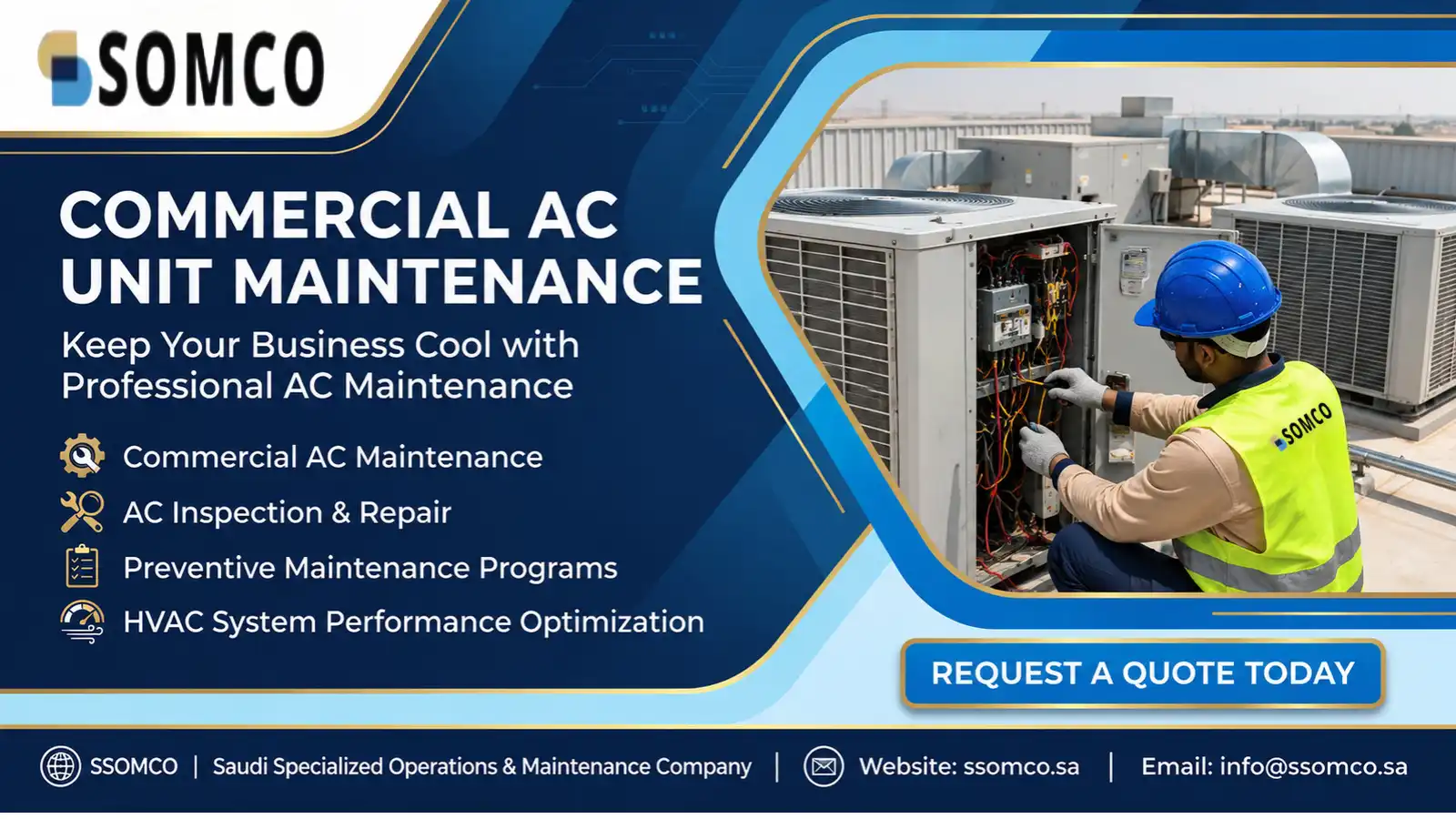
Commercial buildings depend on reliable air conditioning to maintain comfortable indoor temperatures and support daily operations. Offices, shopping centres, restaurants, hotels, warehouses, and industrial facilities all require cooling systems that can operate according to their specific needs.
However, continuous operation, dust accumulation, restricted airflow, and neglected servicing can affect air conditioning performance over time. This is why commercial AC unit maintenance is an important part of managing commercial properties and HVAC equipment.
A structured maintenance programme helps identify developing faults, maintain equipment condition, and reduce the risk of unexpected interruptions. For businesses operating in hot and dusty environments, regular inspections are particularly important because outdoor conditions can increase the maintenance demands on HVAC equipment.
In this guide, we explain how commercial air conditioning maintenance works, which components require attention, how to develop a preventive maintenance plan, and what businesses should consider when selecting an HVAC maintenance provider.
What Is Commercial AC Unit Maintenance?
Commercial AC unit maintenance is the planned inspection, cleaning, testing, and servicing of air conditioning equipment installed in commercial properties.
Unlike many residential systems, commercial HVAC equipment may serve multiple rooms, operate for extended periods, or support buildings with varying occupancy levels. Maintenance requirements therefore depend on the system design, operating conditions, equipment specifications, and manufacturer recommendations.
A typical commercial AC maintenance programme may include:
- Inspecting indoor and outdoor AC units
- Cleaning or replacing air filters
- Inspecting evaporator and condenser coils
- Checking fans, motors, and airflow
- Inspecting condensate drainage systems
- Checking thermostats and control settings
- Inspecting electrical connections and components
- Investigating unusual operating noise or vibration
- Checking refrigerant-system performance where appropriate
- Testing cooling operation
- Documenting equipment condition and maintenance findings
The exact scope should be determined by a qualified HVAC professional after reviewing the installed equipment and site requirements.
Why Commercial Air Conditioning Systems Need Regular Maintenance
Commercial air conditioning systems are essential to the operation of many buildings. When cooling performance deteriorates, businesses may experience uncomfortable indoor conditions, equipment interruptions, and additional maintenance expenses.
Regular servicing helps businesses monitor equipment condition and address maintenance requirements systematically.
1. Maintain Reliable Cooling Performance
Commercial AC systems must provide cooling appropriate to the building’s occupancy, internal heat loads, and operating schedule.
Dirty filters, restricted airflow, contaminated coils, and control problems can affect system performance. Routine inspections help identify these issues and determine the appropriate corrective action.
Maintaining suitable airflow and checking system operation can support more consistent indoor temperatures.
2. Identify Equipment Problems Early
Mechanical and electrical components can deteriorate through normal use. Loose connections, unusual vibration, drainage problems, and control faults may develop before a complete system failure occurs.
Preventive inspections help technicians identify potential problems and recommend repairs before they cause more serious operational disruption.
Maintenance cannot eliminate every failure, but it can improve visibility into equipment condition.
3. Support Energy Efficiency
Air conditioning systems may consume more electricity when components are dirty, airflow is restricted, or controls are operating incorrectly.
Commercial AC maintenance helps identify conditions that may contribute to inefficient operation. Correcting these issues can support energy performance, although actual savings depend on the equipment, building conditions, and specific faults identified.
4. Protect Equipment Condition
Routine cleaning, inspection, and timely repairs help address avoidable maintenance issues before they cause further damage.
The condition and lifespan of commercial AC equipment also depend on installation quality, operating conditions, system design, and adherence to manufacturer recommendations.
5. Improve Indoor Comfort
Uneven cooling, insufficient airflow, and inconsistent temperature control can affect employees, customers, and visitors.
Inspecting the air distribution system, filters, controls, and cooling equipment can help identify the causes of these problems.
6. Support Business Continuity
An unexpected AC breakdown can interrupt normal activities, particularly in facilities that depend on controlled indoor temperatures.
A preventive maintenance programme helps businesses plan servicing, document equipment condition, and address identified defects in a more organised way.
Commercial AC Maintenance in Hot and Dusty Environments
Outdoor conditions can influence the maintenance requirements of commercial air conditioning systems.
In hot climates, equipment may experience substantial cooling demand during periods of high outdoor temperatures. Dust and airborne particles can also accumulate on filters, coils, and other exposed components.
These conditions make it important to establish maintenance schedules based on actual operating requirements rather than relying on one fixed interval for every building.
Dust and Air Filter Maintenance
Dust accumulation can restrict airflow when filters are not cleaned or replaced as required.
Restricted airflow can affect cooling performance and may contribute to additional strain on system components.
The appropriate filter inspection and replacement frequency depends on the equipment, filter type, occupancy, and surrounding environment.
Outdoor Condenser Inspection
Outdoor condenser coils release heat from the refrigeration system. Dirt accumulation and restricted airflow around the condenser can interfere with heat transfer.
Technicians should inspect the coils and surrounding area and perform cleaning according to the manufacturer’s recommendations and applicable safety procedures.
Monitoring Cooling Performance
High outdoor temperatures can increase the cooling demand placed on commercial AC systems.
Monitoring operating conditions, indoor temperatures, airflow, and system performance helps technicians identify problems that may require further investigation.
Preventing Drainage Problems
Condensate drainage systems should be inspected for blockages, leakage, and other abnormalities.
A blocked drain can lead to water leakage and potential damage to surrounding areas. Corrective work should address the underlying cause rather than simply removing visible water.
Types of Commercial AC Systems That Require Maintenance
Different commercial buildings use different air conditioning technologies. Each system requires maintenance procedures appropriate to its design.
Split Air Conditioning Systems
Commercial split AC systems are often used in individual offices, shops, meeting rooms, and smaller commercial spaces.
Maintenance may include filter cleaning, coil inspection, condensate drainage checks, electrical inspections, and operational testing.
Packaged Air Conditioning Units
Packaged AC units contain major cooling components within a single cabinet and may be installed on rooftops or at designated outdoor locations.
Maintenance may include inspecting filters, coils, fans, motors, electrical components, and drainage systems.
Access arrangements and workplace safety requirements should be considered when servicing rooftop equipment.
Rooftop HVAC Units
Rooftop units are used in various commercial buildings, including retail properties and some industrial facilities.
Because they are exposed to outdoor conditions, their maintenance programme should consider dust accumulation, weather exposure, outdoor airflow, and equipment accessibility.
Technicians should follow suitable roof-access procedures and use appropriate safety equipment.
VRF and VRV Air Conditioning Systems
Variable Refrigerant Flow (VRF) and Variable Refrigerant Volume (VRV) systems can provide individual temperature control across multiple indoor units.
Maintenance may include filter inspection, drainage checks, outdoor unit inspections, control checks, and investigation of fault codes.
System-specific maintenance should follow the manufacturer’s guidance.
Centralised HVAC and Chiller Systems
Large commercial properties may use centralised HVAC equipment or chilled-water systems to provide cooling across multiple areas.
These systems require a coordinated approach to equipment inspection, airflow or water-flow checks, control-system assessment, and performance monitoring.
Chillers require specialised maintenance procedures based on their type, operating conditions, and manufacturer recommendations.
Commercial AC Unit Maintenance Checklist
A maintenance checklist helps technicians document completed tasks, identify defects, and recommend follow-up work.
Component | Inspection or Maintenance Activity | Purpose |
Air filters | Inspect, clean, or replace as required | Help maintain airflow |
Evaporator coils | Inspect and clean where necessary | Support effective heat transfer |
Condenser coils | Check for dirt and airflow restrictions | Help maintain heat rejection |
Condensate drains | Inspect drainage and check for blockages | Reduce the risk of water leakage |
Fans and motors | Inspect operation, noise, and vibration | Identify potential mechanical problems |
Electrical components | Inspect connections and components | Identify visible damage or electrical abnormalities |
Thermostats and controls | Check settings and operation | Support appropriate temperature control |
Refrigerant circuit | Investigate abnormal readings or suspected leaks | Identify possible refrigeration-system faults |
Air distribution | Assess airflow and cooling consistency | Identify possible distribution problems |
Complete system | Test operation and record findings | Verify performance and document defects |
Not all tasks apply to every unit. Maintenance personnel should follow the relevant equipment documentation and applicable safety requirements.
How Often Should Commercial AC Units Be Serviced?
There is no single maintenance interval suitable for every commercial air conditioning system.
The recommended frequency depends on the equipment type, operating hours, environmental conditions, occupancy, and manufacturer’s instructions.
A practical programme may include the following activities.
Routine visual inspections: Identify visible leakage, unusual sounds, abnormal operation, and other obvious concerns.
Scheduled preventive maintenance: Inspect filters, coils, drainage, electrical components, controls, and system performance at intervals appropriate to the equipment.
Seasonal maintenance reviews: Assess equipment condition before periods of high cooling demand.
Condition-based inspections: Arrange additional checks when monitoring, fault codes, unusual operating conditions, or previous inspection findings indicate a need.
Corrective maintenance: Investigate and repair identified faults according to their severity and operational impact.
Commercial facilities operating for long hours or in dusty environments may need more frequent attention to certain components.
A qualified HVAC provider can help develop an appropriate schedule for the equipment installed at your property.
Warning Signs That Your Commercial AC Unit Needs Servicing
Recognising changes in system operation can help businesses arrange inspections promptly.
Insufficient Cooling
If the system cannot maintain the required indoor temperature, possible causes include restricted airflow, control faults, refrigerant-system problems, or equipment deterioration.
Weak Airflow
Reduced airflow may indicate dirty filters, obstructed ducts, fan problems, or other faults.
Unusual Noise or Vibration
Grinding, rattling, or abnormal vibration may indicate a mechanical problem requiring professional assessment.
Water Leakage
Water around an indoor unit or drainage outlet may indicate a blocked drain, damaged connection, or another drainage issue.
Frequent Shutdowns
Repeated shutdowns or fault codes may indicate electrical, control, overheating, or other equipment problems.
Unexpected Changes in Energy Consumption
Higher electricity consumption can result from several factors, including changing weather, longer operating hours, increased occupancy, or inefficient equipment operation.
Comparing energy use with operating conditions and maintenance records can help determine whether further investigation is needed.
Preventive Maintenance Contracts for Commercial AC Systems
A commercial AC preventive maintenance contract can help businesses organise recurring inspections and servicing.
The contract should clearly define which equipment is covered, how often maintenance visits take place, and which activities are included.
Depending on the agreement, a maintenance contract may include:
- Scheduled preventive maintenance visits
- Equipment inspection and operational testing
- Cleaning of specified components
- Maintenance reports and defect records
- Recommendations for corrective repairs
- Defined procedures for reporting equipment faults
- Agreed response times for certain service requests
Before signing a contract, check whether spare parts, refrigerant, major repairs, emergency visits, and after-hours work are included or charged separately.
A clearly defined agreement helps both the property owner and maintenance provider understand their responsibilities.
How to Choose a Commercial AC Maintenance Company
Selecting an appropriate HVAC maintenance provider is an important part of managing commercial equipment.
Consider the following factors before making a decision.
Relevant Technical Experience
Check whether the provider has experience with the types of commercial AC systems installed at your property.
Qualified Technicians
Ask about technician qualifications, equipment-specific training, and compliance with applicable safety requirements.
Clear Maintenance Procedures
A professional maintenance plan should identify the equipment covered, inspection tasks, recommended intervals, and reporting process.
Transparent Pricing
Request a quotation that explains the maintenance scope, service frequency, exclusions, and any additional charges.
Maintenance Documentation
Inspection reports help facility managers track equipment condition, review completed work, and prioritise repairs.
Clear Service Communication
Confirm how service requests are submitted, how faults are reported, and what response arrangements apply under the agreement.
Commercial AC Maintenance Solutions from SSOMCO
Commercial property owners and facility managers need an organised approach to maintaining their HVAC equipment.
Saudi Specialized Operations & Maintenance Company (SSOMCO) operates in the HVAC and maintenance sector, making commercial AC maintenance a relevant service topic for businesses evaluating their building maintenance requirements.
When arranging maintenance for your facility, begin by identifying the equipment installed, its operating hours, any recurring performance issues, and your preferred maintenance schedule.
A site assessment can help determine the appropriate maintenance scope and identify areas requiring further attention.
Contact SSOMCO to discuss your commercial AC maintenance requirements and request a quotation for suitable HVAC maintenance services.
Frequently Asked Questions
Commercial AC maintenance may include filter cleaning, coil inspection, drainage checks, electrical inspections, control checks, airflow assessment, and operational testing. The precise scope depends on the equipment and maintenance agreement.
Maintenance frequency depends on system type, operating hours, environmental conditions, and manufacturer recommendations. Equipment operating continuously or in dusty environments may require more frequent inspections.
Maintenance can help identify issues such as restricted airflow, dirty coils, and incorrect control settings that may contribute to inefficient operation. Energy savings depend on the system and the problems corrected.
Preventive maintenance involves planned inspections and servicing intended to identify potential issues. Corrective maintenance addresses faults that have already been identified or have affected equipment operation.
A maintenance contract can help organise recurring servicing, document equipment condition, and define service responsibilities. Its value depends on the equipment, contract terms, maintenance scope, and operational requirements.
In many cases, maintenance can be scheduled to reduce disruption. However, some tasks may require equipment shutdowns or restricted access. The maintenance provider should coordinate the work with the facility manager.
Prepare details about the building, equipment types, number of units, operating hours, known issues, and required service frequency. Contact an HVAC maintenance provider to discuss the site requirements and request a quotation.
Conclusion
Commercial AC unit maintenance is an important part of managing HVAC equipment in offices, retail properties, restaurants, hotels, and industrial facilities.
Regular inspections, appropriate cleaning, performance checks, and timely corrective work help businesses monitor equipment condition and address developing issues. A well-planned maintenance programme can also support more organised service scheduling and informed maintenance decisions.
The most appropriate approach depends on the installed equipment, operating conditions, environmental exposure, and manufacturer’s recommendations.
For businesses seeking a structured approach to commercial air conditioning maintenance, the first step is to assess the equipment and establish a maintenance plan that reflects the facility’s actual requirements.
Contact SSOMCO to discuss your HVAC maintenance needs and request information about commercial AC maintenance solutions.
