

 Blog
Hydrocarbon chillers are used in specialised industrial cooling applications where system performance, temperature control, and equipment reliability are important. These systems use hydrocarbon-based refrigerants, which can offer useful thermodynamic properties but also require careful handling because many hydrocarbon refrigerants are flammable.
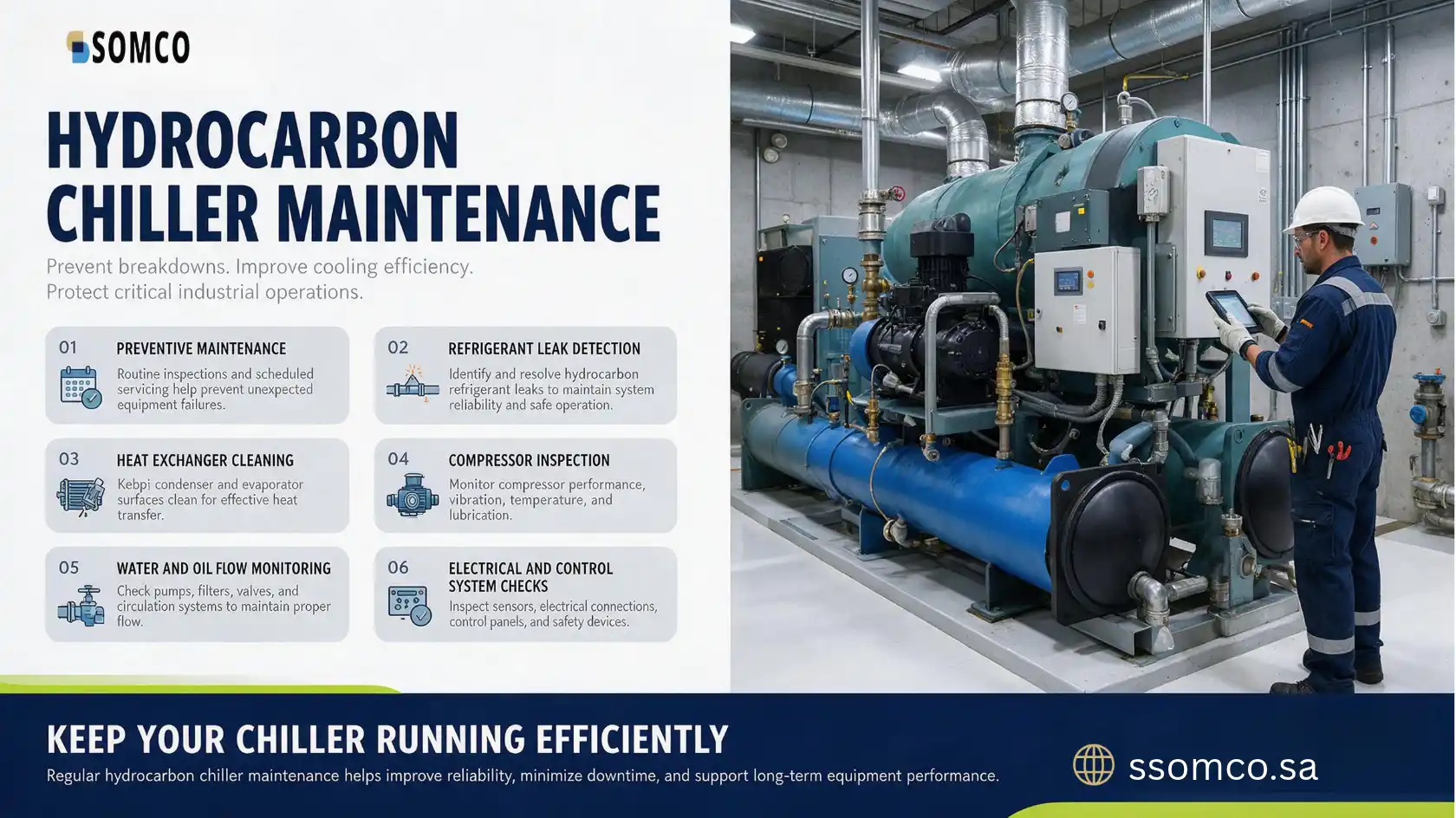
For industrial facilities, regular hydrocarbon chiller maintenance is essential for monitoring equipment condition, identifying potential faults, and supporting safe operation. Maintenance activities must consider refrigeration performance, refrigerant circuit integrity, electrical components, ventilation and the specific safety requirements of the installation.
This guide explains hydrocarbon chiller systems, their maintenance requirements, common problems, safety considerations, and how industrial facilities can develop an effective maintenance programme.
What Is a Hydrocarbon Chiller?
A hydrocarbon chiller is a refrigeration system that uses a hydrocarbon refrigerant to remove heat from a process or secondary cooling fluid, commonly water or a water-based solution.
Hydrocarbon refrigerants include substances such as:
- Propane (R290)
- Isobutane (R600a)
- Propylene (R1270)
The refrigerant selected depends on the system design, cooling capacity, application, and applicable safety requirements.
Hydrocarbon refrigerants are used in certain commercial and industrial refrigeration applications because of their thermodynamic characteristics and relatively low global warming potential. However, their flammability means that system design, installation, operation, and maintenance require appropriate safety controls.
How Does a Hydrocarbon Chiller Work?
A hydrocarbon chiller generally operates through a vapour-compression refrigeration cycle. Its main purpose is to remove heat from a process fluid and reject that heat through a condenser.
The main stages include:
1. Evaporation
The refrigerant absorbs heat from the process fluid inside the evaporator and changes from a liquid into a vapour.
2. Compression
The compressor increases the refrigerant pressure and temperature before sending it to the condenser.
3. Condensation
The condenser releases heat to the surrounding air or cooling medium, allowing the refrigerant to return to a liquid state.
4. Expansion
The expansion device reduces refrigerant pressure and temperature before the refrigerant returns to the evaporator.
This cycle continues to provide the required cooling, subject to the system’s design and operating conditions.
Why Is Hydrocarbon Chiller Maintenance Important?
Hydrocarbon chiller maintenance involves more than checking cooling performance. It also includes monitoring refrigerant containment, electrical equipment, ventilation and safety-related components.
1. Maintaining Cooling Performance
Dirty heat-transfer surfaces, incorrect operating conditions and component deterioration can affect chiller performance. Regular inspection helps identify issues that may reduce cooling capacity.
2. Identifying Refrigerant Leaks
Hydrocarbon refrigerants are flammable. Maintaining the integrity of the refrigerant circuit and identifying potential leaks are critical safety priorities.
3. Protecting Compressor Performance
The compressor is a major component of the refrigeration system. Monitoring its operating conditions can help identify abnormal vibration, overheating and other developing issues.
4. Supporting Energy Efficiency
Poor heat transfer, incorrect settings and mechanical problems can increase energy consumption. Maintenance helps identify conditions that may affect system efficiency.
5. Reducing Unexpected Downtime
Industrial cooling interruptions can affect production processes, storage conditions and facility operations. Planned maintenance helps identify potential problems before they cause major interruptions.
Hydrocarbon Chiller Preventive Maintenance Checklist
A structured preventive maintenance programme should follow the manufacturer’s instructions, equipment design and applicable safety requirements.
The following areas are important to consider.
1. Refrigerant Circuit Inspection
The refrigerant circuit should be checked for signs of damage, corrosion, deterioration, or leakage.
Maintenance considerations include:
- Inspecting accessible refrigerant piping and connections
- Reviewing signs of oil residue or possible leakage
- Checking relevant pressure and temperature readings
- Reviewing refrigerant circuit operating conditions
- Confirming that refrigerant-related safety procedures are followed
Hydrocarbon refrigerant leak investigations must be carried out by trained personnel using equipment suitable for flammable refrigerants.
2. Compressor Inspection
The compressor should be monitored for abnormal operating conditions.
Checks may include:
- Reviewing operating pressure and temperature
- Checking vibration and unusual noise
- Inspecting electrical connections
- Reviewing motor operating current
- Checking for signs of overheating
- Assessing operating trends against manufacturer specifications
3. Condenser Maintenance
The condenser releases heat from the refrigeration system. Poor heat transfer can affect system performance and operating pressure.
Maintenance may include:
- Inspecting condenser surfaces
- Cleaning accumulated dust and debris using approved methods
- Checking fans and motors
- Reviewing airflow or cooling-water conditions
- Inspecting visible signs of corrosion or damage
4. Evaporator Inspection
The evaporator transfers heat from the process fluid to the refrigerant.
Important inspection areas include:
- Checking process-fluid flow
- Inspecting accessible heat-transfer surfaces
- Reviewing inlet and outlet temperatures
- Checking for abnormal pressure drops
- Inspecting insulation and visible connections
- Monitoring signs of freezing or fouling
5. Electrical and Control System Inspection
Electrical and control components support safe and reliable chiller operation.
Maintenance considerations include:
- Inspecting control panels
- Checking electrical connections
- Reviewing protective devices
- Testing control functions
- Checking temperature and pressure sensors
- Reviewing alarms and fault records
Electrical work must follow the equipment manufacturer’s instructions and the hazardous-area requirements applicable to the installation.
6. Ventilation and Gas Detection Systems
Because hydrocarbon refrigerants are flammable, the ventilation and gas detection arrangements are particularly important.
Depending on the installation, checks may include:
- Reviewing ventilation system operation
- Inspecting refrigerant gas detection devices
- Confirming alarm functionality
- Checking safety interlocks
- Reviewing emergency response arrangements
- Confirming that equipment and electrical installations are suitable for the designated hazardous area
These checks should be performed by competent personnel following the system’s safety design and applicable regulations.
Common Hydrocarbon Chiller Problems
Industrial hydrocarbon chillers can experience different mechanical, electrical, and refrigeration-related problems.
Common problem | Possible cause |
Insufficient cooling | Heat-transfer issues, incorrect operating conditions, or refrigerant circuit faults |
High operating pressure | Condenser fouling, restricted airflow, or cooling problems |
Compressor overheating | Operating conditions, electrical faults or inadequate heat rejection |
Unusual vibration | Mechanical wear, alignment issues or mounting problems |
Frequent shutdowns | Control faults, safety trips, or abnormal operating conditions |
Refrigerant leakage | Damaged connections, seals, or piping |
Incorrect temperature readings | Sensor faults or control system problems |
These are possible causes, not definitive diagnoses. A qualified refrigeration specialist should investigate abnormal operating conditions before repairs are undertaken.
Hydrocarbon Refrigerant Safety Requirements
Safety is one of the most important considerations when maintaining hydrocarbon chillers.
Unlike many commonly used non-flammable refrigerants, hydrocarbon refrigerants can ignite when released and mixed with air within their flammable range.
Maintenance teams should therefore follow suitable procedures.
Important Safety Precautions
- Allow only trained and competent personnel to work on hydrocarbon refrigeration systems.
- Review the refrigerant type and equipment safety documentation before starting work.
- Follow approved isolation and permit-to-work procedures.
- Use suitable gas detection equipment where required.
- Confirm that ventilation arrangements are operating correctly.
- Control ignition sources in accordance with the applicable safety procedure.
- Use tools and equipment appropriate for the installation’s hazardous-area classification.
- Follow manufacturer-approved refrigerant recovery and handling procedures.
- Do not release refrigerant intentionally into the atmosphere.
- Maintain suitable emergency response and evacuation arrangements.
Important: Refrigerant leaks, recovery, charging, and repairs must not be treated as routine general maintenance. They require qualified personnel, suitable equipment and procedures designed specifically for flammable refrigerants.
Hydrocarbon Chiller Maintenance Schedule
The maintenance frequency depends on equipment design, operating hours, manufacturer guidance, environmental conditions and industrial application.
A maintenance plan may be organised as follows:
Maintenance interval | Example activities |
Daily or routine operational checks | Review temperatures, alarms and abnormal operating conditions |
Monthly or scheduled inspections | Inspect accessible components, condenser cleanliness and visible connections |
Periodic technical maintenance | Review compressor performance, electrical systems and controls |
Manufacturer-recommended servicing | Complete detailed component inspections and specified service tasks |
Condition-based maintenance | Investigate abnormal readings, recurring alarms, or performance changes |
This is a general planning framework, not a universal service interval. The actual schedule should be established for the specific chiller model and installation.
Hydrocarbon Chiller Maintenance vs General Chiller Maintenance
Both systems require refrigeration maintenance, but hydrocarbon chillers have additional refrigerant-specific safety considerations.
Maintenance area | General chiller | Hydrocarbon chiller |
Cooling performance | Important | Important |
Compressor inspection | Required | Required |
Condenser and evaporator checks | Required | Required |
Electrical inspection | Required | Requires consideration of applicable hazardous-area requirements |
Refrigerant leak checks | Important | Critical because of flammability |
Gas detection | Depends on refrigerant and installation | Important where required by the safety design |
Ventilation assessment | Depends on installation | Important where required by the safety design |
Refrigerant handling | Refrigerant-specific procedures | Procedures specifically suitable for flammable refrigerants |
The maintenance approach must be based on the refrigerant used and the chiller’s actual design.
Industries That Use Hydrocarbon Chiller Systems
Hydrocarbon refrigeration technology may be found in selected commercial and industrial applications.
Industrial Processing
Industrial facilities may use specialised cooling systems to support process temperature requirements and equipment operation.
Food and Beverage Facilities
Certain refrigeration applications in food processing and storage may use hydrocarbon refrigerants, depending on equipment design and capacity.
Chemical and Manufacturing Facilities
Specialised cooling equipment can support process operations where controlled temperatures are required.
Commercial Refrigeration
Hydrocarbon refrigerants are used in selected commercial refrigeration equipment and systems.
The suitability of a hydrocarbon chiller for any facility depends on the required cooling capacity, refrigerant charge, system configuration, and applicable safety standards.
How to Choose a Hydrocarbon Chiller Maintenance Company
Choosing a maintenance provider requires particular attention to technical competence and refrigerant safety.
Consider these factors before selecting a company.
- Refrigeration expertise: Confirm that the technicians understand industrial chiller systems and the specific hydrocarbon refrigerant used.
- Refrigerant safety training: Ask whether the maintenance team is trained to handle flammable refrigerants and follows suitable safety procedures.
- Equipment-specific knowledge: Check whether the provider understands the chiller manufacturer’s maintenance requirements and system design.
- Inspection and reporting: Maintenance reports should document operating conditions, inspection findings, identified faults, and recommended actions.
- Safety equipment: Confirm that suitable gas detection, isolation, and other required safety equipment is available.
- Maintenance planning: Review the proposed maintenance schedule, service scope, and responsibilities.
- Corrective maintenance capability: Confirm how faults and safety-related issues will be assessed and managed.
Why Choose SSOMCO for Industrial Chiller Maintenance Requirements?
Industrial cooling systems require a planned maintenance approach based on equipment specifications, operating conditions, and facility requirements.
SSOMCO provides maintenance-related services for commercial and industrial facilities, including chiller maintenance, HVAC maintenance, air-conditioning maintenance, MEP maintenance, and building maintenance.
For specialised hydrocarbon chiller requirements, the equipment type, refrigerant, technical scope, and safety arrangements should be assessed before confirming the appropriate maintenance service.
Businesses can discuss their requirements based on:
- Chiller type and manufacturer
- Refrigerant specification
- Cooling capacity and application
- Current operating condition
- Required inspection and maintenance scope
- Site safety and access requirements
Contact SSOMCO to discuss your industrial cooling maintenance requirements and request a quotation.
Explore the SSOMCO services page for more information about its maintenance-related services.
Conclusion
Hydrocarbon chiller maintenance is essential for monitoring industrial cooling performance, protecting important refrigeration components, and maintaining appropriate safety conditions.
Regular inspection of compressors, condensers, evaporators, electrical systems, refrigerant circuits, ventilation and gas detection arrangements helps businesses manage their cooling equipment more effectively.
Because hydrocarbon refrigerants are flammable, maintenance must be performed by competent personnel using procedures and equipment suitable for the specific installation.
A well-planned maintenance programme can help industrial facilities identify potential faults, manage operational risks and support the long-term performance of their cooling systems.
Frequently Asked Questions (FAQs)
Hydrocarbon chiller maintenance involves inspecting, servicing, and monitoring refrigeration equipment that uses hydrocarbon refrigerants, including compressors, condensers, evaporators, controls, and safety systems.
Common hydrocarbon refrigerants include propane (R290), isobutane (R600a), and propylene (R1270). The refrigerant depends on the equipment design and application.
It helps monitor cooling performance, identify component deterioration, maintain refrigerant circuit integrity, and address safety requirements associated with flammable refrigerants.
Yes. Common hydrocarbon refrigerants are flammable. Their use and maintenance require appropriate system design, ventilation, leak detection where required, and trained personnel.
Important components include the compressor, condenser, evaporator, refrigerant piping, electrical controls, sensors, fans, and applicable safety devices.
Service intervals depend on the manufacturer's instructions, equipment design, operating hours and site conditions. A maintenance schedule should be developed for the specific installation.
Only personnel with appropriate refrigeration expertise and training in flammable refrigerant safety should carry out work on hydrocarbon chiller systems.
Follow the site's emergency procedure, keep people away from the affected area, control ignition sources only where it is safe and authorised to do so, and contact appropriately trained personnel. Do not attempt an unqualified repair.
Regular inspection and servicing can help identify conditions that affect heat transfer, compressor operation, and cooling performance. Results depend on the equipment's condition and maintenance requirements.
SSOMCO provides chiller and HVAC maintenance-related services for commercial and industrial facilities. Specialised hydrocarbon refrigerant work should be confirmed according to the equipment and required safety qualifications.

Maintenance Services In Riyadh: Complete Guide For Commercial And Industrial Businesses - Best Air Duct And Kitchen Hood Cleaning Service Provider In KSA
November 24, 2026 3:49 pm[…] Chiller maintenance […]