

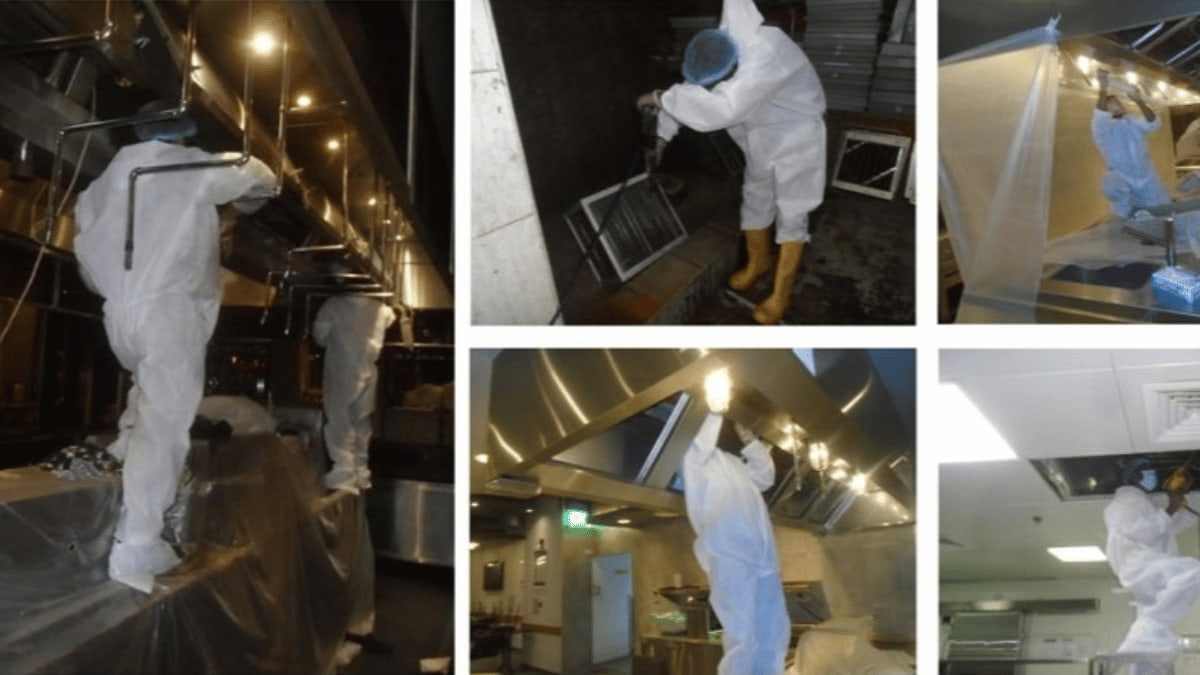
 Cleaning
A commercial kitchen produces much more than food. During cooking, heat, smoke, vapor, oil particles, and grease can enter the kitchen exhaust system. As daily operations continue, some of this material can accumulate on the hood, filters, exhaust areas, and other parts of the ventilation system.
For restaurants, hotels, food-service facilities, and other commercial kitchens, keeping the kitchen hood system clean is therefore an important part of routine property maintenance.
Professional kitchen hood cleaning services provide a more comprehensive approach than simply wiping the visible hood surface or washing removable filters. Professional cleaning focuses on the areas where grease and residue can accumulate and helps businesses maintain a cleaner and better-maintained kitchen exhaust system.
SSOMCO provides kitchen hood cleaning services designed for commercial and other kitchen environments in Saudi Arabia. The company’s published service information highlights cleaning of hood surfaces, filters, grease accumulation, exhaust areas, and relevant exhaust-system components.
This guide explains what professional kitchen hood cleaning involves, why routine cleaning matters, how grease buildup develops, when cleaning should be scheduled, and what businesses should consider when selecting a kitchen hood cleaning provider.
Why Kitchen Hood Cleaning Is Important
A kitchen exhaust hood works continuously to help remove heat, smoke, grease-laden vapours, and cooking-related contaminants from the kitchen environment.
The more frequently a kitchen operates, the more material can pass through the exhaust system.
Over time, grease may settle on different surfaces and components. If cleaning is postponed, the buildup can become more difficult to remove and may affect the condition of the exhaust system.
Regular professional cleaning can help businesses:
- Control grease accumulation
- Maintain cleaner exhaust components
- Support effective kitchen ventilation
- Reduce the buildup of difficult-to-remove residue
- Maintain a more organized kitchen maintenance program
- Identify visible maintenance concerns
- Keep records of completed cleaning work
Kitchen hood cleaning should therefore be treated as a planned maintenance activity rather than something performed only when the hood looks dirty.
How Grease Builds Up Inside a Kitchen Exhaust System
Grease accumulation is a gradual process.
During cooking, oil and grease can become airborne in the form of vapor or fine particles. The exhaust system captures this material as it moves through the kitchen ventilation pathway.
Some of the grease is collected by filters, while other residue can accumulate on additional surfaces.
The amount of buildup can vary depending on:
- Type of food prepared
- Cooking methods
- Daily operating hours
- Number of meals prepared
- Volume of cooking
- Grease-producing equipment
- Cleaning practices
- Previous professional cleaning
- Condition of the exhaust system
A kitchen that prepares fried foods throughout the day can have very different cleaning requirements from a low-volume kitchen.
This is why professional assessment is useful when determining an appropriate cleaning schedule.
What Is Included in Professional Kitchen Hood Cleaning?
The exact scope depends on the kitchen and exhaust-system configuration.
However, professional kitchen hood cleaning services can focus on several important areas.
Hood Surfaces
The visible hood surface can collect grease, smoke residue, dust, and other material.
Cleaning these surfaces helps maintain the appearance and general cleanliness of the kitchen exhaust area.
Filters
Filters capture grease and particles before they move further through the exhaust system.
When filters become heavily coated, cleaning becomes increasingly important.
Professional cleaning can address removable filters according to their condition and system requirements.
Exhaust Areas
The areas connected to the hood form part of the overall ventilation pathway.
Cleaning relevant exhaust areas helps control grease accumulation beyond the visible portion of the hood.
Grease Accumulation
Professional cleaning focuses on removing accumulated grease rather than simply wiping the surface.
This is particularly important in commercial kitchens where cooking takes place for many hours each day.
Exhaust System Components
Depending on the configuration and agreed scope, other accessible exhaust components may also require attention.
The objective is to address the areas where grease and residue have accumulated rather than concentrating only on the easiest visible surfaces.
Professional Cleaning vs Routine Kitchen Staff Cleaning
Kitchen staff already perform many important cleaning activities during normal operations.
Daily cleaning can help control visible grease and maintain the kitchen’s general hygiene.
However, routine staff cleaning and professional hood cleaning are not the same.
Kitchen staff can generally focus on tasks such as:
- Wiping visible hood surfaces
- Cleaning accessible areas
- Handling removable filters according to established procedures
- Removing fresh grease before it hardens
Professional cleaning goes deeper.
A professional team can work on areas that are difficult for kitchen staff to access and can use appropriate equipment and cleaning procedures for heavier accumulation.
SSOMCO’s existing article specifically distinguishes routine DIY cleaning from professional cleaning and notes that hidden areas such as ductwork and exhaust fans can contain grease that is not addressed by surface-level cleaning.
The two approaches should therefore complement each other.
Why Surface Cleaning Alone Is Not Enough
One of the most common mistakes is judging the cleanliness of a kitchen hood by its visible appearance.
A hood may look clean from the outside while grease remains in less accessible areas.
This happens because exhaust systems contain areas that are not always visible during everyday kitchen operations.
For example, grease can accumulate around:
- Internal hood areas
- Filters
- Exhaust pathways
- Accessible duct sections
- Other exhaust-system components
Professional cleaning is valuable because it addresses the system as a whole rather than treating the visible hood surface as the entire cleaning requirement.
The Relationship Between Kitchen Hood Cleaning and Fire Risk
Grease is a combustible material.
When grease accumulates within a kitchen exhaust system, it becomes an important safety concern.
Regular cleaning helps control this accumulation.
A properly maintained exhaust system does not eliminate every possible kitchen fire risk, but reducing grease buildup is an important part of responsible kitchen maintenance.
For commercial kitchens, hood cleaning should therefore be connected with the property’s broader safety and maintenance procedures.
Businesses should also maintain appropriate kitchen operating practices and follow the applicable safety requirements for their facility.
SSOMCO publishes dedicated information on NFPA 96 kitchen hood cleaning standards and kitchen hood maintenance, which can be useful when planning the maintenance of commercial exhaust systems.
Kitchen Hood Cleaning and Ventilation Performance
A kitchen exhaust system is designed to move unwanted heat, smoke, and cooking vapors away from the cooking area.
Grease accumulation can interfere with the cleanliness of the exhaust pathway and contribute to maintenance problems.
Professional cleaning helps maintain cleaner exhaust components and can support the continued operation of the ventilation system.
However, poor ventilation can have several causes.
If a kitchen has weak extraction, unusual noise, excessive heat, or persistent smoke, cleaning alone may not solve the issue.
The exhaust system may require additional inspection to identify the actual cause.
This distinction is important because professional cleaning should not be presented as a solution to every ventilation problem.
How Often Should a Kitchen Hood Be Professionally Cleaned?
Cleaning frequency should be based on kitchen usage and grease production.
There is no single schedule that works equally well for every commercial kitchen.
Factors that influence cleaning frequency include:
Cooking Volume
A busy restaurant producing hundreds of meals every day can accumulate grease more quickly than a small low-volume kitchen.
Cooking Type
Frying, grilling, roasting, and other grease-producing methods can place greater demands on the exhaust system.
Operating Hours
A kitchen operating throughout the day can generate more exhaust residue than one operating for a few hours.
Equipment Used
The type and quantity of cooking equipment can influence the amount of grease entering the exhaust system.
Previous Cleaning
If professional cleaning has been delayed for a long time, accumulated grease may require more extensive attention.
Visible Grease Buildup
Visible accumulation is an obvious reason to review the cleaning condition of the system.
SSOMCO’s current article recommends professional cleaning approximately every 3–6 months depending on grease production, while noting that high-volume kitchens may need more frequent service.
Businesses should use their actual kitchen conditions and maintenance requirements when determining the appropriate schedule.
Signs That Your Kitchen Hood Needs Professional Cleaning
A kitchen does not have to wait until the exhaust system becomes heavily contaminated.
Several signs can indicate that professional cleaning should be considered.
Excessive Grease on the Hood
If grease quickly returns after routine cleaning, the system may require deeper professional attention.
Dirty Filters
Filters that become heavily coated can indicate ongoing grease accumulation.
Grease in Hard-to-Reach Areas
Visible buildup around areas that staff cannot easily clean should be assessed.
Persistent Kitchen Odors
Strong or unusual exhaust-related odors can indicate that the system requires cleaning or inspection.
Smoke Remaining in the Kitchen
If cooking smoke is not being removed effectively, the exhaust system should be assessed. Cleaning may be required, although technical problems should also be considered.
Long Period Without Professional Service
A commercial kitchen that has not received professional hood cleaning for an extended period should have the system reviewed.
A Professional Kitchen Hood Cleaning Process
A structured cleaning process helps ensure that the work is organized properly.
- Initial Inspection
The cleaning team reviews the kitchen hood and exhaust arrangement.
The purpose is to understand:
- System configuration
- Grease buildup
- Accessible components
- Filter condition
- Cleaning requirements
- Areas requiring additional attention
- Work Area Protection
Kitchen equipment and nearby surfaces should be protected before cleaning begins.
This helps control water, grease, and cleaning residue during the service.
- Removal of Accessible Components
Where appropriate, removable filters or other accessible components can be taken out for separate cleaning.
- Degreasing
Suitable cleaning products and procedures are used to break down accumulated grease.
The approach should be appropriate for the surfaces and equipment involved.
- Cleaning of Hood and Exhaust Areas
The relevant areas are cleaned to remove grease and residue.
The exact scope depends on the system and agreed service requirements.
- Component Cleaning
Filters and other appropriate components are cleaned according to their condition.
- Final Inspection
After cleaning, the system and work area are reviewed.
This helps confirm that the planned cleaning has been completed and allows visible issues to be identified.
Why Proper Equipment Matters
Heavy grease accumulation cannot always be removed effectively with household cleaning tools.
Professional kitchen hood cleaning requires suitable equipment and cleaning methods.
The equipment selected can depend on:
- Grease thickness
- Surface type
- Accessibility
- Exhaust-system configuration
- Size of the kitchen
- Cleaning scope
Using the wrong equipment or cleaning method can create unnecessary problems.
Professional technicians are better positioned to determine how the system should be approached.
Kitchen Hood Cleaning for Restaurants
Restaurants are among the most common environments requiring professional kitchen hood cleaning.
Daily cooking activity can create continuous grease and vapor production.
A restaurant maintenance program should therefore consider:
- Daily surface cleaning
- Filter maintenance
- Regular inspection
- Professional deep cleaning
- Maintenance records
- Cleaning frequency based on cooking volume
A documented schedule can help restaurant management avoid relying on memory or waiting until grease buildup becomes obvious.
Kitchen Hood Cleaning for Hotels
Hotel kitchens can operate at significant volumes, particularly when serving breakfast, lunch, dinner, room-service requirements, events, or other food operations.
Different hotel kitchens may also have different operating patterns.
Professional cleaning can therefore be planned according to actual kitchen usage rather than applying one generic schedule to every facility.
For hotel facility managers, maintaining cleaning records can also simplify future planning.
Kitchen Hood Cleaning for Other Commercial Food Facilities
Professional hood cleaning can also be relevant to other food-service environments.
Examples include:
- Commercial food-service kitchens
- Hospitality kitchens
- Institutional kitchens
- High-volume cooking facilities
Each facility should be assessed according to its individual exhaust configuration and cooking activity.
What Happens When Hood Cleaning Is Delayed?
Delaying professional cleaning can allow grease to accumulate progressively.
As buildup increases, the cleaning task can become more difficult.
Potential maintenance concerns include:
- Heavier grease accumulation
- More difficult cleaning
- Reduced cleanliness of exhaust components
- Stronger odors
- Greater maintenance effort
- Increased concern regarding combustible grease deposits
The objective of planned cleaning is to avoid allowing the system to reach a condition where accumulated grease becomes unnecessarily difficult to manage.
How to Build a Kitchen Hood Cleaning Schedule
A simple maintenance schedule can make professional cleaning easier to manage.
Daily
Kitchen staff can inspect visible areas and remove fresh grease from accessible surfaces according to their cleaning procedures.
Weekly
Filters and accessible components can receive deeper routine attention where appropriate.
Monthly
Management can review the overall condition of the hood and look for signs of increasing grease buildup.
Periodically
Professional cleaning should be scheduled based on cooking volume, grease production, system condition, and previous service records.
This approach creates a layered maintenance system instead of depending on one annual cleaning event.
Why Cleaning Records Matter
A commercial kitchen should ideally maintain records of its maintenance activities.
A simple record can include:
- Service date
- Kitchen location
- Hood identification
- Areas cleaned
- Filter condition
- Observed grease buildup
- Additional observations
- Next planned cleaning
- Service provider
Records can help management understand how quickly grease accumulates and whether the existing cleaning frequency remains suitable.
They can also provide useful documentation when reviewing the property’s maintenance history.
Choosing Professional Kitchen Hood Cleaning Services
When searching for professional kitchen hood cleaning services, businesses should compare more than price.
Important questions include:
- Does the provider inspect the system before cleaning?
- Is the cleaning scope clearly explained?
- Are hood surfaces and filters included?
- Are relevant exhaust areas addressed?
- What equipment will be used?
- How will the kitchen equipment be protected?
- Is the service documented?
- Can cleaning be scheduled around kitchen operations?
- Does the provider understand commercial kitchen requirements?
A clear service scope makes it easier for businesses to understand what they are paying for.
Why SSOMCO for Kitchen Hood Cleaning?
SSOMCO provides professional kitchen hood cleaning services in Saudi Arabia and identifies kitchen hood cleaning as one of its core service areas.
The company’s current service information states that its kitchen hood cleaning work focuses on hood surfaces, exhaust areas, filters, grease accumulation, and exhaust-system components.
SSOMCO’s published kitchen hood content also emphasizes the difference between routine staff cleaning and professional cleaning, particularly for areas that are difficult to access.
For businesses, this approach allows routine kitchen cleaning and professional exhaust-system cleaning to work together.
SSOMCO can also support customers with its approved maintenance and facility-related services when broader property requirements exist.
Professional Kitchen Hood Cleaning in Saudi Arabia
Commercial kitchens across Saudi Arabia operate under different conditions.
A restaurant in Riyadh may have a different cooking schedule from a food facility in Dammam or a hospitality kitchen in Jeddah.
The cleaning requirement should therefore be determined by the actual kitchen rather than simply by location.
SSOMCO’s published information identifies service availability across major Saudi locations and the Eastern Province. Its website also lists Al Ahsa as the company’s location.
For organizations operating multiple properties, planned kitchen hood cleaning can help create a more consistent maintenance approach.
Kitchen Hood Cleaning Checklist
Use this checklist when reviewing your kitchen exhaust maintenance:
- Inspect visible hood surfaces
- Check filter condition
- Look for grease accumulation
- Review exhaust areas
- Check for unusual odors
- Monitor ventilation performance
- Review the last professional cleaning date
- Consider kitchen operating hours
- Consider cooking volume
- Record completed cleaning work
- Schedule the next professional service
- Investigate any unusual exhaust-system problems
This simple process can help kitchen managers maintain better control over their exhaust-system cleaning requirements.
Frequently Asked Questions
Professional kitchen hood cleaning is the specialized cleaning of kitchen exhaust components to remove accumulated grease, dirt, and residue from relevant areas of the system.
It helps control grease accumulation, supports cleaner exhaust components, and forms an important part of commercial kitchen maintenance and safety practices.
Kitchen staff can perform routine cleaning of visible surfaces and appropriate removable components. However, routine cleaning does not replace professional deep cleaning of harder-to-reach exhaust areas.
Frequency depends on cooking volume, grease production, operating hours, equipment, and previous cleaning history. SSOMCO's current article gives a general 3–6 month range and notes that high-volume kitchens may require more frequent cleaning.
Regularly removing combustible grease accumulation is an important part of responsible kitchen exhaust maintenance and fire-risk reduction.
Hotel kitchens should assess their cleaning requirements based on cooking volume, operating schedules, equipment, and grease accumulation.
Check the proposed cleaning scope, equipment, experience, work-area protection, scheduling, documentation, and areas included in the service.
Yes. Kitchen hood cleaning is one of the services identified by SSOMCO on its website, covering hood surfaces, filters, grease accumulation, exhaust areas, and relevant exhaust components.
Final Thoughts
A commercial kitchen’s exhaust system works every day to handle the heat, smoke, and grease generated by cooking. Because much of the exhaust system is difficult to see, routine surface cleaning alone may not be enough to control long-term grease accumulation.
Professional kitchen hood cleaning services provide a more comprehensive approach by addressing the hood, filters, grease buildup, exhaust areas, and other relevant components according to the system and service scope.
For restaurants, hotels, food-service facilities, and other commercial kitchens, the best approach is to combine everyday cleaning with planned professional service.
Regular inspections, maintenance records, appropriate cleaning intervals, and professional attention can help businesses maintain a cleaner and better-managed kitchen exhaust system.
SSOMCO provides professional kitchen hood cleaning services for businesses across Saudi Arabia, with its published service scope focused on maintaining hood and exhaust-system cleanliness.
If your kitchen hood system has accumulated grease or has not received professional cleaning for an extended period, a professional assessment can help determine the appropriate next step.
Maintain your kitchen exhaust system with a planned, professional cleaning approach and keep kitchen maintenance focused on cleanliness, safety, and reliable operation with SSOMCO.
