

 Blog
Air conditioning is essential for maintaining comfortable indoor environments, particularly in commercial buildings, offices, hotels, restaurants, and residential properties. When an air conditioning system stops working properly, it can affect indoor comfort, daily operations, and workplace productivity.
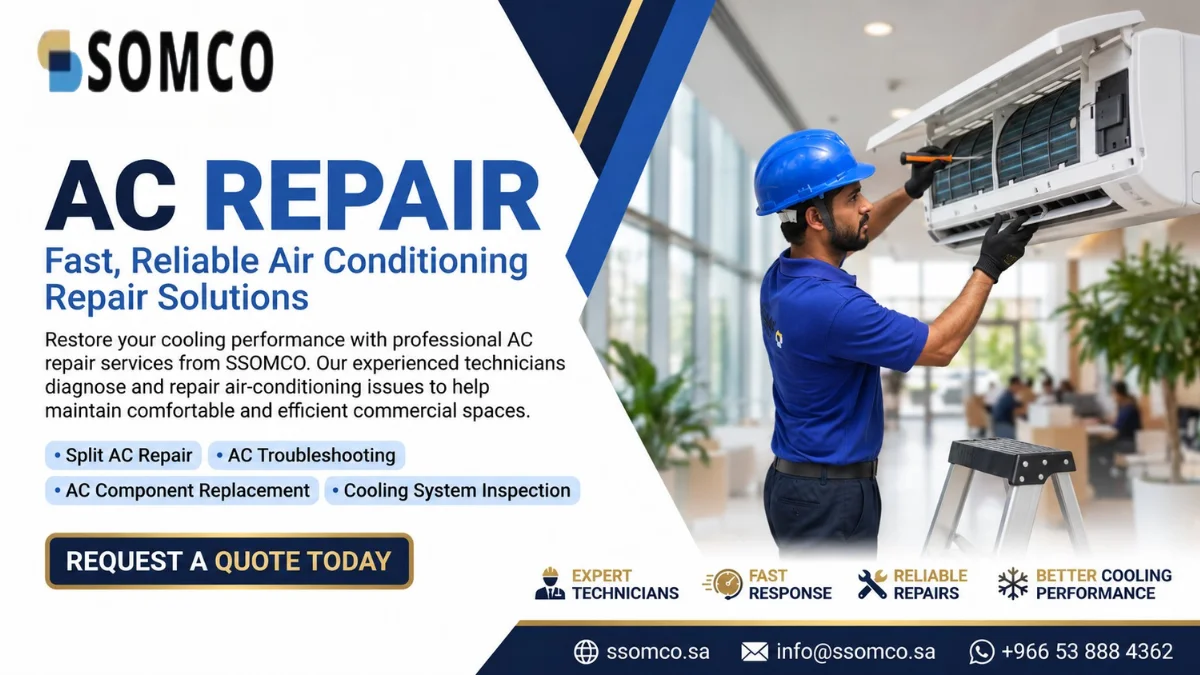
Professional AC repair helps identify and resolve problems affecting cooling performance, airflow, electrical components, drainage, and other system functions.
Whether your air conditioner is not cooling properly, making unusual noises, leaking water, or frequently switching off, understanding the possible causes can help you determine when professional HVAC assistance is required.
SSOMCO provides HVAC operation and maintenance services, including air conditioning maintenance and related technical support for commercial and other facilities.
What Is AC Repair?
AC repair is the process of identifying and correcting faults that affect the operation and performance of an air conditioning system.
An air conditioner contains several interconnected components that work together to provide cooling. When one or more components develop a fault, the system may experience reduced performance or stop operating altogether.
Professional AC repair may involve:
- Diagnosing cooling problems
- Inspecting electrical components
- Checking refrigerant system performance
- Cleaning or replacing air filters
- Inspecting evaporator and condenser coils
- Checking drainage systems
- Examining thermostats and control systems
- Identifying unusual noises and vibrations
- Testing overall system operation
The repair procedure depends on the equipment type, fault condition, manufacturer recommendations, and system specifications.
Common Air Conditioning Problems That Require AC Repair
Air conditioners can develop different problems due to continuous operation, poor maintenance, component wear, or incorrect installation.
Here are some common issues that may require professional attention.
1. AC Not Cooling Properly
One of the most common air conditioning complaints is insufficient cooling.
An AC unit may continue running without maintaining the desired indoor temperature.
Possible causes include:
- Dirty air filters
- Blocked airflow
- Dirty evaporator or condenser coils
- Refrigerant leakage
- Faulty thermostat
- Compressor problems
- Incorrect system settings
A professional inspection can help identify the actual cause and determine the appropriate repair.
2. AC Water Leakage
Water leakage from an indoor air conditioning unit can indicate a problem with the condensate drainage system.
Common causes include:
- Blocked drain lines
- Damaged drain pans
- Incorrect drainage installation
- Frozen evaporator coils
- Improper condensate disposal
Ignoring water leakage can damage ceilings, walls, flooring, and nearby equipment.
3. Weak Airflow from AC Vents
Weak airflow can affect the distribution of conditioned air throughout a building.
Potential causes include:
- Clogged air filters
- Blocked supply vents
- Dirty evaporator coils
- Ductwork restrictions
- Blower motor problems
- Incorrect air balancing
Checking the air distribution system can help identify whether the issue is related to the AC equipment or ductwork.
4. Unusual Noise from the Air Conditioner
Air conditioning systems generally produce some operating noise. However, unusual sounds may indicate a developing mechanical or electrical problem.
Examples include:
- Rattling sounds
- Humming noises
- Grinding sounds
- Vibrations
- Unusual fan noise
A technician should inspect the system to identify loose components, motor issues, fan problems, or other faults.
5. AC Frequently Turns On and Off
Frequent starting and stopping is commonly known as short cycling.
This condition can affect system operation and may increase unnecessary equipment wear.
Possible causes include:
- Thermostat problems
- Incorrect system sizing
- Dirty air filters
- Electrical faults
- Refrigerant-related issues
- Control system problems
Professional diagnosis is recommended before replacing any components.
6. AC Not Turning On
An air conditioner that does not start may have an electrical, control, or equipment-related problem.
Potential causes include:
- Power supply interruptions
- Tripped circuit breakers
- Faulty thermostats
- Damaged electrical connections
- Control board faults
- Safety switch activation
Electrical components should be inspected by qualified technicians using appropriate safety procedures.
Why Is Professional AC Repair Important?
Air conditioning systems contain electrical, mechanical, and refrigeration components that require appropriate technical knowledge.
Professional repair offers several important benefits.
Restores Cooling Performance
Identifying and correcting system faults helps restore the intended cooling operation.
Supports Equipment Reliability
Addressing problems early can help prevent additional damage caused by continued operation under abnormal conditions.
Helps Reduce Unnecessary Energy Consumption
Faulty components, restricted airflow, and incorrect system operation can affect energy performance. Appropriate repairs can help the system operate under its intended conditions.
Supports Indoor Comfort
A properly functioning air conditioning system helps maintain more consistent indoor temperatures and suitable airflow.
Helps Extend Equipment Service Life
Correct maintenance and timely repairs can help reduce avoidable equipment stress and support longer operating life.
Different Types of AC Systems That May Require Repair
Different air conditioning systems have different components and maintenance requirements.
Split AC Repair
Split air conditioning systems are commonly used in homes, offices, shops, and smaller commercial spaces.
Repair requirements may involve indoor units, outdoor units, refrigerant circuits, drainage, electrical components, and controls.
Central AC Repair
Central air conditioning systems distribute conditioned air through ductwork to multiple rooms or areas.
Repair may involve air handling equipment, compressors, fans, coils, thermostats, controls, and ductwork-related problems.
Package Unit AC Repair
Package air conditioning units combine major cooling components within a single outdoor cabinet.
Professional inspection may involve compressors, condenser coils, fans, electrical components, filters, and control systems.
Chiller System Repair
Chillers provide cooling for larger commercial and industrial HVAC applications.
Chiller-related repair requires specialised technical assessment of components such as compressors, heat exchangers, pumps, controls, and associated water or refrigerant circuits.
VRF and VRV System Repair
Variable Refrigerant Flow systems serve multiple indoor units through connected outdoor equipment.
Troubleshooting may involve communication faults, sensors, electronic controls, refrigerant circuits, and individual indoor or outdoor unit components.
AC Repair for Commercial Buildings
Commercial properties often depend on reliable air conditioning to maintain comfortable working environments and support business operations.
Different facilities have different cooling requirements.
Office Buildings
Office AC systems support employees, meeting rooms, reception areas, and shared workspaces.
Timely repairs help address cooling complaints and maintain comfortable working conditions.
Hotels and Hospitality Facilities
Hotels require properly functioning air conditioning in guest rooms, corridors, restaurants, and common areas.
HVAC repair and maintenance help support guest comfort and operational requirements.
Restaurants and Commercial Kitchens
Restaurants need suitable cooling and ventilation arrangements for dining areas and other occupied spaces.
Air conditioning problems can affect indoor comfort, while kitchen exhaust and ventilation systems require their own specialised maintenance.
Retail and Shopping Facilities
Retail properties depend on air conditioning to maintain comfortable environments for customers, employees, and visitors.
Regular inspection and timely repair can help address equipment faults before they cause extended disruption.
Industrial Facilities
Industrial environments may use different HVAC systems to support offices, workshops, production areas, and other facility requirements.
Repair procedures should account for equipment specifications and operating conditions.
The Professional AC Repair Process
A structured repair process helps technicians identify problems and determine suitable corrective actions.
Step 1: Initial Inspection
The technician reviews the reported problem, system type, operating condition, and equipment history.
Step 2: Fault Diagnosis
The air conditioning system is examined to identify the underlying cause.
This may involve checking airflow, electrical connections, control settings, refrigeration components, and drainage.
Step 3: Repair Planning
After identifying the problem, the technician determines the required corrective work and suitable replacement components, if needed.
Step 4: Repair Work
The agreed repair work is carried out according to equipment specifications and applicable safety procedures.
Step 5: System Testing
After repair, the system is tested to verify operation and check whether the reported problem has been resolved.
Step 6: Maintenance Recommendations
Where appropriate, the technician may recommend additional maintenance to help prevent recurring problems.
AC Repair vs Preventive AC Maintenance
AC repair and preventive maintenance serve different purposes.
AC Repair | Preventive AC Maintenance |
Addresses existing equipment faults | Helps reduce the likelihood of faults |
Usually begins after a problem is reported | Performed according to a planned schedule |
May involve component replacement | May involve inspection, cleaning, and adjustments |
Focuses on restoring system operation | Focuses on maintaining system condition |
Depends on the identified fault | Depends on equipment and maintenance requirements |
Both activities are important for maintaining air conditioning systems.
A preventive maintenance programme can help identify developing problems before they lead to unexpected equipment breakdowns.
How to Reduce the Need for Frequent AC Repairs
Although equipment faults cannot always be prevented, appropriate maintenance can help reduce avoidable problems.
Clean or Replace Air Filters
Air filters should be inspected and maintained according to the manufacturer’s recommendations and operating conditions.
Dirty filters can restrict airflow and affect cooling performance.
Keep Outdoor Units Clear
Outdoor units require suitable airflow around the condenser.
Remove obstructions and arrange appropriate cleaning when dust or debris accumulates.
Inspect Drainage Systems
Condensate drainage should be checked to identify blockages, leaks, and other drainage-related problems.
Schedule Professional HVAC Maintenance
Planned inspections help identify equipment problems and maintenance requirements.
Monitor AC Performance
Changes in cooling, airflow, noise, or operating behaviour should be investigated rather than ignored.
Avoid Unqualified Repairs
Electrical and refrigeration work should be handled by appropriately qualified technicians using suitable tools and procedures.
How to Choose a Professional AC Repair Company
Selecting the right HVAC service provider is important for obtaining reliable repair and maintenance support.
Before appointing a company, consider the following factors:
- Technical experience: Check experience with your particular AC system and equipment type.
- Qualified technicians: Confirm that personnel have suitable technical training and experience.
- Fault diagnosis: Choose a provider that identifies the cause of the problem rather than replacing components without proper assessment.
- Repair scope: Ask for a clear explanation of the required repair work.
- Genuine replacement parts: Confirm the suitability and specifications of any replacement components.
- Safety procedures: Electrical and refrigeration work should follow appropriate safety requirements.
- Maintenance support: Consider whether the company can also provide preventive maintenance and ongoing HVAC support.
A professional service provider should explain the problem, recommended repair, and expected work before proceeding.
Why Consider SSOMCO for AC Maintenance and HVAC Support?
SSOMCO (Saudi Specialized Operations & Maintenance Company) provides HVAC operation and maintenance services for commercial and other facilities.
Its HVAC-related service offering includes air conditioning maintenance, HVAC maintenance, and associated technical support.
For businesses experiencing air conditioning problems, the appropriate service requirement should be assessed according to the equipment type, reported fault, and property requirements.
SSOMCO can discuss HVAC maintenance requirements and available service options for commercial properties and facilities.
Whether your property needs an inspection, planned maintenance, or support for an existing AC problem, contact SSOMCO to discuss the appropriate next step.
Need professional AC repair or HVAC support? Contact SSOMCO to discuss your air conditioning requirements.
Frequently Asked Questions
Common causes include dirty filters, restricted airflow, dirty coils, refrigerant leakage, thermostat faults, and compressor-related problems. A professional inspection is required to identify the exact cause.
Warning signs include insufficient cooling, water leakage, unusual noises, weak airflow, frequent cycling, and unexpected shutdowns.
Yes. Dirty filters can restrict airflow and affect cooling performance. Filters should be inspected and maintained according to manufacturer recommendations.
Yes. AC repair addresses existing faults, while preventive maintenance involves planned inspections, cleaning, and servicing to help maintain equipment condition.
Water leakage may be caused by blocked drain lines, damaged drain pans, frozen coils, or drainage installation problems. The system should be inspected to identify the actual cause.
Regular maintenance can help identify developing problems and reduce avoidable equipment faults. Actual repair costs depend on equipment condition and the nature of the problem.
SSOMCO provides HVAC operation and maintenance services, including air conditioning maintenance. Contact the company to confirm the availability of the specific repair service required for your equipment and location.
Contact SSOMCO with your property location, AC system type, description of the problem, and preferred service requirements to discuss the available options.
Conclusion
Air conditioning systems are essential for maintaining comfortable indoor environments in residential, commercial, and industrial properties.
From insufficient cooling and water leakage to electrical faults and airflow problems, timely diagnosis and appropriate repair help maintain equipment performance and reliability.
For businesses looking for professional AC repair and HVAC support, selecting an experienced service provider is an important step.
Contact SSOMCO to discuss your air conditioning maintenance requirements and explore suitable HVAC service solutions for your facility.
