

 Blog
Maintaining clean air ducts is an important part of keeping commercial and industrial HVAC systems in good condition. Over time, dust, dirt, debris, and other unwanted deposits can accumulate inside ventilation systems, potentially affecting airflow and indoor environmental conditions.
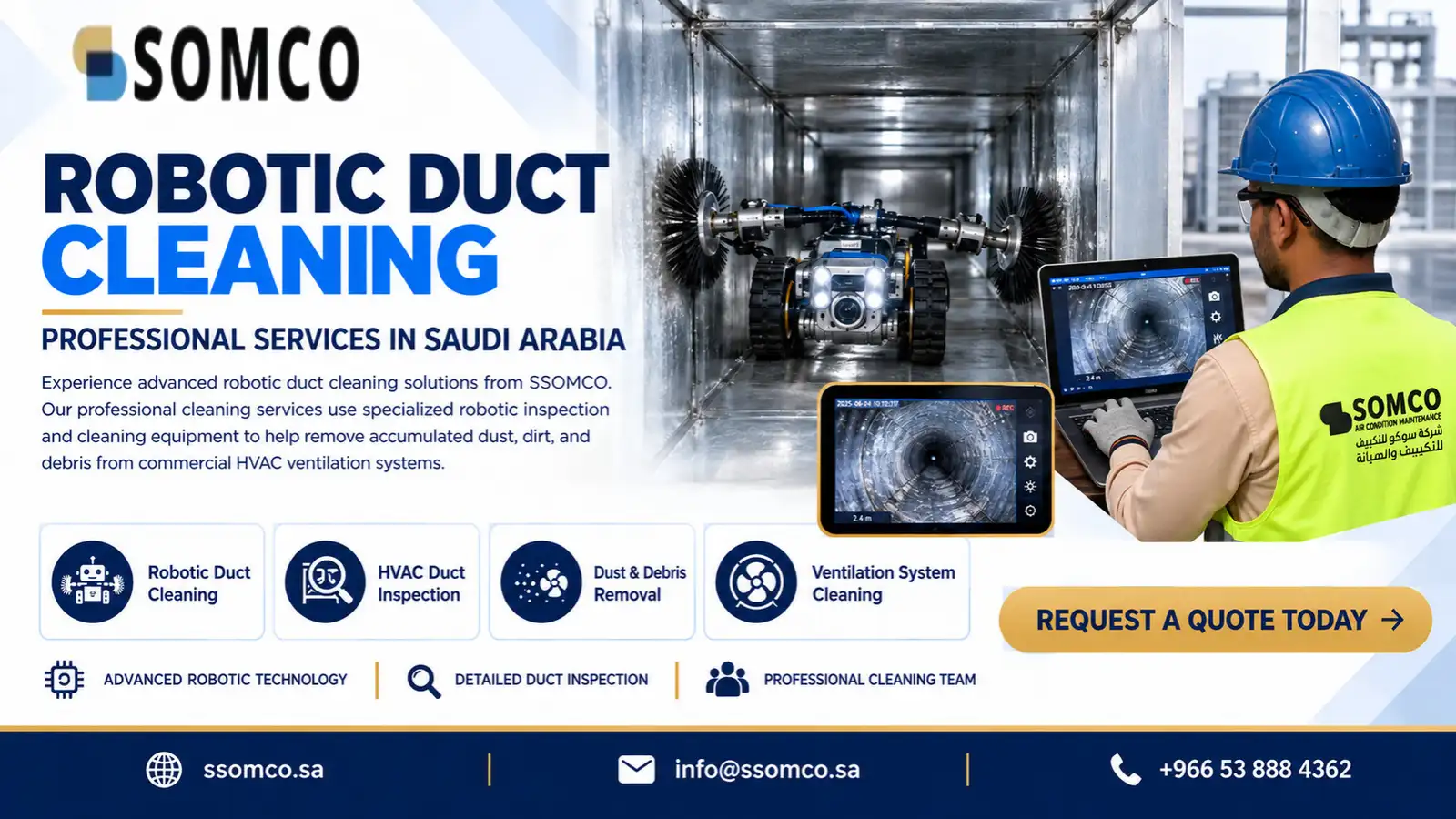
Robotic duct cleaning in Saudi Arabia is an advanced approach to HVAC duct maintenance. It uses remotely operated cleaning equipment and inspection cameras to access duct sections, identify contamination, and support cleaning in areas that may be difficult to reach manually.
For commercial buildings, offices, hospitals, hotels, restaurants, and industrial facilities, robotic duct cleaning can provide a practical way to inspect and maintain complex air distribution systems.
SSOMCO provides professional air duct cleaning services for commercial, industrial, hospitality, and other facilities. Businesses considering robotic cleaning can discuss their ductwork requirements and confirm the appropriate cleaning method for their property.
What Is Robotic Duct Cleaning?
Robotic duct cleaning is a specialised HVAC cleaning method that uses remotely controlled robotic equipment to inspect and clean the internal surfaces of air ducts.
The equipment is typically fitted with cameras, lighting, brushes, or other cleaning attachments. An operator controls the robot from outside the ductwork while monitoring the cleaning process through a video display.
Depending on the equipment and duct configuration, robotic cleaning systems may help technicians:
- Inspect internal duct surfaces.
- Identify dust and debris accumulation.
- Reach selected duct sections with limited manual access.
- Dislodge accumulated dirt using suitable cleaning attachments.
- Support the removal of loosened contaminants through an appropriate vacuum extraction system.
- Record visual inspection footage before and after cleaning.
The equipment used depends on duct dimensions, material, access points, contamination levels, and project requirements.
Why Is Robotic Duct Cleaning Important in Saudi Arabia?
Buildings in Saudi Arabia often depend heavily on air-conditioning and ventilation systems to maintain comfortable indoor environments.
Dust accumulation, continuous HVAC operation, building activities, and environmental conditions can contribute to contamination within ductwork.
Professional duct cleaning can help address these maintenance requirements.
1. Access to Difficult Duct Sections
Commercial buildings may have extensive duct networks with multiple branches, bends, and restricted access points.
Robotic equipment can help inspect and clean selected areas that are difficult to reach using conventional manual methods.
2. Internal Duct Inspection
Some robotic systems include cameras that allow operators to view internal duct conditions.
Visual inspection can help identify dust deposits, debris, damaged sections, and other conditions that may require attention.
3. Controlled Cleaning Operations
Remote operation allows technicians to control cleaning equipment while observing its movement inside the ductwork.
The cleaning method should be selected according to the duct material, condition, and type of contamination.
4. Support for HVAC Maintenance
Cleaning is one part of a wider HVAC maintenance programme. It can be combined with equipment inspection, airflow assessment, air balancing, and other relevant maintenance activities.
5. Documented Inspection Results
Camera-equipped robotic systems can support visual documentation of accessible duct sections.
Where included in the service scope, before-and-after footage can help clients review the condition of the ductwork and understand the work performed.
How Does Robotic Air Duct Cleaning Work?
A professional robotic duct cleaning project generally involves several stages. The exact procedure depends on the equipment, building layout, and cleaning requirements.
Step 1: Initial HVAC Duct Inspection
The cleaning team reviews the ventilation system, available access points, duct dimensions, and visible conditions.
An initial inspection helps determine whether robotic cleaning is appropriate or whether another cleaning method is more suitable.
Step 2: Robotic Camera Inspection
Where camera-equipped equipment is used, the operator guides the inspection robot through accessible duct sections.
The camera helps identify areas with dust accumulation, debris, or other visible contamination.
Step 3: Cleaning Equipment Setup
The appropriate robotic cleaning equipment is selected according to the duct dimensions and internal conditions.
Cleaning attachments may include rotating brushes, agitation tools, or other equipment designed for the specific application.
Step 4: Controlled Internal Cleaning
The operator controls the robot while suitable cleaning attachments dislodge accumulated dirt from internal duct surfaces.
The cleaning procedure should be appropriate for the duct material and should avoid damaging insulation, joints, dampers, or other components.
Step 5: Vacuum Extraction
A suitable negative-pressure vacuum extraction arrangement is used to collect loosened dust and debris.
Proper containment and filtration are important to help prevent dislodged contaminants from spreading into occupied spaces.
Step 6: Final Inspection
After cleaning, the relevant duct sections may be inspected again to evaluate the results.
Visual documentation can help confirm the condition of the accessible areas after the cleaning process.
Step 7: Reporting and Recommendations
The client may receive a service report describing the inspected areas, cleaning activities, observations, and any additional maintenance requirements.
Benefits of Robotic Duct Cleaning for Commercial Buildings
Robotic duct cleaning may be suitable for facilities with extensive duct networks or sections that are difficult to access.
Offices and Corporate Buildings
Office buildings often contain multiple air distribution zones serving meeting rooms, workspaces, corridors, and shared facilities.
Robotic inspection and cleaning may help maintenance teams assess selected internal duct sections and address identified contamination.
Hospitals and Healthcare Facilities
Healthcare buildings require particular attention to ventilation, hygiene, filtration, and environmental control.
Any duct cleaning work must follow the facility’s infection-control procedures, HVAC design requirements, and applicable healthcare standards.
Hotels and Hospitality Properties
Hotels operate HVAC systems across guest rooms, restaurants, meeting spaces, and shared facilities.
Planned duct inspection and cleaning can form part of a wider ventilation maintenance programme.
Shopping Malls and Retail Buildings
Large retail properties may contain extensive duct networks serving shops, corridors, food courts, and common areas.
Robotic equipment can be considered for suitable duct sections where internal access is limited.
Industrial Facilities
Factories, warehouses, and industrial buildings may have large ventilation systems with different operating conditions and contamination risks.
The cleaning method should be selected after assessing the type of deposits, duct construction, and any specialized industrial ventilation requirements.
Restaurants and Commercial Kitchens
Restaurants and commercial kitchens have different ventilation and exhaust cleaning requirements.
Kitchen exhaust systems can contain grease deposits and require appropriate cleaning procedures. General HVAC duct cleaning should not be treated as a substitute for specialised kitchen exhaust and hood cleaning.
Robotic Duct Cleaning vs Traditional Duct Cleaning
Both robotic and conventional duct cleaning methods can play an important role in HVAC maintenance.
Feature | Robotic duct cleaning | Conventional duct cleaning |
Equipment | Remotely operated cleaning equipment | Manual tools and mechanical cleaning equipment |
Inspection | May include internal camera inspection | May use manual or separate inspection tools |
Access | Useful for suitable restricted-access sections | Depends on available access and duct configuration |
Operation | Controlled remotely by an operator | Performed directly by technicians |
Documentation | May provide recorded video footage | May use photographs and inspection reports |
Application | Selected complex or difficult-to-access ductwork | A wide range of accessible duct systems |
The most appropriate method depends on the duct layout, contamination, available access, material, and project specifications. Robotic cleaning is not automatically the best solution for every HVAC system.
Why Professional Duct Cleaning Matters
Duct cleaning should be based on an assessment of the ventilation system rather than an assumption that every duct requires frequent cleaning.
Professional assessment helps determine whether cleaning is necessary and which method is appropriate.
Important considerations include:
- Visible dust and debris accumulation.
- Contamination identified during inspection.
- Airflow complaints or ventilation concerns.
- Construction dust following renovation work.
- Evidence of moisture or suspected microbial growth.
- Maintenance history and operating conditions.
- Manufacturer and project maintenance requirements.
Where microbial contamination or moisture problems are suspected, the underlying cause should be investigated and corrected rather than relying on cleaning alone.
How to Choose a Robotic Duct Cleaning Company in Saudi Arabia
Selecting a suitable duct cleaning provider is important for protecting HVAC equipment and achieving an appropriate cleaning result.
Before hiring a company, consider the following factors.
1. Experience in HVAC Duct Cleaning
Ask about the company’s experience with commercial duct systems, ventilation networks, and complex building environments.
2. Robotic Equipment and Inspection Technology
If robotic cleaning is required, confirm that the provider has suitable robotic equipment and trained operators.
Ask whether internal camera inspection and recorded footage are included in the service.
3. Cleaning and Extraction Methods
Understand how dust and debris will be dislodged, collected, and contained during the cleaning process.
Suitable vacuum extraction and filtration arrangements should be considered.
4. Industry Standards and Procedures
Ask which cleaning procedures and acceptance criteria will be followed.
Where applicable, discuss relevant NADCA guidance and the project’s technical requirements. Do not assume that a company is NADCA-certified simply because it refers to NADCA standards.
5. Before-and-After Documentation
A professional service provider should explain how the cleaning work will be documented.
Depending on the agreed scope, this may include inspection photographs, camera footage, service records, and recommendations.
6. Safety and Building Coordination
Cleaning should be coordinated with building operations to protect occupants, equipment, and surrounding areas.
The provider should explain access requirements, isolation procedures, work schedules, and safety precautions.
Robotic Duct Cleaning and Indoor Air Quality
HVAC ductwork is part of the building’s air distribution system. Its condition can influence how air moves through the property.
Removing accumulated dust and debris from ducts, where cleaning is justified, can help maintain the cleanliness of the air distribution system.
However, duct cleaning alone does not guarantee improved indoor air quality.
Indoor environmental conditions also depend on:
- Outdoor air ventilation.
- HVAC filtration.
- Filter maintenance.
- Humidity management.
- Moisture control.
- Equipment cleanliness.
- Building occupancy and activities.
- Other indoor pollution sources.
A complete indoor air quality strategy should consider these factors together.
Why Consider SSOMCO for Air Duct Cleaning Services?
SSOMCO (Saudi Specialized Operations & Maintenance Company) provides professional air duct cleaning services for commercial, industrial, hospitality, food-service, and other facilities.
Its air duct cleaning services address the removal of accumulated dust, dirt, debris, and other unwanted deposits from ventilation systems.
SSOMCO’s HVAC-related service portfolio also includes air balancing and HVAC operation and maintenance.
For businesses considering robotic duct cleaning, the appropriate equipment and cleaning method should be confirmed according to the building’s ductwork, inspection findings, and project requirements.
SSOMCO can discuss your air duct cleaning requirements and help identify the appropriate service approach for your facility.
Looking for professional air duct cleaning services? Contact SSOMCO to discuss your building’s ventilation and HVAC maintenance requirements.
Frequently Asked Questions
Robotic duct cleaning uses remotely operated equipment to inspect and clean suitable internal duct sections. Some systems include cameras, rotating brushes, and cleaning attachments.
It can be suitable for commercial buildings with complex duct networks or restricted-access sections. A site assessment is needed to determine whether robotic cleaning is appropriate.
Robotic cleaning uses remotely operated equipment, often with camera inspection. Conventional cleaning generally relies on technicians using manual or mechanical cleaning tools. Both methods can be appropriate depending on the duct system.
Removing accumulated contaminants from ductwork can support ventilation system cleanliness. However, indoor air quality also depends on ventilation, filtration, humidity, and other environmental factors.
There is no single cleaning frequency suitable for every building. Cleaning requirements depend on inspection findings, building usage, contamination, maintenance history, and applicable standards.
Some robotic systems include cameras and lighting that allow operators to inspect accessible internal duct sections and record visual information.
Kitchen exhaust systems require specialised grease-removal procedures. A robotic HVAC duct cleaning method should not automatically be considered suitable for kitchen exhaust cleaning.
SSOMCO provides professional air duct cleaning services. Robotic cleaning equipment availability should be confirmed directly with SSOMCO before booking a project.
Conclusion
Robotic duct cleaning is an advanced option for inspecting and cleaning suitable HVAC duct systems, particularly in commercial and industrial buildings with complex ventilation networks.
By combining suitable inspection equipment, controlled cleaning procedures, and appropriate dust extraction, robotic technology can support more detailed duct maintenance.
For businesses planning HVAC duct cleaning in Saudi Arabia, the most important step is to assess the ductwork and select a cleaning method that matches the building’s requirements.
Contact SSOMCO to discuss professional air duct cleaning, air balancing, and HVAC maintenance requirements for your facility.

AC Repair: Common Issues And Solutions Explained
November 2, 2026 4:26 pm[…] professional AC repair or HVAC support? Contact SSOMCO to discuss your air conditioning […]