

 Blog
Heating, ventilation, and air conditioning systems play an essential role in maintaining comfortable, healthy, and productive indoor environments. In commercial and industrial buildings, HVAC equipment often operates for extended hours to support employees, customers, visitors, and daily business activities.
However, continuous operation, dust accumulation, equipment wear, and changing cooling demands can affect HVAC performance over time. Without proper inspection and maintenance, minor equipment issues may develop into unexpected breakdowns, increased energy consumption, and operational disruption.
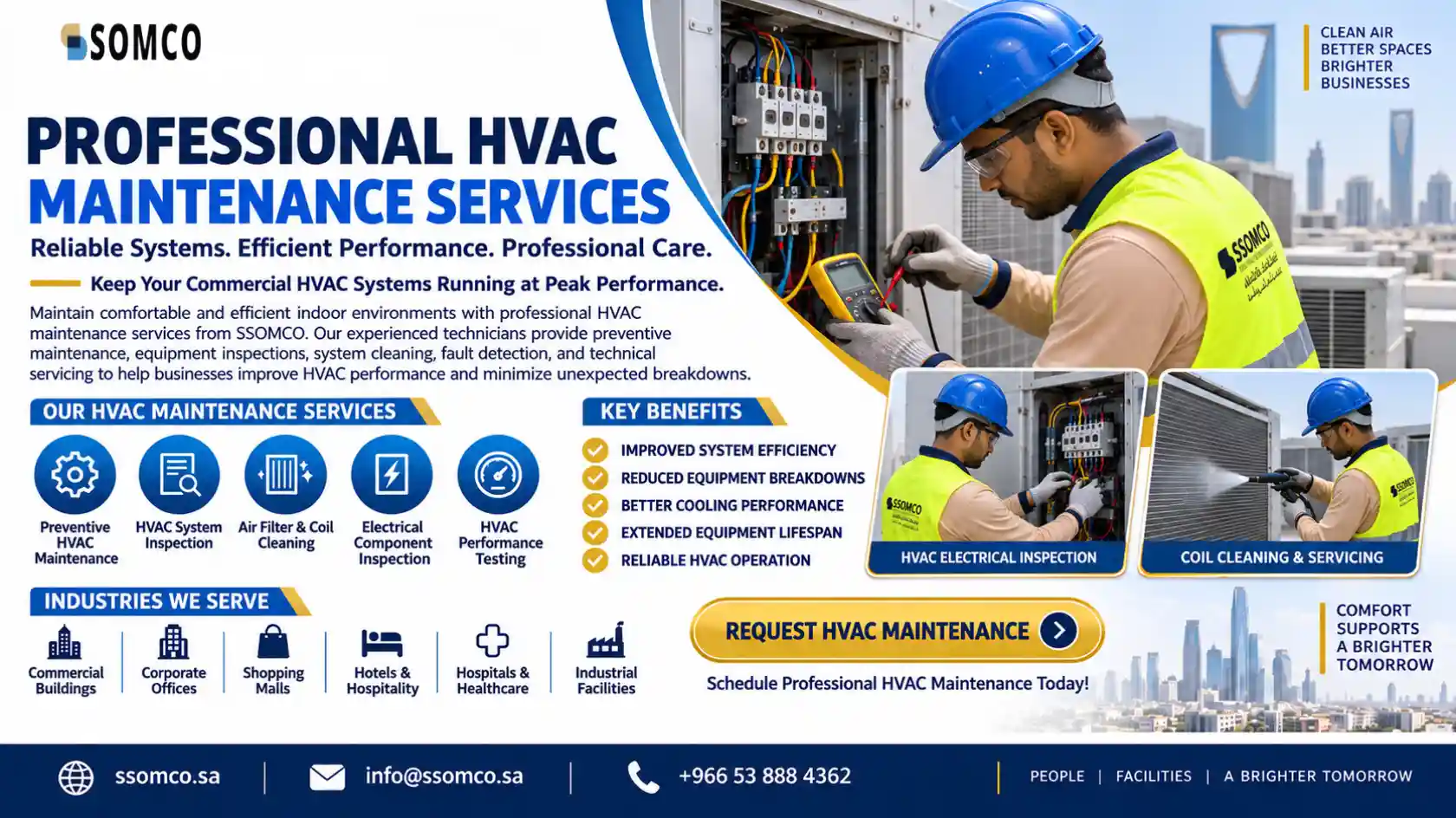
A professional HVAC maintenance service helps businesses maintain their heating, ventilation, and air conditioning equipment through planned inspections, cleaning, servicing, troubleshooting, and corrective maintenance.
Whether you manage an office building, hotel, shopping centre, restaurant, warehouse, or industrial facility, an effective HVAC maintenance programme can support equipment reliability and long-term building performance.
This guide explains the importance of HVAC maintenance, the services involved, common system problems, maintenance schedules, and how to select the right HVAC maintenance company.
What Is HVAC Maintenance Service?
HVAC maintenance service refers to the planned inspection, cleaning, servicing, testing, and repair of heating, ventilation, and air conditioning equipment.
The objective is to keep HVAC systems operating according to their intended requirements, identify developing faults, and reduce avoidable equipment failures.
Depending on the installed equipment and service agreement, HVAC maintenance may include:
- Air conditioning inspection and servicing
- HVAC preventive maintenance
- Commercial AC maintenance
- Chiller inspection and maintenance
- VRF and VRV system maintenance
- Air handling unit inspection
- Ventilation system maintenance
- Air filter cleaning and replacement
- Evaporator and condenser coil inspection
- Electrical and control system checks
- Condensate drainage inspection
- HVAC troubleshooting and corrective maintenance
- Chilled-water system inspection
The actual scope depends on equipment specifications, manufacturer recommendations, operating conditions, and the agreed maintenance contract.
Why Is Regular HVAC Maintenance Important?
Commercial HVAC systems are important building assets. Their performance can influence indoor comfort, business operations, and facility operating costs.
Regular maintenance provides several benefits.
1. Supports Reliable Equipment Operation
Routine inspections help identify developing problems such as unusual vibration, restricted airflow, drainage issues, and abnormal operating conditions.
Addressing these concerns early may help reduce the risk of unexpected equipment failure.
2. Helps Maintain Cooling Performance
Dirty filters, restricted airflow, and fouled heat-transfer surfaces can affect HVAC performance.
Appropriate cleaning and inspection help maintain the equipment in a suitable operating condition.
3. Helps Manage Energy Consumption
HVAC systems may consume more energy when operating with dirty components, incorrect settings, restricted airflow, or mechanical faults.
Maintenance helps identify conditions that may affect energy performance. Actual savings depend on the equipment, building design, operating schedule, and corrective work completed.
4. Supports Indoor Comfort
Properly maintained air conditioning and ventilation equipment help support suitable indoor temperature, airflow, and environmental conditions.
This is important in offices, hotels, restaurants, educational buildings, and other occupied facilities.
5. Helps Reduce Unexpected Repair Requirements
Preventive inspection can identify developing equipment issues before they become more serious.
Although maintenance cannot prevent every failure, it can help businesses manage equipment risks more effectively.
6. Supports Equipment Service Life
Following manufacturer maintenance recommendations helps protect important HVAC components and supports long-term equipment reliability.
Types of HVAC Maintenance Services for Commercial Buildings
Different HVAC systems require different maintenance procedures. A professional maintenance programme should cover the equipment installed at the property.
1. Commercial AC Maintenance
commercial HVAC technician inspecting split air conditioning indoor unit office building
Commercial air conditioning systems provide cooling for offices, retail spaces, hotels, restaurants, and other business properties.
Commercial AC maintenance may include:
- Inspecting indoor and outdoor units
- Cleaning or replacing air filters
- Checking evaporator and condenser coils
- Inspecting fan and blower operation
- Checking condensate drainage
- Reviewing electrical connections
- Assessing cooling performance
- Identifying unusual noise or vibration
The maintenance procedure should follow the equipment manufacturer’s recommendations.
2. Chiller Maintenance Services
industrial central water cooled chiller HVAC mechanical plant room
Chillers are important components of central cooling systems used in large commercial and industrial facilities.
Chiller maintenance may involve:
- Reviewing operating readings and alarms
- Inspecting compressor operation
- Checking condenser and evaporator conditions
- Reviewing refrigerant-related operating parameters
- Inspecting electrical and control systems
- Checking chilled-water flow conditions
- Inspecting associated pumps and connections
Maintenance requirements vary according to whether the equipment is air-cooled, water-cooled, centrifugal, screw, or another configuration.
3. VRF and VRV System Maintenance
commercial VRF HVAC outdoor unit installation and technician inspection
Variable Refrigerant Flow (VRF) and Variable Refrigerant Volume (VRV) systems provide zoned cooling for commercial and residential properties.
Their maintenance may include:
- Indoor unit filter inspection
- Outdoor unit condition assessment
- Coil and airflow inspection
- Drainage checks
- Controller and communication checks
- Electrical component inspection
- Review of system alarms
- Assessment of operating conditions
Manufacturer-specific procedures should be followed when diagnosing faults or servicing refrigerant-related components.
4. Air Handling Unit Maintenance
commercial air handling unit AHU HVAC plant room filters fans coils
Air Handling Units (AHUs) support air circulation, filtration, and temperature control in commercial buildings.
AHU maintenance may include:
- Filter inspection and replacement
- Cooling coil inspection
- Fan and motor checks
- Belt and drive inspection where applicable
- Drain pan and drainage checks
- Electrical and control inspection
- Airflow assessment
- General equipment condition review
5. Ventilation System Maintenance
Ventilation systems help circulate and distribute air throughout buildings.
Maintenance may include inspecting fans, motors, filters, dampers, controls, and accessible duct connections.
Where required, duct cleaning and air balancing should be assessed as separate or specifically defined service activities.
HVAC Preventive Maintenance vs Corrective Maintenance
A complete HVAC maintenance strategy includes both preventive and corrective activities.
Preventive Maintenance | Corrective Maintenance |
Planned before equipment failure | Performed after a fault is identified |
Focuses on inspection and servicing | Focuses on diagnosing and correcting problems |
Helps identify developing issues | Restores affected equipment operation |
Usually follows a maintenance schedule | Depends on equipment condition and fault severity |
Supports equipment reliability | Addresses existing performance problems |
Businesses should combine both approaches to manage their HVAC assets effectively.
Common HVAC Problems That Require Maintenance
HVAC systems can develop different problems depending on equipment age, usage, environmental conditions, and maintenance history.
Common issue | Possible cause | Recommended maintenance action |
Weak airflow | Dirty filters, fan problems, airflow restrictions | Inspect filters, fans, and airflow paths |
Insufficient cooling | Coil fouling, refrigerant issues, control faults | Inspect system operating conditions |
Water leakage | Blocked drainage or damaged connections | Inspect drainage and related components |
Unusual noise | Loose components or mechanical wear | Arrange mechanical inspection |
Frequent shutdown | Safety trips, electrical or control faults | Review alarms and diagnose the fault |
High energy consumption | Poor operating conditions or equipment inefficiency | Assess equipment performance |
Uneven cooling | Air distribution or control issues | Inspect airflow and system controls |
These are possible causes, not definitive diagnoses. A qualified technician should inspect the equipment before recommending repairs.
HVAC Maintenance Schedule for Commercial Facilities
An effective maintenance schedule depends on equipment type, operating hours, environmental conditions, manufacturer recommendations, and building requirements.
The following is a general planning framework rather than a fixed schedule for every HVAC system.
Maintenance activity | Planning approach |
Review system alarms and operating conditions | Regularly during operation |
Inspect visible leakage and unusual noise | During routine inspections |
Check air filters | According to equipment condition and manufacturer guidance |
Inspect coils and airflow | At planned maintenance intervals |
Check condensate drainage | During scheduled inspections |
Inspect electrical and control components | According to equipment requirements |
Assess chiller and AHU condition | As part of the facility maintenance plan |
Review overall system performance | At defined service intervals |
For commercial buildings, a documented HVAC maintenance plan helps coordinate inspections and track service history.
What Is an HVAC Annual Maintenance Contract (AMC)?
An HVAC Annual Maintenance Contract is an agreement between a property owner or facility manager and a maintenance provider for scheduled servicing over an agreed period.
An AMC can help businesses organise maintenance activities and establish clear responsibilities.
Depending on the contract, an HVAC AMC may include:
- Scheduled preventive maintenance visits
- Inspection of agreed HVAC equipment
- Filter and coil cleaning where specified
- Electrical and control checks
- Operating condition assessments
- Maintenance reports
- Recommendations for corrective work
- Agreed repair support
Before signing an AMC, businesses should review the contract carefully.
Important details include:
- Equipment covered by the agreement
- Number and frequency of service visits
- Included cleaning activities
- Emergency response arrangements
- Spare-parts provisions
- Labour and material exclusions
- Corrective maintenance responsibilities
- Contract duration and renewal terms
An AMC should clearly define what is included rather than assuming that every repair or replacement is covered.
HVAC Maintenance for Different Industries
Different industries have different HVAC operating requirements.
Office Buildings
Offices require suitable cooling and ventilation across workspaces, meeting rooms, reception areas, and shared facilities.
Regular maintenance helps facility teams manage equipment condition and indoor comfort.
Hotels and Hospitality
Hotels depend on reliable cooling across guest rooms, lobbies, restaurants, and other shared areas.
Maintenance work should be planned around occupancy and operational requirements.
Shopping Malls and Retail Centres
Retail properties may contain central chillers, AHUs, VRF systems, and multiple air conditioning units.
A coordinated maintenance programme helps manage equipment across different zones.
Restaurants and Commercial Kitchens
Restaurants require appropriate cooling and ventilation for dining areas and other spaces.
HVAC maintenance should be distinguished from kitchen exhaust and grease-duct cleaning, which may require separate specialist procedures.
Industrial Facilities
Industrial buildings may use HVAC systems for occupant comfort, process support, and selected equipment environments.
Maintenance should account for operating conditions, equipment specifications, and site safety requirements.
Educational Buildings
Schools and other educational facilities need suitable indoor conditions in classrooms, offices, and shared spaces.
Maintenance scheduling should minimise disruption to daily activities.
How to Choose the Right HVAC Maintenance Company
Selecting an experienced HVAC maintenance provider is important for commercial and industrial properties.
Before appointing a contractor, consider these factors.
1. Technical Experience
Confirm that the provider has relevant experience with the HVAC equipment installed at your property.
Chillers, VRF systems, AHUs, and commercial AC units may require different technical skills.
2. Clearly Defined Service Scope
Ask for a written list of equipment and maintenance activities included in the service agreement.
This helps avoid misunderstandings about cleaning, inspection, repairs, and spare parts.
3. Qualified Technicians
Check that technicians have the appropriate qualifications and training for the equipment and work they will perform.
4. Safety Procedures
HVAC maintenance may involve electrical systems, rotating equipment, refrigerants, elevated work areas, and mechanical plant rooms.
Confirm that the provider follows suitable site and equipment safety procedures.
5. Maintenance Reports
A good maintenance process should document work completed, equipment observations, identified faults, and recommendations.
6. Preventive Maintenance Planning
Choose a provider that can help establish a maintenance schedule based on equipment requirements and facility operations.
Why Choose SSOMCO for HVAC Maintenance Support?
Saudi Specialized Operations & Maintenance Company (SSOMCO) provides HVAC and maintenance-related solutions for commercial and facility environments.
Its service portfolio includes:
- HVAC maintenance
- AC maintenance
- Chiller-related services
- VRF and VRV-related services
- Building maintenance
- Facility maintenance
- MEP-related maintenance support
For commercial properties, effective maintenance starts with understanding the installed equipment, operating conditions, and the facility’s service requirements.
Businesses can contact SSOMCO to discuss their HVAC maintenance needs, equipment coverage, and suitable maintenance arrangements.
Looking for professional HVAC maintenance support for your commercial property? Contact SSOMCO to discuss your requirements and request a quotation.
Frequently Asked Questions About HVAC Maintenance Service
HVAC maintenance may include equipment inspection, filter cleaning, coil inspection, drainage checks, electrical and control checks, performance assessment, and corrective maintenance recommendations. The exact scope depends on the equipment and service agreement.
Maintenance frequency depends on equipment specifications, operating hours, site conditions, and manufacturer recommendations. Commercial facilities should follow a documented maintenance schedule.
Preventive maintenance helps identify developing problems, maintain equipment condition, support cooling performance, and reduce avoidable breakdown risks.
AC maintenance focuses on air conditioning equipment, while HVAC maintenance may cover a broader range of systems, including chillers, ventilation equipment, AHUs, and associated controls.
An HVAC Annual Maintenance Contract is an agreement for scheduled maintenance over a defined period. Its coverage depends on the agreed equipment list, service frequency, repair provisions, and exclusions.
Appropriate maintenance can help address conditions such as dirty filters, restricted airflow, fouled coils, and incorrect operating settings that may affect energy performance. Actual results depend on the entire system.
Common signs include weak airflow, insufficient cooling, unusual noise, water leakage, frequent shutdowns, and abnormal operating conditions.
SSOMCO provides HVAC and maintenance-related services for commercial and facility environments. Contact the team to confirm equipment coverage, service availability, and the maintenance scope required.
Conclusion
HVAC maintenance is an essential part of managing commercial and industrial building systems. Regular inspection, cleaning, servicing, and timely corrective work help maintain equipment condition and support reliable building operations.
From commercial AC units and VRF systems to chillers and air handling units, each component requires an appropriate maintenance approach based on its design and operating requirements.
For businesses looking to manage their HVAC equipment effectively, a planned preventive maintenance programme combined with professional technical support can make a significant difference.
Explore SSOMCO’s HVAC and maintenance solutions and contact the team to discuss your property’s requirements.
SSOMCO – Supporting commercial HVAC and facility maintenance requirements.

Maintenance Company In Riyadh For Commercial Success
November 7, 2026 1:21 pm[…] properties have different operational requirements. A modern office building may need regular HVAC servicing, while a hotel may require coordinated maintenance across air conditioning, plumbing, electrical […]