

 Blog
Commercial buildings depend on heating, ventilation, and air conditioning (HVAC) systems to maintain comfortable indoor environments and support daily business operations. Offices, shopping centres, hotels, restaurants, warehouses, and industrial facilities all require properly functioning HVAC equipment to manage indoor temperatures and air circulation.
However, installing an HVAC system is not enough to ensure consistent performance. Equipment needs regular inspection, cleaning, servicing, and timely repairs to remain in suitable operating condition.
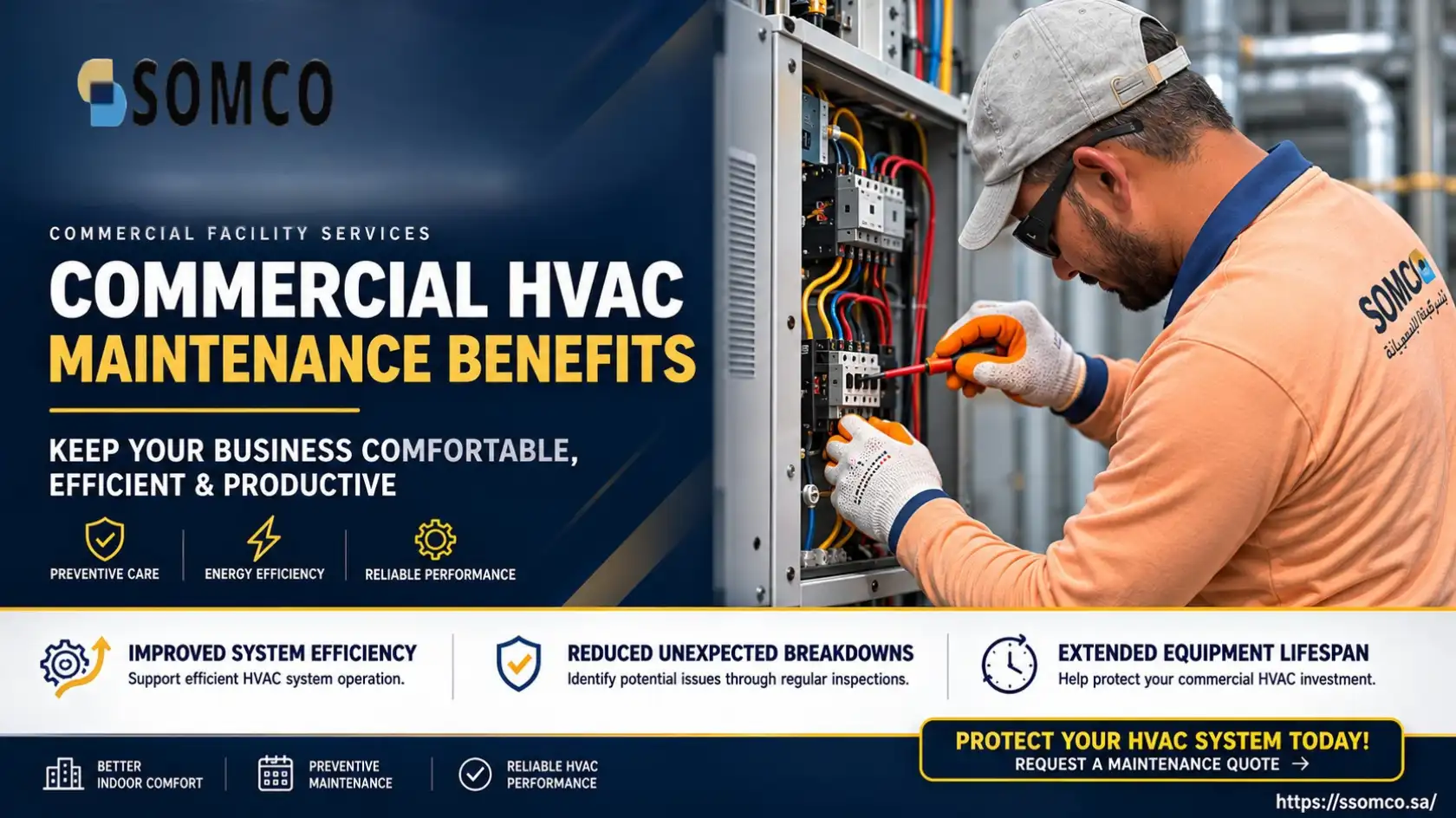
Professional HVAC maintenance helps businesses identify potential equipment problems, manage operating expenses, support indoor comfort, and plan their facility maintenance activities more effectively.
For commercial property owners and facility managers, investing in a structured HVAC maintenance programme is an important part of managing building operations.
In this guide, we explore the major benefits of professional HVAC maintenance, the importance of preventive servicing, common maintenance activities, and how businesses can choose the right HVAC maintenance company.
What Is Professional HVAC Maintenance?
Professional HVAC maintenance involves the inspection, servicing, cleaning, testing, and repair of heating, ventilation, and air conditioning equipment by appropriately trained technicians.
Commercial HVAC systems can include several interconnected components, such as:
- Air conditioning units.
- Chillers and chilled-water systems.
- Air handling units (AHUs).
- Fan coil units (FCUs).
- VRF and VRV systems.
- Ventilation fans.
- Air distribution ductwork.
- Thermostats and control systems.
- Pumps, motors, and electrical components.
A professional maintenance programme is developed according to the equipment installed, manufacturer recommendations, operating hours, building conditions, and maintenance requirements.
Typical activities include filter inspection, coil cleaning, drainage checks, electrical inspections, airflow assessment, control checks, and equipment performance reviews.
10 Major Benefits of Professional HVAC Maintenance for Commercial Buildings
Regular HVAC maintenance provides practical benefits for businesses that depend on reliable cooling, ventilation, and indoor environmental control.
1. Improves HVAC System Performance
One of the main benefits of professional HVAC maintenance is helping equipment operate under suitable conditions.
Dust accumulation, blocked filters, dirty coils, restricted airflow, and incorrect control settings can affect system performance.
During scheduled maintenance, technicians inspect relevant components and identify conditions that may be affecting operation.
Maintenance activities may include:
- Cleaning or replacing air filters.
- Inspecting evaporator and condenser coils.
- Checking fan and motor operation.
- Inspecting drainage systems.
- Reviewing thermostat settings.
- Checking airflow and temperature conditions.
- Identifying abnormal equipment behaviour.
Addressing these issues helps maintain the intended operation of the HVAC system and supports consistent indoor cooling.
2. Helps Reduce Energy Consumption
HVAC systems can account for a significant portion of energy use in commercial buildings. Equipment operating with dirty filters, restricted airflow, poorly adjusted controls, or developing faults may consume more energy than necessary.
Professional maintenance helps identify these conditions and provides opportunities to improve system operation.
Energy-related maintenance activities may include:
- Cleaning filters and heat-transfer surfaces.
- Checking airflow restrictions.
- Reviewing thermostat settings.
- Inspecting fans and motors.
- Checking control operation.
- Reviewing equipment operating schedules.
- Identifying unnecessary equipment operation.
However, maintenance alone does not guarantee a specific percentage of energy savings. Results depend on the existing equipment, building design, operating conditions, and corrective work performed.
3. Extends HVAC Equipment Service Life
Commercial HVAC equipment represents a significant investment for building owners and businesses.
Neglected equipment may experience increased wear, repeated faults, and operating problems that can contribute to premature component failure.
Routine maintenance helps monitor equipment condition and identify issues that may require attention.
For example:
- Air filters should be inspected and maintained.
- Fans and motors should be checked for abnormal operation.
- Electrical components should be inspected.
- Refrigerant circuits should be assessed when performance indicates a possible issue.
- Drainage systems should be checked for blockages.
- Mechanical components should be inspected according to manufacturer recommendations.
A documented maintenance history also helps facility managers make better decisions about equipment repair, refurbishment, and replacement.
4. Reduces the Risk of Unexpected Breakdowns
An unexpected HVAC breakdown can create significant difficulties for a commercial property.
Cooling failures may affect employee comfort, customer experience, equipment operation, and daily business activities.
Preventive maintenance helps identify warning signs before they develop into more serious equipment problems.
Common issues that can be identified during maintenance include:
- Unusual noise or vibration.
- Weak airflow.
- Water leakage.
- Faulty electrical connections.
- Blocked filters.
- Damaged fan components.
- Abnormal cooling performance.
- Control system errors.
Preventive maintenance cannot eliminate every breakdown, but it helps businesses identify developing issues and organise corrective work before equipment failure causes major disruption.
5. Supports Indoor Comfort and Air Circulation
A properly maintained HVAC system helps maintain suitable indoor temperatures and air circulation.
In commercial properties, poor cooling or airflow can create uncomfortable conditions for employees, visitors, and customers.
Professional maintenance helps identify issues involving filters, fans, coils, ventilation components, and air distribution.
Depending on the system, maintenance may include:
- Checking supply and return airflow.
- Inspecting air filters.
- Reviewing thermostat operation.
- Checking ventilation equipment.
- Inspecting accessible ductwork.
- Investigating uneven temperatures.
- Identifying possible airflow obstructions.
HVAC maintenance supports system operation, but indoor air quality also depends on ventilation design, filtration, building conditions, occupancy, and other environmental factors.
6. Helps Manage Long-Term Maintenance Costs
Unexpected equipment failures can require urgent repair work, replacement components, and additional maintenance resources.
A planned maintenance programme helps businesses identify potential issues, prioritise repairs, and organise servicing activities.
It also allows facility managers to monitor:
- Recurring equipment faults.
- Maintenance expenses.
- Equipment condition.
- Repair history.
- Replacement requirements.
- Outstanding maintenance recommendations.
This information can support more informed maintenance budgeting and help businesses avoid relying entirely on reactive repairs.
7. Supports Business Continuity
Commercial properties often depend on HVAC systems throughout their operating hours.
A cooling problem in an office, hotel, restaurant, shopping centre, or industrial facility can affect normal activities.
Regular maintenance helps facility managers plan servicing around building schedules and identify problems that require attention.
A structured programme may include:
- Scheduled inspections.
- Preventive servicing.
- Equipment condition reports.
- Fault identification.
- Corrective maintenance planning.
- Maintenance records.
The goal is to reduce avoidable disruption and support the continuity of building operations.
8. Improves Maintenance Planning and Equipment Management
Commercial buildings may contain dozens or hundreds of HVAC components across different floors, departments, and operating zones.
Without organised maintenance records, it can be difficult to understand which equipment has been serviced, which components need attention, and where recurring faults are occurring.
Professional HVAC maintenance can provide documented information about:
- Equipment identification.
- Inspection dates.
- Completed maintenance activities.
- Identified faults.
- Corrective actions.
- Recommended follow-up work.
- Equipment condition.
These records help facility managers monitor maintenance progress and plan future activities.
9. Helps Identify Potential Safety Issues
HVAC equipment includes electrical connections, motors, rotating components, refrigerant circuits, and mechanical systems.
Faulty electrical components, damaged wiring, unusual vibration, or other abnormal conditions may require professional attention.
During maintenance, appropriately qualified technicians can inspect relevant components and identify issues that need corrective work.
Maintenance should follow applicable safety procedures, manufacturer instructions, and site requirements. It should not be treated as a substitute for required safety inspections or statutory compliance activities.
10. Supports More Effective Facility Management
HVAC maintenance is an important part of wider building operations and maintenance.
A properly organised programme helps facility managers coordinate equipment inspections, maintenance visits, repair requirements, and operational schedules.
It also creates opportunities to review system performance and identify areas where maintenance procedures or operating settings may need improvement.
For businesses managing multiple buildings or commercial locations, consistent maintenance records and defined service responsibilities can make facility management more organised.
Benefits of Preventive HVAC Maintenance vs. Reactive Maintenance
Businesses generally approach HVAC maintenance through preventive and reactive activities.
Understanding the difference can help facility managers decide how to manage their equipment.
Preventive HVAC maintenance | Reactive HVAC maintenance |
Planned inspections and servicing | Maintenance after a fault develops |
Identifies potential equipment problems | Addresses existing equipment problems |
Helps organise maintenance budgets | May involve unplanned repair expenses |
Supports equipment condition monitoring | Focuses on restoring failed equipment |
Uses scheduled maintenance records | Often depends on breakdown reports |
Helps reduce avoidable disruption | Can result in operational interruptions |
Preventive maintenance does not remove the need for corrective repairs. Both approaches are important, but relying entirely on breakdown repairs can make equipment management more difficult.
Which Commercial HVAC Systems Require Regular Maintenance?
Different commercial buildings use different HVAC technologies. Each system has specific maintenance requirements.
1. Commercial Air Conditioning Systems
Commercial AC systems are used in offices, retail stores, meeting rooms, restaurants, and other business environments.
Maintenance may include filter cleaning, coil inspection, drainage checks, electrical inspections, and cooling performance assessment.
2. Chiller Systems
Chillers are used in central cooling applications for large commercial and industrial buildings.
Maintenance may involve inspection of compressors, heat exchangers, pumps, motors, electrical components, and control systems, depending on the equipment and agreed scope.
3. VRF and VRV Systems
VRF and VRV systems provide zoned cooling through multiple indoor units connected to outdoor equipment.
Maintenance may include indoor and outdoor unit inspections, filter cleaning, drainage checks, refrigerant piping inspection, controller checks, and system diagnostics.
4. Air Handling Units
AHUs distribute conditioned air throughout commercial buildings.
Maintenance may involve filter replacement, coil inspection, fan and motor checks, belt inspection where applicable, drainage checks, and airflow assessment.
5. Ventilation Systems
Ventilation equipment supports the movement and exchange of air inside buildings.
Maintenance may include fan inspection, motor checks, damper inspection, accessible ductwork assessment, and airflow checks.
6. Fan Coil Units
FCUs are used in many commercial buildings to provide localised heating or cooling.
Maintenance may include filter cleaning, coil inspection, fan checks, drainage inspection, and control testing.
Commercial HVAC Maintenance Checklist
A structured maintenance checklist helps ensure that important HVAC components are inspected according to the maintenance plan.
Component | Example maintenance activity |
Air filters | Inspect, clean, or replace as required |
Evaporator coils | Check condition and clean when necessary |
Condenser coils | Inspect and remove accumulated dirt |
Fans and motors | Check operation, noise, and vibration |
Electrical components | Inspect connections and relevant components |
Thermostats | Check settings and control response |
Drainage systems | Inspect drain pans and pipes for blockages |
Ductwork | Inspect accessible sections for damage or restrictions |
Chillers | Review equipment condition and operating parameters |
AHUs | Inspect filters, coils, fans, and dampers |
VRF systems | Review controllers, indoor units, and system alarms |
The actual checklist should be adjusted to the installed equipment, manufacturer instructions, site conditions, and agreed service scope.
How Often Should Commercial HVAC Systems Be Maintained?
There is no universal maintenance schedule suitable for every commercial building.
Maintenance frequency depends on:
- Equipment type and manufacturer.
- Building operating hours.
- Occupancy levels.
- Dust and environmental exposure.
- Equipment condition.
- Previous maintenance history.
- Business operating requirements.
The following table is an illustrative planning guide, not a fixed technical standard.
Activity | Example planning frequency |
Visual equipment inspection | Monthly |
Air filter inspection | Monthly or as conditions require |
Drainage inspection | Monthly to quarterly |
Coil condition inspection | Quarterly or according to operating conditions |
Electrical and control inspection | Periodically, as recommended |
Detailed equipment performance review | According to equipment requirements |
Overall maintenance programme review | Annually |
Commercial buildings operating cooling systems for extended periods or in dusty environments may need more frequent inspections.
The final maintenance schedule should follow manufacturer recommendations and the actual operating conditions of the property.
HVAC Maintenance for Different Commercial Buildings
Every commercial property has different cooling, ventilation, and maintenance requirements.
Office Buildings
Office environments require suitable temperatures and airflow across workstations, meeting rooms, reception areas, and shared spaces.
Regular maintenance helps facility managers identify cooling problems and organise equipment servicing around office operations.
Shopping Centres and Retail Stores
Shopping centres may contain large HVAC installations serving multiple retail areas and public spaces.
Maintenance planning should consider equipment coverage, occupancy patterns, cooling zones, and operating hours.
Hotels and Hospitality Properties
Hotels require attention to guest rooms, reception areas, restaurants, meeting rooms, and other shared facilities.
Maintenance schedules should be coordinated to minimise disruption to guests and daily operations.
Restaurants and Commercial Kitchens
Restaurants have separate cooling and ventilation requirements for dining spaces and kitchen areas.
Air conditioning maintenance should be coordinated with relevant ventilation requirements. Kitchen hood and grease duct cleaning are separate activities and should be included in the maintenance scope where required.
Warehouses and Industrial Facilities
Industrial and warehouse properties may use specialised cooling and ventilation arrangements.
Maintenance planning should consider equipment accessibility, operating conditions, environmental exposure, and the needs of the facility.
How to Choose a Professional HVAC Maintenance Company
Choosing a suitable HVAC maintenance company is important for commercial property owners and facility managers.
Before selecting a provider, consider these factors:
- Commercial experience: Check whether the company has experience maintaining the HVAC systems installed at your property.
- Technical capability: Confirm that the maintenance team can work with your specific equipment types.
- Preventive maintenance planning: Ask whether the provider can prepare an equipment-specific servicing schedule.
- Clear service scope: Understand which inspections, cleaning activities, repairs, and reports are included.
- Maintenance documentation: Request service records, inspection findings, and recommendations.
- Contract transparency: Review labour, spare-parts coverage, exclusions, additional charges, and service arrangements.
- Operational coordination: Confirm how maintenance visits will be arranged around business hours and site access requirements.
A reliable maintenance arrangement should provide clear responsibilities, documented activities, and a maintenance plan that reflects the actual needs of the building.
Why Professional HVAC Maintenance Matters for Saudi Arabian Businesses
Commercial properties in Saudi Arabia rely heavily on air conditioning, particularly during periods of high outdoor temperatures.
Long cooling operating hours and environmental conditions can place considerable demands on commercial HVAC equipment.
For this reason, businesses should pay attention to:
- Regular air filter inspection.
- Coil cleanliness.
- Outdoor unit condition.
- Airflow restrictions.
- Refrigerant circuit condition.
- Electrical component condition.
- Drainage system performance.
- Equipment operating schedules.
- Preventive maintenance planning.
A maintenance programme designed around the building’s actual equipment and operating conditions can help facility managers monitor performance and plan maintenance activities more effectively.
Professional HVAC Maintenance Solutions by SSOMCO
SSOMCO (Saudi Specialized Operations & Maintenance Company) provides operations and maintenance solutions for commercial and business environments.
For commercial buildings, HVAC maintenance is an important part of managing essential building equipment and supporting daily facility operations.
Depending on the agreed project requirements, HVAC maintenance activities may involve air conditioning servicing, chiller maintenance, VRF and VRV system maintenance, equipment inspections, and other related maintenance work.
Businesses planning a maintenance programme should first identify their installed equipment, operating requirements, site conditions, and preferred service arrangements.
Explore SSOMCO’s HVAC and maintenance services to learn more about the company’s service offering.
Have a commercial HVAC maintenance requirement or an upcoming facility project? Contact SSOMCO to discuss your requirements and request a quotation.
Frequently Asked Questions About Professional HVAC Maintenance
Professional HVAC maintenance helps monitor equipment condition, maintain system performance, identify developing faults, support indoor comfort, and organise maintenance activities.
Commercial buildings depend on HVAC systems for indoor cooling, heating where required, and ventilation. Regular maintenance helps facility managers monitor these systems and reduce the risk of avoidable equipment problems.
Maintenance can identify conditions such as dirty filters, restricted airflow, and poorly operating components that may affect energy performance. Actual savings depend on the equipment and building conditions.
Preventive maintenance allows businesses to schedule inspections, identify potential problems, organise corrective work, and maintain equipment records.
The frequency depends on equipment specifications, operating hours, environmental conditions, and manufacturer recommendations. A maintenance schedule should be prepared for each building.
Regular inspections and servicing can help identify developing faults and maintain equipment in suitable operating condition. This may help reduce premature wear, although equipment lifespan also depends on design, usage, and operating conditions.
Depending on the agreement, an HVAC maintenance contract may include scheduled inspections, filter servicing, coil checks, electrical inspections, equipment reporting, and specified corrective maintenance arrangements.
Preventive maintenance involves scheduled servicing to identify potential issues. Corrective maintenance involves repairing faults that have already occurred.
Commercial HVAC maintenance may cover split AC systems, ducted systems, packaged units, chillers, VRF and VRV systems, air handling units, fan coil units, and ventilation equipment.
A professional provider can inspect relevant equipment, identify technical issues, follow suitable maintenance procedures, and provide documented findings and recommendations according to the agreed service scope.
Conclusion
Professional HVAC maintenance is an important investment in the management of commercial buildings. Regular servicing helps businesses monitor equipment performance, identify developing faults, support indoor comfort, organise maintenance expenses, and plan future equipment requirements.
From commercial air conditioning and chillers to VRF systems, air handling units, and ventilation equipment, every HVAC installation requires maintenance suited to its design and operating conditions.
For offices, hotels, retail stores, restaurants, warehouses, and industrial facilities, a structured preventive maintenance programme can support more organised building operations.
Looking for professional HVAC maintenance solutions for your commercial property? Contact SSOMCO to discuss your facility requirements and request a quotation.
