

 Blog
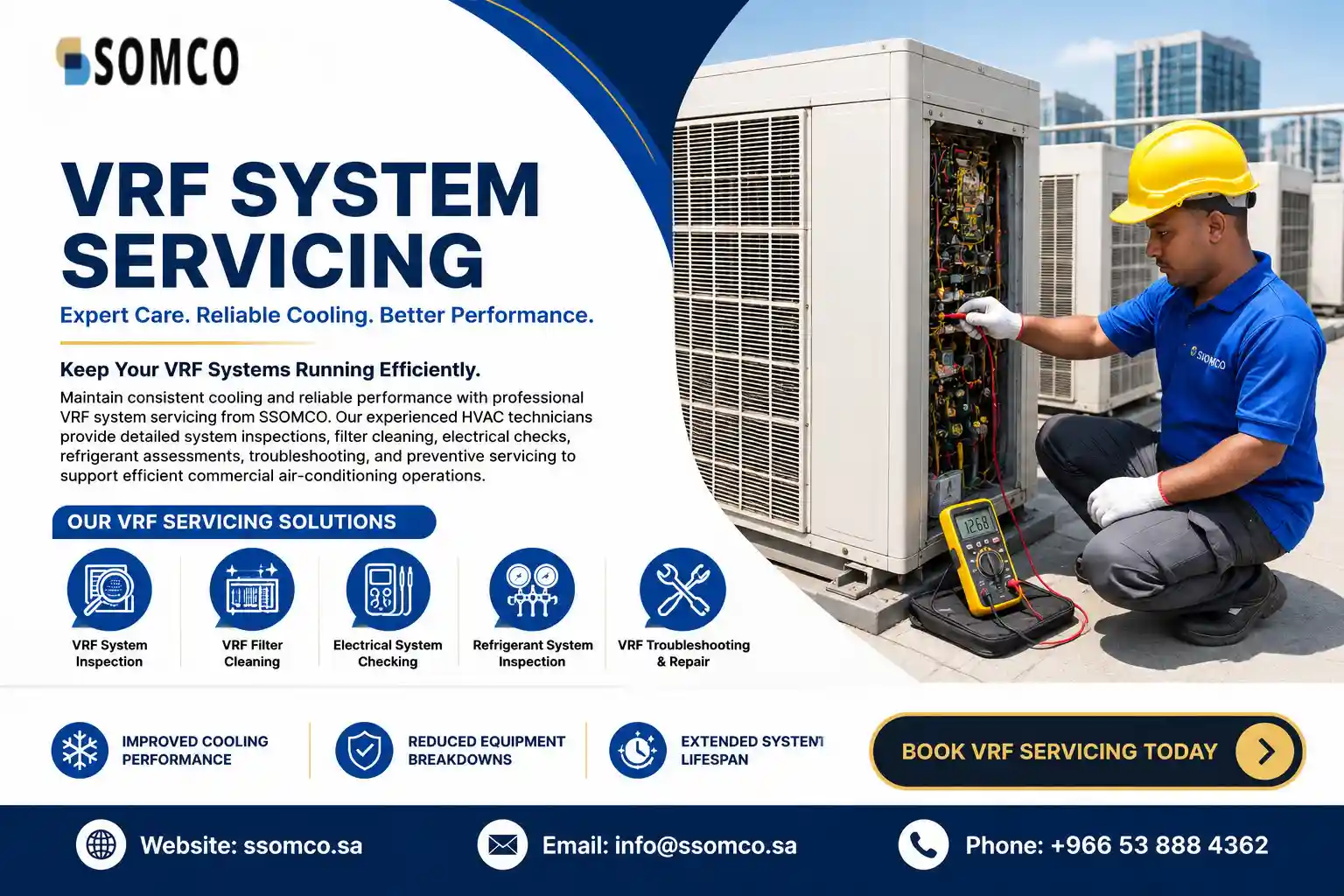
Commercial buildings depend on reliable air conditioning to maintain comfortable indoor environments and support uninterrupted business operations. Offices, hotels, shopping centres, hospitals, restaurants, and large commercial properties often use Variable Refrigerant Flow (VRF) systems to provide individual temperature control across multiple areas.
However, continuous operation, dust accumulation, restricted airflow, electrical issues, and inadequate servicing can affect VRF system performance over time.
VRF maintenance is essential for keeping indoor and outdoor units in good operating condition, identifying developing faults, maintaining cooling performance, and reducing unexpected equipment downtime.
For commercial property owners and facility managers, a structured VRF preventive maintenance programme helps protect valuable HVAC equipment and maintain dependable cooling throughout the building.
This guide explains VRF system maintenance, essential servicing procedures, common technical problems, preventive maintenance planning, and how to choose a professional VRF maintenance contractor.
What Is VRF System Maintenance?
VRF maintenance is the systematic inspection, cleaning, servicing, and performance assessment of Variable Refrigerant Flow air conditioning equipment.
A VRF system uses refrigerant to transfer heat between outdoor units and multiple indoor units. Its capacity adjusts according to the cooling or heating demand of connected zones.
Because multiple indoor units may operate through a connected system, maintenance should consider the complete installation rather than examining individual units in isolation.
A professional VRF maintenance programme may cover:
- VRF indoor unit inspection and cleaning
- Outdoor unit maintenance
- Air filter cleaning and replacement
- Evaporator and condenser coil inspection
- Refrigerant circuit assessment
- Electrical component inspection
- Communication wiring checks
- Condensate drainage maintenance
- Fan and motor inspection
- Controller and sensor testing
- System alarm and error-code diagnosis
- Overall cooling performance assessment
The exact maintenance scope should follow the equipment manufacturer’s recommendations and the installation’s technical specifications.
Why Is VRF Preventive Maintenance Important?
VRF systems are sophisticated air conditioning installations. A fault in one component may affect the operation of an individual unit or, depending on the system configuration, other connected equipment.
Regular maintenance helps businesses identify problems and manage their HVAC assets more effectively.
1. Maintain Consistent Cooling Across Multiple Zones
One of the main advantages of VRF systems is the ability to control temperatures in different rooms or zones.
Dirty filters, restricted airflow, sensor problems, and equipment faults can affect individual areas.
Routine maintenance helps identify these issues and supports consistent cooling performance.
2. Improve HVAC Equipment Reliability
Inspection of indoor units, outdoor equipment, electrical components, and refrigerant connections helps identify abnormal conditions before they develop into major failures.
3. Support Energy-Efficient Operation
Dirty heat exchangers, blocked filters, and unsuitable operating conditions may increase the workload on HVAC equipment.
Appropriate maintenance helps address these issues and supports efficient system operation.
4. Reduce Unexpected Equipment Downtime
Unplanned air conditioning failures can affect employees, customers, guests, and business operations.
Preventive servicing helps identify developing faults and allows facility managers to plan corrective work.
5. Maintain Indoor Airflow and Comfort
Clean filters, properly functioning fans, and suitable airflow distribution contribute to indoor comfort.
6. Protect Long-Term Equipment Performance
Following manufacturer maintenance procedures helps maintain equipment condition and supports its expected service life.
Complete VRF Maintenance Services: What Should Be Inspected?
A VRF installation includes multiple mechanical, electrical, and electronic components. Each requires appropriate inspection and maintenance.
1. VRF Indoor Unit Cleaning and Servicing
Indoor units deliver conditioned air into individual rooms and commercial spaces.
Dust accumulation and blocked filters can restrict airflow and affect cooling performance.
Indoor unit maintenance may include:
- Removing and inspecting air filters
- Cleaning reusable filters where appropriate
- Inspecting evaporator coils
- Checking blower and fan operation
- Inspecting condensate drain pans
- Checking drainage connections
- Inspecting electrical connections
- Reviewing temperature sensor operation
- Testing remote controllers and thermostats
Regular indoor unit servicing helps maintain airflow and identify problems affecting individual zones.
2. VRF Outdoor Unit Maintenance
Outdoor units are responsible for heat exchange and form an important part of the refrigerant circulation process.
Outdoor unit maintenance may include:
- Inspecting condenser coil condition
- Removing suitable surface dust and debris
- Checking fan operation
- Inspecting compressor operating conditions
- Checking electrical connections
- Inspecting mounting and vibration conditions
- Checking refrigerant pipe connections
- Reviewing operating alarms
- Confirming adequate ventilation and equipment clearance
Outdoor units should be maintained according to manufacturer instructions and site conditions.
3. Refrigerant Circuit Inspection
Refrigerant flow is central to VRF system operation.
Maintenance may include reviewing relevant operating parameters, inspecting accessible pipe connections, investigating signs of refrigerant leakage, and checking for abnormal system behaviour.
If a leak is suspected, qualified technicians should identify and repair the source before determining the correct refrigerant charging procedure.
Refrigerant handling must follow manufacturer specifications and applicable safety and environmental requirements.
4. Evaporator and Condenser Coil Cleaning
Heat exchanger cleanliness is important for effective heat transfer.
Dust and other contamination may accumulate on evaporator and condenser coils, potentially affecting system performance.
Maintenance may include:
- Inspecting coil surfaces
- Identifying accumulated dust and debris
- Cleaning accessible coil sections
- Inspecting fins for visible damage
- Checking airflow through heat exchangers
- Reviewing the condition after cleaning
Cleaning procedures should be suitable for the equipment and its manufacturer recommendations.
5. Condensate Drainage System Maintenance
During cooling operation, indoor VRF units produce condensate that must be discharged through the drainage system.
Blocked drain pipes, contaminated drain pans, or unsuitable drainage arrangements may cause water leakage.
Maintenance activities may include:
- Inspecting drain pans
- Checking condensate pipes
- Removing suitable blockages
- Checking drainage connections
- Inspecting for water leakage
- Verifying drainage operation
6. Electrical and Communication System Inspection
VRF systems use electrical connections and communication networks to coordinate indoor and outdoor unit operation.
Maintenance may include:
- Inspecting electrical terminals
- Checking visible wiring conditions
- Reviewing communication connections
- Inspecting sensors and control components
- Checking relevant electrical protection devices
- Reviewing system alarms
- Inspecting controller functionality
Electrical inspection and repair should be undertaken by appropriately qualified technicians.
7. VRF Controller and System Diagnostic Checks
Modern VRF systems use electronic controllers and diagnostic functions to monitor equipment operation.
Maintenance may involve:
- Reviewing displayed error codes
- Checking temperature settings
- Inspecting sensor readings
- Reviewing operating modes
- Checking communication status
- Investigating recurring alarms
- Reviewing relevant manufacturer diagnostic information
Error codes should always be interpreted using the correct manufacturer’s technical documentation.
8. Final System Performance Assessment
After completing maintenance activities, the system should be reviewed to confirm its operating condition.
Depending on the installation, this may include checking airflow, temperature conditions, operating alarms, drainage performance, and available diagnostic information.
Any unresolved issues should be documented and communicated to the facility manager.
Common VRF Air Conditioning Problems and Troubleshooting
Understanding common VRF problems helps facility managers recognise when professional maintenance is required.
Common problem | Possible causes | Recommended action |
Insufficient cooling | Dirty filters, coil contamination, airflow restrictions or system faults | Inspect filters, airflow and system operating conditions |
Indoor unit not operating | Power, communication, controller or equipment fault | Check power supply and diagnostic information |
Water leakage | Blocked drainage or drain pan problem | Inspect condensate drainage |
Outdoor unit abnormal noise | Fan, motor, compressor or mounting issue | Arrange mechanical inspection |
Frequent error codes | Sensor, communication, electrical or refrigerant-related fault | Diagnose using manufacturer procedures |
Uneven room temperatures | Airflow, sensor, settings or equipment issue | Inspect affected zones and controls |
Frequent system shutdown | Protective shutdown, electrical or mechanical fault | Identify the cause before restarting repeatedly |
These are possible causes, not definitive diagnoses. The correct solution depends on the equipment model and actual inspection findings.
VRF Maintenance Checklist for Commercial Buildings
A maintenance checklist helps technicians follow a consistent inspection process and enables facility managers to monitor equipment condition.
Indoor unit checklist
- Inspect air filters.
- Check evaporator coil condition.
- Inspect indoor fan and blower.
- Check condensate drainage.
- Inspect electrical connections.
- Review thermostat and controller operation.
- Check for unusual noise or vibration.
Outdoor unit checklist
- Inspect condenser coils.
- Check outdoor fan operation.
- Inspect compressor operating conditions.
- Check refrigerant pipe connections.
- Inspect electrical components.
- Check equipment clearance and ventilation.
- Review system alarms and operating conditions.
System-level checklist
- Review communication between connected units.
- Check relevant diagnostic information.
- Investigate recurring error codes.
- Review cooling performance.
- Record inspection findings.
- Prepare corrective maintenance recommendations.
The checklist should be adapted to the specific VRF manufacturer, equipment model, and site requirements.
Recommended VRF Preventive Maintenance Schedule
A planned maintenance programme helps prevent servicing activities from being overlooked.
The following is a general planning example, not a universal manufacturer-approved schedule.
Maintenance activity | Suggested frequency |
Visual indoor unit inspection | Monthly |
Air filter inspection | Monthly or as required |
Condensate drain inspection | Monthly or as required |
Outdoor unit visual inspection | Monthly |
Coil condition inspection | Quarterly or as required |
Fan and motor inspection | According to equipment requirements |
Electrical and communication checks | According to manufacturer recommendations |
Refrigerant circuit assessment | During scheduled servicing or when indicated |
Complete system performance review | Periodically and after significant repairs |
Facilities operating in dusty environments or under continuous cooling demand may require more frequent servicing.
For accurate planning, maintenance intervals should be based on the manufacturer’s instructions, operating hours, environmental conditions, and previous inspection reports.
VRF Maintenance for Different Commercial Sectors
VRF systems are commonly considered for properties that require independent temperature control across different rooms and operational areas.
VRF Maintenance for Office Buildings
Offices may have separate cooling zones for meeting rooms, workstations, executive offices, and reception areas.
Routine maintenance helps support comfortable working conditions and reliable air conditioning.
VRF Maintenance for Hotels
Hotels may operate numerous indoor units across guest rooms, restaurants, reception areas, lounges, and corridors.
A planned maintenance programme helps facility teams coordinate inspections without unnecessary disruption to guests.
VRF Maintenance for Shopping Centres
Shopping centres and retail properties may have different tenants and independently controlled areas.
Maintenance helps identify individual unit faults and monitor connected equipment.
VRF Maintenance for Restaurants and Cafés
Restaurants and cafés require suitable indoor cooling for dining and customer areas.
Maintenance planning should consider business operating hours, access to equipment, and the property’s ventilation arrangements.
VRF Maintenance for Educational Institutions
Schools, colleges, and training facilities may use VRF systems across classrooms, administrative offices, and shared spaces.
Equipment servicing should be scheduled around occupancy and operational requirements.
VRF Annual Maintenance Contract: What Should Businesses Consider?
A VRF Annual Maintenance Contract (AMC) helps businesses organise regular maintenance through an agreed service arrangement.
Depending on the contract, services may include:
- Scheduled preventive maintenance visits
- Indoor and outdoor unit inspections
- Filter cleaning and servicing
- Coil condition inspection
- Drainage system checks
- Electrical and control inspections
- System diagnostic checks
- Fault identification
- Maintenance reports
- Corrective maintenance recommendations
Before approving a VRF AMC, review the following:
- Total number of indoor units.
- Number and type of outdoor units.
- Equipment manufacturer and model.
- Maintenance visit frequency.
- Included cleaning and inspection activities.
- Spare parts and consumables coverage.
- Emergency response arrangements.
- Repair exclusions and additional charges.
- Reporting and documentation requirements.
A detailed maintenance agreement makes responsibilities clearer and helps facility managers plan servicing and maintenance expenses.
How to Choose a Reliable VRF Maintenance Contractor
VRF systems require technicians who understand their mechanical, electrical, refrigerant, and electronic control components.
Before selecting a contractor, consider the following points.
- Relevant VRF experience
Check whether the contractor has experience with your installed VRF equipment and system configuration.
- Manufacturer-specific knowledge
Different manufacturers use different diagnostic procedures, control arrangements, and maintenance requirements.
- Technical diagnostic capability
Confirm the contractor can investigate system alarms, communication problems, refrigerant-related issues, and equipment faults within the agreed scope.
- Qualified maintenance technicians
Ensure the technicians have appropriate technical knowledge and training for the work involved.
- Preventive maintenance planning
Ask for an equipment-specific maintenance schedule rather than a generic servicing plan.
- Detailed service reporting
Maintenance reports should explain completed work, equipment condition, identified faults, and recommended corrective action.
- Transparent quotation
The quotation should clearly identify the equipment covered, service frequency, labour, consumables, spare parts, and exclusions.
VRF Maintenance and HVAC Services by SSOMCO
Saudi Specialized Operations & Maintenance Company (SSOMCO) provides HVAC and maintenance-related solutions for commercial and facility requirements.
Our service portfolio includes:
- VRF and VRV system services
- HVAC maintenance
- Commercial AC maintenance
- Chiller maintenance
- HVAC operation and maintenance
- Air duct cleaning
- Building maintenance
- Facility maintenance
- MEP installation and maintenance
We understand that commercial properties depend on reliable air conditioning to support daily operations and indoor comfort.
Whether you manage an office, hotel, retail property, or another commercial facility, SSOMCO can discuss your HVAC and VRF maintenance requirements.
Our team can review your equipment requirements and discuss a suitable maintenance scope based on the project.
Need VRF maintenance for your commercial building?
Contact SSOMCO to discuss your system, maintenance requirements, and upcoming project.
Have an RFQ or upcoming project? Request a quotation today!
Frequently Asked Questions About VRF Maintenance
VRF maintenance may include indoor and outdoor unit inspection, air filter cleaning, coil inspection, drainage checks, electrical inspection, refrigerant circuit assessment, controller checks, and system performance reviews.
Service frequency depends on the manufacturer, operating hours, system condition, and environmental conditions. A preventive maintenance schedule should be established for each installation.
Possible causes include restricted airflow, dirty filters, contaminated coils, refrigerant circuit problems, sensor faults, or other equipment issues. A technical inspection is necessary to determine the actual cause.
Common possibilities include blocked condensate drainage, drain pan problems, or drainage installation issues. The affected unit should be inspected before normal operation continues.
Appropriate maintenance can address restricted airflow, dirty heat exchangers, and other operating problems that may affect energy performance. Actual savings depend on the equipment condition and building operation.
Yes. VRF maintenance also considers communication between indoor and outdoor units, refrigerant circuit operation, system diagnostics, and coordinated multi-zone controls.
A VRF AMC may include scheduled inspections, preventive servicing, filter maintenance, coil checks, drainage inspection, system diagnostics, and maintenance reports. The exact coverage depends on the agreement.
SSOMCO offers VRF and VRV-related services as part of its HVAC service portfolio. Contact the team to confirm the available maintenance scope for your system and property.
Conclusion
VRF systems are important cooling solutions for commercial buildings that require individual temperature control across multiple areas. However, their performance depends on appropriate maintenance of indoor units, outdoor equipment, refrigerant circuits, drainage systems, electrical components, and controls.
Regular inspections and preventive servicing help identify developing equipment issues, support cooling performance, and improve maintenance planning.
Choosing a suitable VRF maintenance contractor is an important step in protecting your HVAC equipment and supporting reliable facility operations.
For commercial VRF, air conditioning, and HVAC maintenance requirements, contact SSOMCO to discuss your project and request a quotation.
