

 Blog
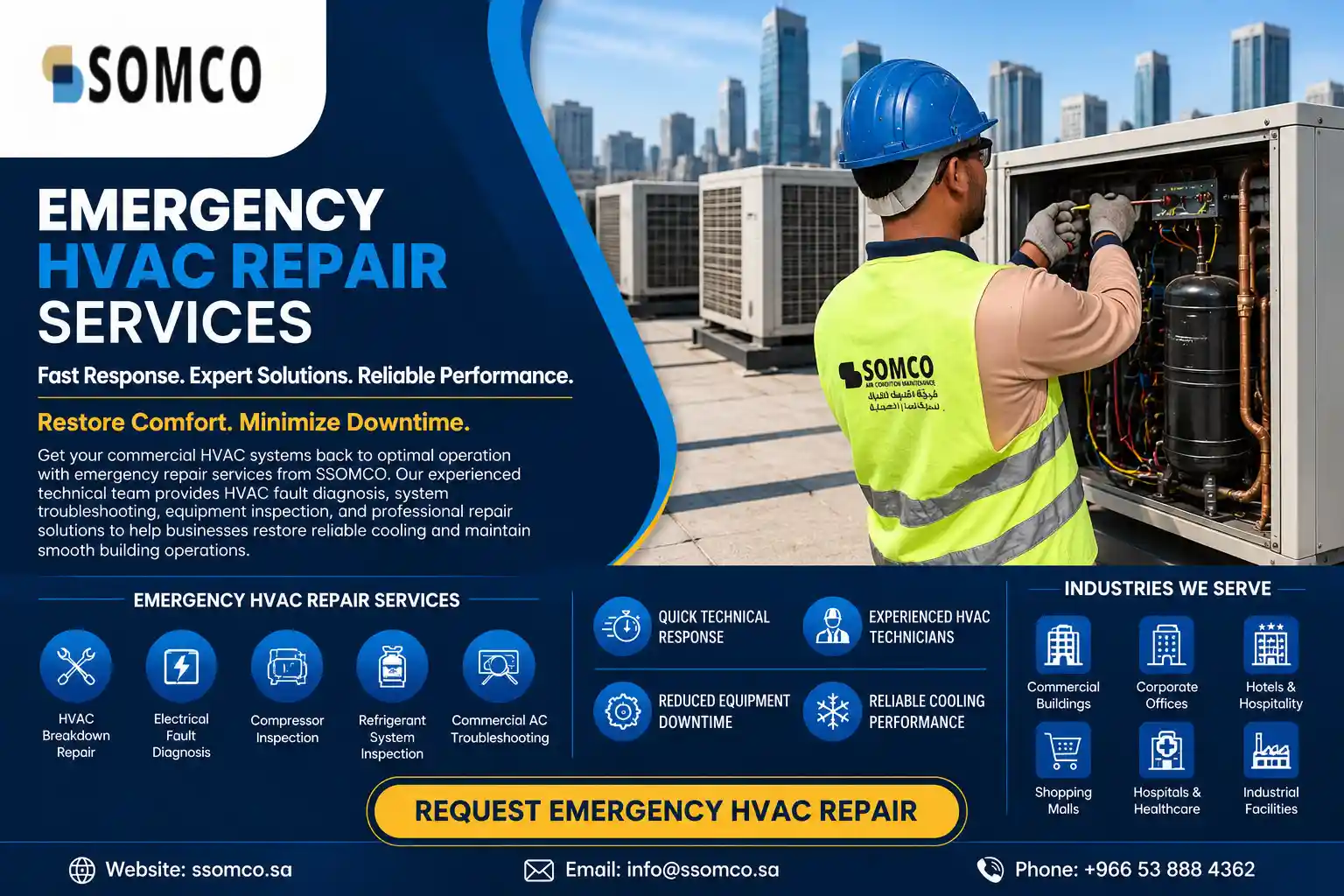
An HVAC breakdown can happen without warning. A commercial air conditioning system may suddenly stop cooling, an air handling unit may develop an electrical fault, or a chiller may fail during peak operating hours. When these problems occur, they can affect indoor comfort, employee productivity, equipment performance, and daily business operations.
Professional HVAC emergency repair helps identify urgent system problems, restore essential heating, ventilation, and air conditioning functions, and reduce the risk of further equipment damage.
For commercial buildings, emergency HVAC support is especially important because even a short period without proper cooling or ventilation can disrupt operations. Businesses need a structured response that prioritises safety, accurate fault diagnosis, and effective repairs.
What Is HVAC Emergency Repair?
HVAC emergency repair refers to urgent troubleshooting and repair work carried out when a heating, ventilation, or air conditioning system experiences a sudden failure or serious performance issue.
Unlike routine preventive maintenance, emergency repair focuses on addressing unexpected faults that require immediate attention.
Common emergency HVAC problems include:
- Complete air conditioning system failure
- Chiller breakdown or cooling interruption
- Refrigerant leaks or abnormal refrigerant pressure
- Electrical faults and control system failures
- Air handling unit malfunction
- Unusual equipment noise or vibration
- Water leakage from indoor HVAC equipment
- Poor airflow or sudden loss of cooling
- Ventilation system failure
The repair process depends on the equipment type, fault severity, manufacturer requirements, and site conditions.
Common Signs Your HVAC System Needs Emergency Repair
Recognising early warning signs can help facility teams respond before a minor issue develops into a major breakdown.
1. Sudden Loss of Cooling
If a commercial HVAC system stops delivering sufficient cooling, indoor temperatures can rise quickly. This may affect offices, hotels, restaurants, retail spaces, and other occupied buildings.
Possible causes include compressor problems, electrical faults, refrigerant-related issues, blocked filters, or control system malfunctions.
2. HVAC System Not Starting
An air conditioning unit, chiller, or air handling unit that fails to start may have an electrical supply issue, faulty control component, safety lockout, or equipment failure.
A qualified technician should inspect the system before attempting to restart it repeatedly.
3. Unusual Noise or Vibration
Grinding, rattling, buzzing, or excessive vibration may indicate loose components, motor problems, bearing wear, or fan-related faults.
Ignoring unusual sounds can increase the risk of further mechanical damage.
4. Water Leakage
Water around indoor units, AHUs, or drainage lines may indicate a blocked condensate drain, damaged drain connection, insulation problem, or other system issue.
Water leakage should be addressed promptly to reduce the risk of property damage.
5. Electrical or Burning Smell
A burning smell, repeated circuit trips, smoke, or visible electrical damage requires immediate attention. Switch off the affected equipment if it is safe to do so and arrange inspection by qualified personnel.
Never attempt electrical repairs without the appropriate qualifications.
Types of Commercial HVAC Emergency Repair
Commercial HVAC systems include several interconnected components. Emergency repair requirements vary according to the type of equipment installed.
Commercial AC Emergency Repair
Commercial AC systems provide cooling for offices, shops, restaurants, hotels, and other business premises.
Urgent AC repair may involve:
- Diagnosing cooling failure
- Inspecting indoor and outdoor units
- Checking electrical connections and controls
- Inspecting filters, coils, and airflow
- Checking condensate drainage
- Investigating abnormal operating conditions
The objective is to identify the underlying fault and restore reliable cooling where possible.
Chiller Emergency Repair
Chillers are important components of central cooling systems in many large commercial and industrial buildings.
A chiller breakdown can affect multiple areas of a facility. Emergency inspection may include checking:
- Chiller operating alarms
- Compressor performance
- Water flow conditions
- Electrical and control systems
- Condenser and evaporator conditions
- Refrigerant-related operating parameters
Chiller repairs should follow manufacturer recommendations and applicable site safety procedures.
VRF and VRV System Emergency Repair
Variable Refrigerant Flow (VRF) and Variable Refrigerant Volume (VRV) systems provide zoned cooling for commercial properties.
Emergency issues may include communication errors, indoor unit failures, outdoor unit faults, abnormal system operation, or controller problems.
A systematic diagnosis is important because one fault can affect multiple indoor units or zones.
AHU and Ventilation System Repair
Air Handling Units (AHUs) support air circulation, filtration, and indoor environmental conditions.
Emergency AHU inspection may involve:
- Fan and motor operation
- Filter condition
- Belt and drive components
- Electrical controls
- Airflow restrictions
- Drainage and coil condition
Ventilation failures should be assessed according to the building’s operational and safety requirements.
HVAC Emergency Repair Process: What Businesses Should Expect
A structured repair process helps reduce unnecessary delays and supports effective fault resolution.
Step 1: Initial Problem Assessment
The facility team should communicate the equipment type, location, symptoms, alarm codes, and time when the problem started.
This information helps the service team understand the urgency and prepare for inspection.
Step 2: Site Inspection and Fault Diagnosis
Technicians inspect the affected equipment and review its operating condition. Depending on the system, this may involve checking electrical components, controls, airflow, refrigerant-related parameters, drainage, and mechanical parts.
Step 3: Identify the Required Repair
After diagnosis, the technician identifies the likely cause and recommends the required corrective action.
If replacement components are needed, their availability and compatibility should be confirmed before installation.
Step 4: Carry Out the Repair
The repair is performed using appropriate tools, approved procedures, and suitable replacement parts.
Safety isolation and manufacturer instructions should be followed throughout the work.
Step 5: Testing and Performance Verification
After the repair, the system should be checked to confirm that the identified fault has been addressed and the equipment operates within the applicable requirements.
Step 6: Maintenance Recommendations
The service team may recommend preventive maintenance, component replacement, or further inspection to reduce the likelihood of similar breakdowns.
Why Fast HVAC Emergency Repair Matters for Commercial Buildings
An HVAC failure is not simply an inconvenience. In many commercial environments, it can affect business continuity and the building’s operating conditions.
Protects Business Operations: Timely repairs help minimise disruption to offices, hotels, restaurants, retail properties, and industrial facilities.
Supports Indoor Comfort: Restoring cooling and ventilation helps maintain more suitable indoor conditions for employees, customers, and visitors.
Reduces Further Equipment Damage: Prompt diagnosis can help prevent an existing fault from causing additional damage to connected components.
Supports Equipment Reliability: Corrective repairs combined with preventive maintenance can improve long-term equipment performance.
Helps Protect Business Assets: Addressing water leakage, electrical faults, and equipment overheating can help reduce the risk of avoidable property or equipment damage.
HVAC Emergency Repair vs Preventive Maintenance
Emergency repair and preventive maintenance serve different purposes, but both are important for commercial HVAC reliability.
HVAC Emergency Repair | Preventive HVAC Maintenance |
Responds to unexpected breakdowns | Reduces the likelihood of breakdowns |
Focuses on urgent fault diagnosis | Focuses on scheduled inspection |
Addresses equipment failure | Identifies developing issues |
Usually reactive | Planned and proactive |
Restores affected system functions | Supports long-term performance |
Businesses should not rely only on emergency repairs. A planned HVAC maintenance programme can help identify issues before they develop into operational emergencies.
How to Reduce the Risk of HVAC Emergencies
Although unexpected failures cannot always be prevented, a consistent maintenance programme can reduce avoidable equipment problems.
Recommended practices include:
- Schedule regular HVAC inspections.
- Clean or replace filters according to equipment requirements.
- Inspect indoor and outdoor coils.
- Check condensate drains and drainage connections.
- Monitor unusual noise, vibration, and operating conditions.
- Inspect electrical connections and control systems.
- Review equipment alarms and operating history.
- Follow manufacturer-recommended maintenance procedures.
- Keep records of repairs and recurring faults.
- Arrange professional inspections for chillers, AHUs, and VRF systems.
The appropriate maintenance frequency depends on equipment type, operating hours, environmental conditions, and manufacturer guidance.
Choosing the Right Commercial HVAC Emergency Repair Company
Selecting a suitable HVAC service provider is important when a commercial system fails.
Before appointing a contractor, businesses should consider:
- Commercial HVAC experience: Look for experience with the type and scale of equipment installed at your property.
- Technical expertise: Confirm that technicians are qualified to inspect and repair the relevant equipment.
- Fault diagnosis: Choose a provider that investigates the underlying cause rather than relying only on temporary fixes.
- Repair transparency: Request a clear explanation of the fault, recommended work, and any required replacement parts.
- Safety procedures: Confirm that work follows applicable safety requirements and equipment manufacturer guidance.
- Preventive maintenance support: Consider whether the provider can help reduce recurring failures through planned maintenance.
Response times, emergency availability, service coverage, and spare-part access should be confirmed directly with the contractor.
HVAC Emergency Repair Support for Commercial Properties
Different commercial environments have different HVAC requirements.
- Office Buildings: Cooling failures can affect employee comfort, meeting rooms, and daily operations.
- Hotels: HVAC problems can affect guest rooms and shared facilities.
- Restaurants: Reliable cooling and ventilation support comfortable dining and kitchen environments.
- Retail Properties: HVAC failures may affect customer experience and staff working conditions.
- Industrial Facilities: Cooling and ventilation interruptions may affect equipment, processes, and working environments.
- Educational Buildings: HVAC performance contributes to suitable indoor conditions in classrooms and shared spaces.
A repair approach should be based on the building’s equipment, operating requirements, and the severity of the fault.
Why Choose SSOMCO for HVAC and Maintenance Support?
Saudi Specialized Operations & Maintenance Company (SSOMCO) provides HVAC and maintenance-related services for commercial and facility environments.
Businesses looking for professional HVAC support can explore SSOMCO’s service portfolio, including HVAC maintenance, AC maintenance, chiller maintenance, VRF-related services, building maintenance, and other facility support solutions.
A suitable maintenance approach starts with understanding the property’s equipment, operating requirements, and maintenance priorities.
For emergency repair requirements, contact SSOMCO to discuss the affected equipment, site location, and required support. Confirm emergency response availability and repair scope directly with the team.
Have an HVAC breakdown or an urgent maintenance requirement? Contact SSOMCO to discuss your project and request a quotation.
Frequently Asked Questions About HVAC Emergency Repair
A complete cooling failure, serious electrical fault, refrigerant-related issue, major water leakage, or ventilation failure may require urgent HVAC attention. The urgency depends on the equipment, building use, and safety risk.
If safe, switch off the affected equipment and check whether there is an obvious issue such as a tripped breaker or visible water leakage. Do not open electrical panels or attempt technical repairs. Contact a qualified HVAC service provider.
Yes. In buildings that depend on a central chilled-water system, a chiller failure may interrupt cooling across multiple areas. The actual impact depends on the system design and available backup equipment.
Yes. Emergency repair addresses an unexpected fault, while regular maintenance involves planned inspections, cleaning, testing, and servicing to help reduce the risk of breakdowns.
Regular inspection and servicing can help identify developing issues, maintain equipment condition, and reduce avoidable failures. However, preventive maintenance cannot eliminate every unexpected breakdown.
Contact SSOMCO directly to confirm current emergency response availability, service location, equipment coverage, and the repair scope required for your property.
Conclusion
HVAC failures can interrupt commercial operations, affect indoor comfort, and place additional pressure on facility teams. Professional HVAC emergency repair focuses on identifying the cause of the problem, carrying out appropriate corrective work, and checking system performance after the repair.
For long-term reliability, businesses should combine responsive repair support with a planned preventive maintenance programme.
Explore SSOMCO’s HVAC and maintenance services and contact the team to discuss your commercial property’s requirements.
