

 Blog
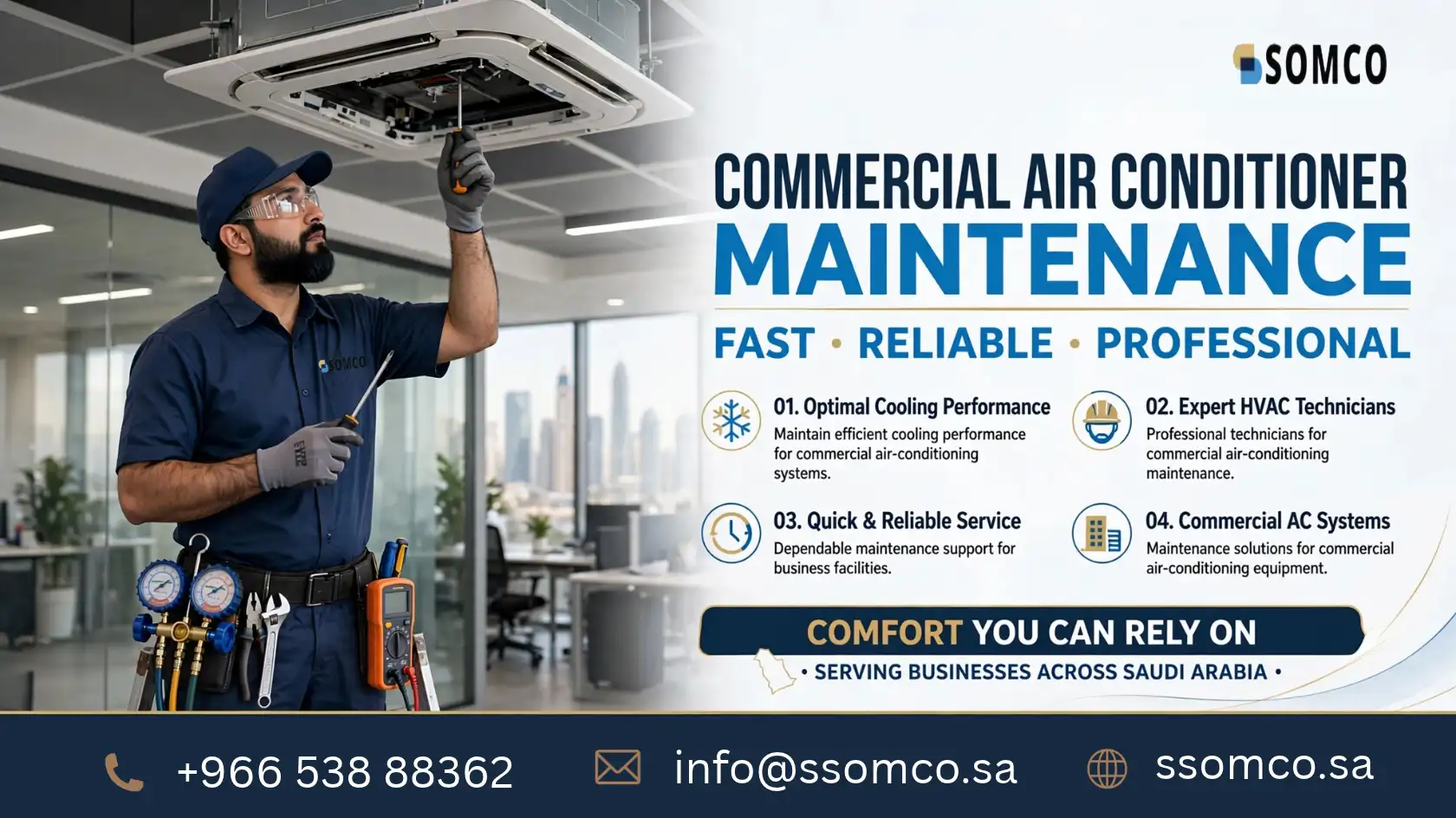
Commercial air conditioner maintenance is essential for keeping offices, shopping centres, hotels, warehouses, and industrial facilities comfortable and operational. In Saudi Arabia, where air conditioning systems operate under demanding weather conditions, regular maintenance helps businesses maintain cooling performance, improve equipment reliability, and reduce unexpected breakdowns.
Commercial air conditioning systems often operate for extended hours and serve large indoor spaces. Without proper inspection and servicing, problems such as weak airflow, water leakage, refrigerant-related faults, and inefficient cooling can affect daily business operations.
Whether you manage an office building, commercial property, or industrial facility, a planned air conditioning maintenance program helps protect your equipment and maintain suitable indoor conditions.
What Is Commercial Air Conditioner Maintenance?
Commercial air conditioner maintenance involves the regular inspection, cleaning, servicing, and repair of air conditioning equipment used in business and industrial environments.
Unlike residential AC maintenance, commercial maintenance often involves larger systems, multiple indoor units, centralized cooling equipment, and complex ventilation arrangements.
Commercial AC maintenance may include:
- Inspection of air conditioning units
- Cleaning or replacement of air filters
- Checking evaporator and condenser coils
- Inspecting electrical connections
- Checking refrigerant-related operating conditions
- Cleaning condensate drain lines
- Inspecting fans and motors
- Checking airflow and cooling performance
- Testing thermostats and control systems
- Identifying potential mechanical problems
The maintenance requirements depend on the equipment type, operating hours, building conditions, and manufacturer recommendations.
Types of Commercial Air Conditioning Systems
Different commercial properties use different air conditioning systems depending on their building size, cooling requirements, and operational needs.
1. Central Air Conditioning Systems
Central air conditioning systems provide cooling through a centralized arrangement that distributes conditioned air throughout a building.
They are commonly used in large offices, hotels, shopping centres, and commercial complexes.
Maintenance may include:
- Inspecting central cooling equipment
- Checking air handling units
- Cleaning filters and coils
- Inspecting ductwork
- Checking control systems
- Reviewing airflow distribution
2. Package Air Conditioning Units
Package units combine major air conditioning components into a single system. They are commonly installed on rooftops or designated outdoor areas of commercial properties.
Regular servicing helps maintain cooling performance and identify equipment-related problems.
3. Split Air Conditioning Systems
Split AC systems consist of indoor and outdoor units. They are commonly found in offices, small commercial spaces, retail shops, and individual rooms.
Maintenance includes filter cleaning, coil inspection, drainage checks, and performance testing.
4. VRF and VRV Air Conditioning Systems
Variable Refrigerant Flow (VRF) and Variable Refrigerant Volume (VRV) systems provide cooling to multiple indoor units through a connected refrigerant network.
These systems are used in commercial buildings that require flexible temperature control across different zones.
Maintenance may involve checking indoor and outdoor units, electrical connections, refrigerant-related conditions, drainage, and system controls.
5. Chilled Water Air Conditioning Systems
Chilled water systems use chillers to produce cooled water that circulates through air handling units or other cooling equipment.
They are commonly used in large commercial and industrial facilities.
Maintenance requirements may include chiller inspections, pump checks, water-system inspections, cooling tower maintenance where applicable, and air handling unit servicing.
Why Is Commercial Air Conditioner Maintenance Important?
Commercial air conditioning systems are important building assets. Regular maintenance helps businesses manage equipment condition and maintain comfortable indoor environments.
1. Maintains Cooling Performance
Dirty filters, blocked coils, and airflow problems can affect cooling performance. Regular servicing helps identify these issues and maintain suitable system operation.
2. Helps Reduce Unexpected Breakdowns
Routine inspections can identify developing equipment problems before they cause major operational interruptions.
3. Supports Energy Efficiency
Poorly maintained air conditioning systems may consume more energy because of restricted airflow, dirty components, or incorrect operating conditions.
Proper maintenance helps identify conditions that may contribute to unnecessary energy consumption.
4. Improves Indoor Comfort
Well-maintained air conditioning systems help maintain more consistent indoor temperatures and suitable airflow for employees, customers, and visitors.
5. Protects Equipment
Regular servicing supports the condition of important components, including motors, fans, coils, electrical connections, and drainage systems.
6. Supports Business Operations
A properly maintained cooling system helps reduce the likelihood of unexpected AC-related disruptions in offices, retail spaces, hotels, and industrial facilities.
Commercial AC Maintenance Services for Different Industries
Every commercial property has different cooling requirements. A suitable maintenance plan should consider the type of facility, equipment configuration, and operating schedule.
Office Buildings
Office buildings require consistent cooling to maintain comfortable workspaces, meeting rooms, reception areas, and shared facilities.
Commercial AC maintenance may include filter cleaning, thermostat checks, airflow inspections, and servicing of indoor and outdoor units.
Shopping Centres and Retail Stores
Retail properties often have multiple cooling zones and high visitor traffic. Regular maintenance helps maintain suitable temperatures across customer areas, shops, and common spaces.
Hotels and Hospitality Facilities
Hotels depend on reliable air conditioning in guest rooms, reception areas, restaurants, and other shared spaces.
Maintenance planning should consider different equipment types and the operating requirements of each area.
Warehouses and Logistics Facilities
Warehouses may experience significant heat accumulation due to building size, roof exposure, machinery, and daily activities.
Suitable cooling and ventilation maintenance helps maintain the required indoor conditions for employees and operations.
Industrial Facilities
Factories and industrial buildings may require specialized HVAC and cooling systems to manage machinery heat, ventilation, and environmental conditions.
Maintenance should reflect the equipment specifications and industrial operating requirements.
Healthcare and Educational Buildings
Healthcare facilities and educational institutions require carefully planned HVAC maintenance to support indoor environmental conditions and building operations.
Commercial Air Conditioner Preventive Maintenance Checklist
Preventive maintenance involves planned inspections and servicing designed to monitor equipment condition and identify potential problems.
A commercial AC maintenance checklist may include:
Maintenance Activity | Purpose |
Air filter inspection | Identify dust accumulation and airflow restrictions |
Evaporator coil cleaning | Maintain heat transfer performance |
Condenser coil inspection | Check outdoor heat-rejection components |
Drain line inspection | Identify blockages and water leakage risks |
Electrical connection checks | Identify loose or damaged connections |
Fan and motor inspection | Check mechanical operation |
Thermostat testing | Review temperature control |
Airflow inspection | Identify uneven air distribution |
Refrigerant-related checks | Identify abnormal operating conditions |
System performance review | Assess overall cooling operation |
The exact maintenance schedule should be based on manufacturer recommendations, equipment usage, environmental conditions, and the facility’s operating requirements.
Common Commercial Air Conditioning Problems
Commercial AC systems can develop different problems over time. Identifying the symptoms early can help businesses arrange suitable inspection and repair work.
1. Air Conditioner Not Cooling Properly
Insufficient cooling may result from dirty filters, airflow restrictions, equipment faults, incorrect settings, or refrigerant-related problems.
2. Weak Airflow
Weak airflow may be associated with blocked filters, fan problems, ductwork restrictions, or air distribution issues.
3. Water Leakage
Water leakage can occur because of blocked condensate drains, drainage problems, or condensation-related issues.
4. Unusual Noise
Unusual sounds may indicate loose components, fan problems, mechanical wear, or other equipment faults.
5. Unpleasant Odours
Unpleasant smells may be related to moisture accumulation, dirty filters, or contamination in certain system components.
6. Frequent System Shutdowns
Repeated shutdowns may be caused by electrical faults, overheating, control problems, or other equipment-related conditions.
A qualified technician should inspect the system to identify the actual cause before carrying out repairs.
Commercial AC Maintenance vs. AC Repair
Maintenance and repair are related but serve different purposes.
Commercial AC Maintenance | |
Planned inspections and servicing | Addresses an existing equipment problem |
Helps identify potential faults | Diagnoses and corrects faults |
Includes filter and component cleaning | May involve replacing or repairing damaged components |
Supports regular equipment care | Restores required system operation |
Can be scheduled periodically | Usually arranged when a fault occurs |
A structured maintenance program helps businesses monitor equipment condition, while repair services address problems that require corrective work.
How Often Should Commercial Air Conditioners Be Maintained?
The maintenance frequency depends on the type of air conditioning system, equipment usage, operating environment, and manufacturer recommendations.
Factors that may influence maintenance frequency include:
- Daily operating hours
- Outdoor temperature and dust exposure
- Building occupancy
- Cooling demand
- Equipment age and condition
- Type of HVAC system
- Manufacturer maintenance instructions
Facilities with continuous operations or demanding environmental conditions may require more frequent inspections than systems with limited usage.
A professional assessment can help establish a suitable preventive maintenance schedule.
How to Choose a Commercial AC Maintenance Company in Saudi Arabia
Selecting the right maintenance provider is important for managing commercial cooling equipment.
Consider the following factors before choosing a company.
Technical Experience
Look for a provider with knowledge of commercial air conditioning systems and the equipment installed in your property.
Range of HVAC Services
Check whether the company can support your requirements, including AC maintenance, HVAC servicing, chiller maintenance, VRF systems, and related technical services.
Preventive Maintenance Planning
A suitable provider should be able to explain inspection schedules, maintenance activities, reporting procedures, and equipment monitoring.
Safety Procedures
Maintenance activities should follow appropriate technical and workplace safety procedures.
Clear Service Scope
Review the quotation carefully to understand the systems covered, maintenance tasks, exclusions, responsibilities, and commercial terms.
Suitable Maintenance Support
Choose a provider whose services and operating arrangements match your building’s requirements.
Commercial Air Conditioner Maintenance Services by SSOMCO
SSOMCO provides HVAC and maintenance-related services for commercial and industrial facilities in Saudi Arabia.
Its service areas include:
- Commercial air conditioning maintenance
- HVAC installation and maintenance
- Chiller installation and maintenance
- VRF system installation and maintenance
- MEP maintenance services
- Building maintenance
- Air duct cleaning
Businesses can discuss their commercial cooling requirements with SSOMCO to identify suitable maintenance services based on their building type, installed equipment, and operational needs.
Whether you manage an office, retail property, warehouse, or industrial facility, a clearly defined maintenance scope helps organize servicing and support the condition of your air conditioning systems.
Visit the SSOMCO website or contact the team to discuss your requirements and request a quotation.
Conclusion
Commercial air conditioner maintenance is essential for businesses that depend on reliable cooling and ventilation systems. Regular inspection, cleaning, servicing, and timely repairs help maintain equipment performance, support indoor comfort, and reduce avoidable operational disruptions.
In Saudi Arabia, high temperatures and demanding building operations make planned HVAC maintenance particularly important for commercial and industrial facilities.
Choosing a suitable maintenance provider and establishing a preventive maintenance schedule can help businesses manage their cooling equipment more effectively.
SSOMCO provides HVAC and maintenance-related services for commercial and industrial requirements. Contact SSOMCO to discuss your commercial air conditioning maintenance needs and request a suitable service quotation.
Frequently Asked Questions
Commercial air conditioner maintenance involves inspecting, cleaning, servicing, and maintaining air conditioning equipment used in offices, retail spaces, hotels, warehouses, and industrial facilities.
It may include filter cleaning, coil inspection, drain line checks, electrical inspections, fan and motor checks, thermostat testing, airflow inspection, and overall system performance assessment.
Saudi Arabia's high temperatures can increase cooling demand and place additional operating loads on air conditioning equipment. Regular maintenance helps businesses monitor equipment condition and maintain suitable cooling performance.
Service frequency depends on the system type, operating hours, environmental conditions, manufacturer recommendations, and building requirements. A preventive maintenance plan can help determine appropriate inspection intervals.
Maintenance involves planned inspections and servicing to monitor equipment condition. Repair focuses on diagnosing and correcting existing faults or damaged components.
Yes. Maintenance can identify issues such as dirty filters, restricted airflow, and poorly operating components that may contribute to higher energy consumption. Actual savings depend on the system and its operating conditions.
Offices, shopping centres, hotels, restaurants, warehouses, educational institutions, healthcare buildings, and industrial facilities can all require regular air conditioning maintenance.
SSOMCO provides HVAC and maintenance-related services, including air conditioning maintenance, chiller services, VRF system maintenance, and building maintenance for commercial and industrial requirements.
You can contact SSOMCO through its website at https://ssomco.sa/ to discuss your facility's cooling requirements and request a suitable quotation.
