
 Blog
Imagine your office air conditioning suddenly stops working during a busy working day. Employees become uncomfortable, customers may leave, and your business operations can be disrupted. For commercial buildings, air conditioning is not just about comfort—it is an important part of maintaining a functional indoor environment.
This is why commercial air conditioning maintenance should be an essential part of every facility management plan.
Regular AC maintenance helps businesses identify equipment issues, maintain cooling performance, plan repairs, and manage their air conditioning systems more effectively. From office buildings and hotels to retail spaces and industrial facilities, a structured maintenance approach can help reduce unexpected disruptions.
In this guide, we explain why AC maintenance matters, which maintenance tasks businesses should consider, and how to choose the right maintenance provider.
What Is Commercial Air Conditioning Maintenance?
Commercial air conditioning maintenance involves inspecting, servicing, and maintaining the cooling systems used in business premises and commercial properties.
Unlike a small residential unit, a commercial building may have multiple air conditioning systems operating across different areas. These systems may require coordinated inspections, scheduled servicing, maintenance records, and timely corrective work.
Depending on the equipment and agreed service scope, commercial AC maintenance may include:
- Inspecting air conditioning units and system components.
- Checking and cleaning applicable air filters.
- Inspecting airflow and cooling performance.
- Checking condensate drainage.
- Inspecting accessible electrical and mechanical components.
- Checking thermostats and system controls.
- Identifying faults and recommending corrective maintenance.
- Recording completed maintenance activities.
The exact maintenance requirements depend on the equipment type, manufacturer recommendations, building usage, and operating conditions.
Why Is Regular AC Maintenance Important for Businesses?
1. Maintain Consistent Cooling Performance
Commercial buildings often depend on air conditioning throughout the working day. Poor airflow, dirty filters, or equipment faults can affect the system’s ability to maintain comfortable indoor temperatures.
Routine inspections help identify potential problems and determine which maintenance activities are needed to support system performance.
2. Reduce the Risk of Unexpected Breakdowns
An air conditioning fault can disrupt daily business operations, particularly during periods of high cooling demand.
Preventive maintenance helps identify developing issues before they become more serious. Although no maintenance plan can eliminate every breakdown, addressing problems early can reduce some avoidable disruptions.
3. Support Energy Efficiency
Air conditioning systems may consume more energy when operating with restricted airflow, dirty components, or unresolved faults.
Appropriate maintenance can help identify these problems and support efficient system operation. Actual energy consumption depends on several factors, including equipment condition, building insulation, occupancy, controls, and outdoor temperatures.
4. Protect Your Equipment Investment
Commercial AC equipment represents a significant investment. Regular inspections help identify wear, deterioration, and servicing requirements that could affect equipment reliability.
Addressing maintenance needs promptly supports better equipment management and may help prevent avoidable damage.
5. Improve Maintenance Planning
A planned maintenance schedule gives facility managers greater visibility into upcoming servicing requirements.
Instead of waiting for a breakdown, businesses can schedule inspections, prioritize repairs, maintain equipment records, and coordinate maintenance activities around their operating hours.
6. Support a Comfortable Indoor Environment
Comfortable indoor temperatures matter in offices, retail stores, hotels, and other customer-facing facilities.
Properly maintained air conditioning systems help support indoor comfort by allowing potential cooling and airflow issues to be identified and addressed.
Common AC Problems in Commercial Buildings
Recognizing common warning signs can help facility managers arrange inspections before problems become more disruptive.
Air Conditioner Not Cooling Properly
When an AC system fails to provide sufficient cooling, possible causes include restricted airflow, control problems, refrigerant-related issues, or equipment faults.
A qualified technician should inspect the system to identify the actual cause rather than replacing components unnecessarily.
Weak Airflow from Vents
Weak airflow may indicate dirty filters, duct restrictions, fan problems, or other system issues.
Inspecting the relevant components can help determine whether cleaning, repairs, or additional investigation is required.
Unusual Noise or Vibration
Grinding, rattling, or unusual vibration may indicate a mechanical issue or loose component.
Prompt inspection can help identify the source of the noise and determine the appropriate maintenance action.
Water Leakage Around AC Units
Water leakage may be associated with blocked condensate drains, drainage faults, or other equipment problems.
The system should be inspected to identify the cause and prevent continued leakage or damage to surrounding areas.
AC System Switching On and Off Frequently
Frequent cycling can be associated with control issues, equipment faults, incorrect system operation, or other underlying problems.
Professional troubleshooting can help determine the cause and identify suitable corrective action.
Essential Commercial AC Maintenance Checklist
A structured maintenance checklist helps businesses organize inspections and track equipment condition.
Maintenance Task | Why It Matters |
Air filter inspection | Helps identify restrictions caused by accumulated dust and debris. |
Cooling performance checks | Helps identify problems affecting the system’s ability to cool. |
Airflow inspection | Helps identify possible airflow restrictions or fan-related issues. |
Drainage inspection | Helps identify blockages and condensate leakage risks. |
Electrical component inspection | Helps identify signs of damage or abnormal operation. |
Fan and motor inspection | Helps identify unusual noise, vibration, or operating concerns. |
Thermostat and control checks | Helps verify appropriate system response and temperature control. |
Maintenance record updates | Helps track completed work and outstanding issues. |
Maintenance activities should be selected according to the installed equipment, manufacturer instructions, site conditions, and the qualifications required for each task.
How Often Should Commercial AC Systems Be Maintained?
There is no universal maintenance schedule for every commercial air conditioning system.
The appropriate frequency depends on factors such as:
- The type and age of the equipment.
- Manufacturer recommendations.
- Daily operating hours.
- Building occupancy and usage.
- Dust levels and environmental conditions.
- Previous maintenance history.
- The importance of the system to business operations.
Facilities with long operating hours or demanding cooling requirements may need a different maintenance schedule from buildings with limited usage.
A professional assessment can help establish an appropriate maintenance plan for your property.
Preventive Maintenance vs. Emergency AC Repairs
Understanding the difference between preventive and reactive maintenance can help businesses make better maintenance decisions.
Preventive AC Maintenance
Preventive maintenance involves planned inspections and servicing intended to identify potential issues before equipment fails.
Its potential benefits include:
- More organized maintenance scheduling.
- Earlier identification of developing faults.
- Better tracking of equipment condition.
- Improved coordination of maintenance activities.
- Reduced risk of certain avoidable disruptions.
Reactive AC Maintenance
Reactive maintenance occurs after equipment develops a fault or stops operating properly.
Depending on the issue, it may require troubleshooting, component repairs, replacement parts, or additional inspection. Urgent repairs can also be more difficult to coordinate when a building is occupied or operating at full capacity.
For many commercial facilities, a combination of planned preventive maintenance and timely corrective repairs provides a practical approach to managing air conditioning systems.
How to Choose the Right AC Maintenance Company
Selecting a suitable maintenance provider is important for businesses that rely on commercial cooling systems.
Before appointing a contractor, consider the following factors.
Experience with Commercial HVAC Systems
Choose a provider that understands the types of air conditioning equipment installed at your property and the maintenance requirements associated with them.
Clearly Defined Service Scope
Make sure the quotation specifies which equipment, inspection tasks, servicing activities, and corrective work are included.
Suitable Maintenance Scheduling
The provider should be able to discuss a maintenance schedule that reflects your equipment, operating hours, and facility requirements.
Maintenance Documentation
Service records help facility managers track completed work, identify recurring faults, and plan future maintenance activities.
Transparent Quotation
A suitable quotation should reflect the number and type of AC units, property conditions, maintenance requirements, and agreed service scope.
Coordination with Other Building Services
For properties with multiple maintenance requirements, coordinating AC maintenance with other building and HVAC services may simplify maintenance planning.
How SSOMCO Supports Commercial Air Conditioning Maintenance
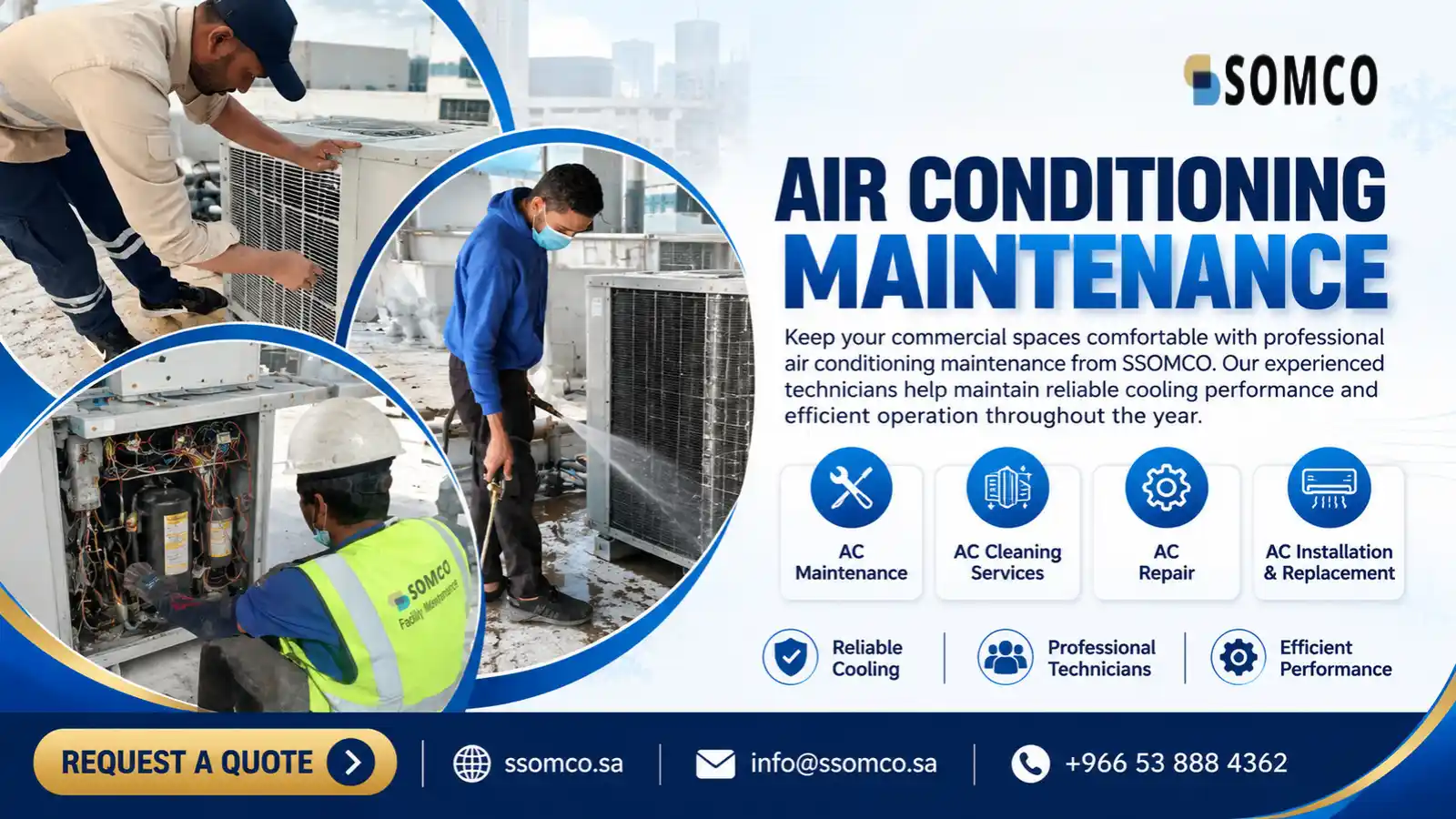
SSOMCO provides HVAC and maintenance solutions for commercial and industrial facilities.
We understand that maintaining building systems requires attention to equipment condition, operational requirements, and maintenance planning.
Our team can discuss your air conditioning maintenance requirements and help identify an appropriate service scope for your property.
Whether you manage an office building, retail property, hotel, or industrial facility, contact SSOMCO to discuss the available maintenance support for your equipment.
Our services may be coordinated with other applicable HVAC and building maintenance activities, depending on your requirements and the agreed scope of work.
Frequently Asked Questions
Depending on the service scope, commercial AC maintenance may include filter inspection, airflow checks, drainage inspection, system performance checks, electrical and mechanical inspections, and identifying faults that require corrective action.
Appropriate maintenance can help identify problems that affect system performance and energy use. However, the amount of any energy savings depends on the equipment condition, building requirements, and maintenance performed.
Preventive maintenance helps identify potential issues before equipment fails. For many businesses, planned servicing can improve maintenance organization and reduce the risk of certain unexpected disruptions.
Offices, hotels, retail properties, healthcare facilities, educational buildings, and industrial facilities may all require air conditioning maintenance. The maintenance approach depends on the installed equipment and the property's operating requirements.
Contact SSOMCO with your property type, approximate number of AC units, equipment details, and maintenance requirements. Our team can discuss the appropriate service scope and quotation.
Conclusion:
Reliable air conditioning is important for maintaining comfortable indoor environments and supporting daily business operations.
Regular inspections, appropriate servicing, and timely repairs help businesses manage equipment condition and plan maintenance more effectively.
Rather than waiting for an AC breakdown, facility managers can take a proactive approach by reviewing their equipment, establishing suitable maintenance schedules, and working with an appropriate maintenance provider.
Looking for commercial air conditioning maintenance services? Contact SSOMCO to discuss your requirements and request a quotation for your facility.
SSOMCO – Saudi Specialized Operations & Maintenance Company
Phone: +966 538884362
Email: info@ssomco.sa
Request a Quote Today and discuss your commercial AC maintenance requirements with our team.
