

 Blog
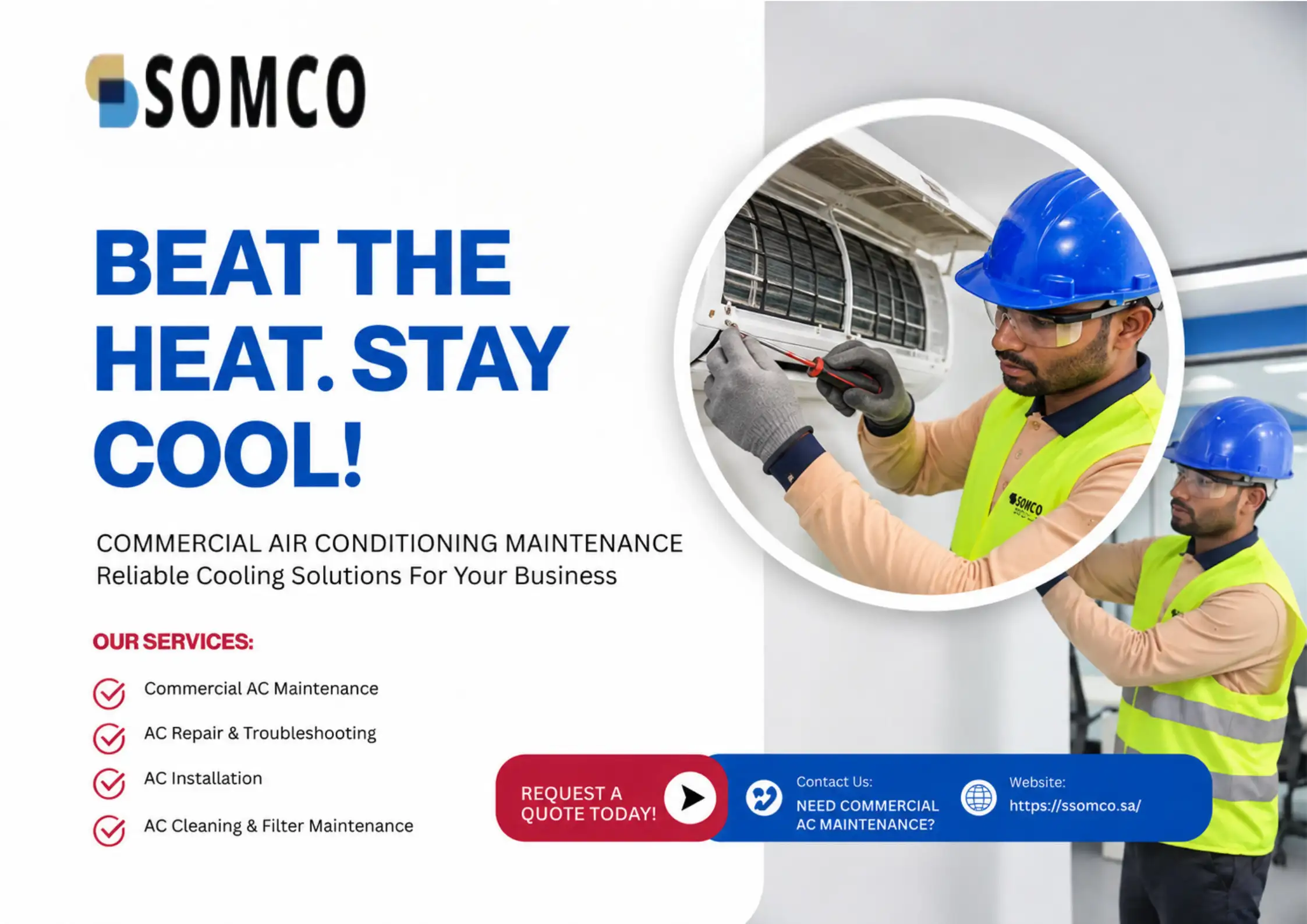
Commercial air conditioning systems play an essential role in maintaining comfortable and productive environments across offices, shopping centres, hotels, restaurants, warehouses, and industrial facilities. In Saudi Arabia, where cooling systems often operate for extended periods, regular maintenance is important for keeping commercial properties comfortable and air conditioning equipment in suitable operating condition.
Without a structured maintenance programme, commercial AC systems can develop problems such as reduced cooling performance, restricted airflow, water leakage, unusual noise, and unexpected equipment breakdowns. These issues can affect daily business operations and lead to additional repair requirements.
Professional commercial air conditioning maintenance focuses on inspecting, cleaning, testing, and maintaining cooling equipment according to its design, operating conditions, and manufacturer recommendations.
This guide explains the importance of commercial AC maintenance, the equipment involved, essential maintenance activities, recommended planning considerations, and how businesses can choose a suitable maintenance provider.
What Is Commercial Air Conditioning Maintenance?
Commercial air conditioning maintenance is the planned inspection, servicing, cleaning, and repair of cooling systems installed in business and commercial properties.
Unlike residential AC maintenance, commercial maintenance often involves multiple indoor and outdoor units, larger cooling capacities, centralised equipment, and complex air distribution systems.
The maintenance requirements depend on the building’s size, equipment type, operating hours, occupancy, and environmental conditions.
A commercial air conditioning maintenance programme may include:
- Inspecting air conditioning equipment and operating conditions.
- Cleaning or replacing air filters when required.
- Inspecting evaporator and condenser coils.
- Checking condensate drainage systems.
- Inspecting electrical connections and control components.
- Checking thermostats and temperature controls.
- Inspecting fans, motors, and belts where applicable.
- Checking refrigerant circuits for signs of leakage.
- Identifying abnormal noise, vibration, and cooling problems.
- Recording maintenance findings and recommending corrective work.
The objective is to identify developing problems, maintain suitable cooling performance, and reduce the likelihood of avoidable equipment failures.
Why Is Commercial AC Maintenance Important?
Commercial properties depend on reliable air conditioning to support employees, customers, visitors, equipment, and daily business activities.
A neglected cooling system can affect indoor comfort and create operational difficulties. Regular maintenance helps businesses manage these risks through planned inspections and timely corrective action.
1. Maintain Consistent Cooling Performance
Dust accumulation, restricted filters, dirty coils, and airflow problems can affect the cooling performance of an air conditioning system.
Routine maintenance helps identify these conditions and determine whether cleaning, adjustment, or repair is required.
Maintaining appropriate airflow and system operation is particularly important in commercial spaces with high occupancy or extended operating hours.
2. Reduce Unexpected Equipment Breakdowns
Commercial AC systems may experience problems involving fans, motors, electrical components, controls, drainage, and refrigerant circuits.
Regular inspection can help identify visible wear, abnormal operating conditions, and developing faults before they result in more serious disruption.
Preventive maintenance cannot eliminate every breakdown, but it provides a structured way to identify and address potential problems.
3. Support Energy Efficiency
Air conditioning equipment that operates with restricted airflow, dirty heat-transfer surfaces, or incorrect control settings may consume more energy than necessary.
Maintenance helps identify conditions that can affect equipment performance.
Depending on the system, this may involve filter inspection, coil cleaning, airflow checks, control verification, and reviewing operating conditions.
Actual energy savings depend on the equipment, building conditions, existing faults, and maintenance work performed.
4. Improve Indoor Comfort
Commercial AC maintenance also supports comfortable indoor environments.
Blocked filters, drainage problems, damaged components, and poor airflow can contribute to temperature inconsistencies and occupant complaints.
Inspecting the air conditioning system and its distribution components helps identify potential causes of these issues.
5. Protect Equipment and Plan Replacement
Commercial air conditioning equipment represents a significant investment.
A maintenance history can help facility managers understand equipment condition, identify recurring faults, plan repairs, and assess when replacement may be more practical than continued maintenance.
6. Support Business Continuity
Unexpected air conditioning failures can interrupt activities in offices, retail stores, restaurants, hotels, and other commercial properties.
Planned servicing allows maintenance teams to organise inspections and corrective work around operational requirements wherever possible.
Types of Commercial Air Conditioning Systems That Require Maintenance
Different commercial properties use different air conditioning technologies. Maintenance procedures should be adapted to the equipment installed at each location.
1. Split Air Conditioning Systems
Commercial split AC systems are commonly used in individual offices, shops, meeting rooms, and smaller commercial spaces.
Maintenance activities may include:
- Inspecting and cleaning air filters.
- Checking indoor and outdoor unit condition.
- Inspecting evaporator and condenser coils.
- Checking condensate drainage.
- Inspecting fan operation.
- Checking electrical connections and controls.
- Reviewing cooling performance.
2. Ducted Air Conditioning Systems
Ducted systems distribute conditioned air through a network of ducts and air outlets.
Maintenance may involve:
- Inspecting filters and filter housings.
- Checking air handling and fan operation.
- Inspecting accessible ductwork for damage or leakage.
- Checking supply and return air grilles.
- Inspecting dampers and controls.
- Checking airflow distribution.
- Inspecting condensate drainage.
Duct cleaning is a separate activity from routine AC servicing and should be assessed according to the ductwork condition and project requirements.
3. Packaged Air Conditioning Units
Packaged AC units combine major cooling components within a single equipment enclosure. They are used in various commercial and industrial applications.
Maintenance may include:
- Inspecting evaporator and condenser sections.
- Checking air filters.
- Inspecting fan motors and belts where fitted.
- Checking electrical components.
- Inspecting refrigerant lines and operating conditions.
- Checking drainage arrangements.
- Reviewing thermostat and control operation.
4. VRF and VRV Air Conditioning Systems
Variable Refrigerant Flow (VRF) and Variable Refrigerant Volume (VRV) systems are used in commercial buildings requiring multiple indoor units and flexible zone control.
Their maintenance requirements may include:
- Inspecting indoor and outdoor units.
- Cleaning filters.
- Checking refrigerant piping and insulation.
- Inspecting condensate drainage.
- Reviewing controller settings and system alarms.
- Checking fan and electrical components.
- Investigating abnormal operating conditions.
Specialist diagnostics should follow the equipment manufacturer’s procedures and system-specific requirements.
5. Central Chiller-Based Air Conditioning Systems
Large commercial properties may use central chilled-water systems to provide cooling to air handling units and fan coil units.
Maintenance may involve several connected components, including:
- Chiller equipment.
- Chilled-water pumps.
- Air handling units.
- Fan coil units.
- Filters and coils.
- Control valves and sensors.
- Chilled-water piping and strainers.
Chiller maintenance requires equipment-specific procedures and should be coordinated with the wider building HVAC maintenance programme.
Commercial Air Conditioning Maintenance Checklist
A structured checklist helps facility managers and maintenance teams organise inspections and document equipment conditions.
The following activities are common considerations. The exact tasks depend on the equipment type, manufacturer instructions, maintenance agreement, and site conditions.
Indoor AC Unit Inspection
- Inspect air filters and clean or replace them when required.
- Check evaporator coils for dust accumulation.
- Inspect fan blades and blower operation.
- Check condensate drain pans and drainage lines.
- Inspect indoor unit casing and accessible components.
- Check thermostat and controller operation.
- Investigate abnormal noise or vibration.
Outdoor AC Unit Inspection
- Inspect condenser coils and clean when required.
- Check outdoor fan operation.
- Remove obstructions around the equipment.
- Inspect visible refrigerant piping and insulation.
- Check equipment mounting and external condition.
- Inspect electrical components using appropriate safety procedures.
- Review operating conditions and identify abnormal performance.
Electrical and Control Inspection
- Inspect accessible electrical connections.
- Check contactors, relays, and other relevant components.
- Review thermostat and controller settings.
- Check safety devices where applicable.
- Investigate electrical faults and abnormal operating readings.
Electrical inspection and repair should be performed by appropriately qualified personnel using suitable safety procedures.
Airflow and Cooling Performance Checks
- Inspect return-air and supply-air paths.
- Check for blocked grilles or diffusers.
- Review fan operation.
- Measure relevant operating temperatures.
- Investigate uneven cooling between areas.
- Check control settings against the building’s operating requirements.
Drainage Inspection
- Inspect condensate drain pans.
- Check drainage pipes for blockage.
- Look for signs of water leakage.
- Inspect condensate pumps where installed.
- Confirm that condensate can drain correctly.
Drainage issues should be addressed promptly to help prevent water damage and related building problems.
How Often Should Commercial Air Conditioning Be Serviced?
There is no single maintenance frequency suitable for every commercial AC system.
The recommended schedule depends on equipment specifications, operating hours, building conditions, dust exposure, occupancy, and maintenance history.
The following table is an illustrative planning guide, not a universal maintenance standard.
Maintenance activity | Example planning frequency |
Visual equipment inspection | Monthly |
Filter inspection | Monthly or as conditions require |
Condensate drain inspection | Monthly to quarterly |
Electrical and control inspection | Quarterly or according to manufacturer guidance |
Coil condition inspection | Quarterly or according to operating conditions |
Detailed system performance review | Periodically, based on equipment requirements |
Annual equipment condition assessment | Annually |
Commercial properties in dusty environments or buildings operating air conditioning for long hours may require more frequent attention.
The maintenance programme should always follow manufacturer instructions and the actual condition of the equipment.
Preventive Maintenance vs Corrective Maintenance
Commercial air conditioning maintenance generally involves two important approaches.
Preventive Maintenance
Preventive maintenance involves scheduled inspections and servicing designed to identify potential problems before equipment failure occurs.
Typical activities include:
- Filter inspection and replacement.
- Coil inspection and cleaning.
- Drainage checks.
- Electrical inspection.
- Control and thermostat checks.
- Fan and motor inspection.
- Equipment condition reporting.
Preventive maintenance helps businesses organise maintenance activities rather than relying entirely on breakdown repairs.
Corrective Maintenance
Corrective maintenance involves identifying and repairing faults that have already developed.
Examples include:
- Repairing faulty electrical components.
- Addressing refrigerant leaks.
- Replacing damaged fans or motors.
- Resolving drainage problems.
- Repairing defective control components.
- Investigating insufficient cooling.
Corrective work should be based on proper fault diagnosis and client approval where required.
For commercial properties, a combination of preventive and corrective maintenance provides a more organised approach to equipment management.
Commercial AC Maintenance for Different Business Sectors
Each commercial sector has different cooling requirements, operating schedules, and building usage patterns.
Office Buildings
Offices require comfortable indoor conditions for employees, visitors, and meeting activities.
Maintenance should consider workstations, meeting rooms, reception areas, and shared spaces.
Shopping Centres and Retail Stores
Retail properties often have varying occupancy levels and extended operating hours.
Maintenance planning should consider different zones, customer comfort, and the effect of servicing on store operations.
Hotels and Hospitality Properties
Hotels require attention to guest rooms, reception areas, restaurants, meeting spaces, and other shared facilities.
Maintenance should be organised to minimise disruption to guest activities.
Restaurants and Commercial Kitchens
Restaurants have different cooling requirements for dining areas, back-of-house spaces, and kitchen environments.
Air conditioning maintenance should be coordinated with ventilation and kitchen exhaust requirements. Kitchen hood and grease duct cleaning are separate services and should not be treated as ordinary AC maintenance.
Warehouses and Industrial Facilities
Warehouses and industrial properties may have large spaces, specialised equipment, and varying cooling requirements.
Maintenance planning should consider equipment accessibility, operating schedules, environmental conditions, and the cooling needs of specific areas.
What Is Included in a Commercial AC Maintenance Contract?
A Commercial Air Conditioning Maintenance Contract, also known as an AC AMC, can help businesses organise recurring servicing and maintenance responsibilities.
However, the exact scope differs between providers and agreements.
A maintenance contract may specify:
- Equipment inventory and covered locations.
- Scheduled preventive maintenance visits.
- Inspection and cleaning activities.
- Corrective maintenance arrangements.
- Breakdown reporting procedures.
- Service response arrangements.
- Maintenance documentation and reports.
- Labour and spare-parts coverage.
- Contract duration and renewal conditions.
- Exclusions and additional charges.
Before signing an agreement, businesses should confirm the number of visits, covered equipment, repair responsibilities, spare-parts policy, and any emergency support arrangements.
A clearly defined scope helps both the client and maintenance provider understand their responsibilities.
Common Signs That a Commercial AC System Needs Maintenance
Facility managers should pay attention to changes in equipment performance.
Some common warning signs include:
Insufficient cooling: The system runs but does not maintain the expected indoor temperature.
Weak airflow: Airflow from supply outlets appears lower than usual.
Water leakage: Water appears around indoor units, ceiling areas, or condensate drainage points.
Unusual noise: Fans, motors, or other components produce abnormal sounds.
Frequent cycling: Equipment switches on and off more frequently than expected.
Uneven temperatures: Some rooms or zones remain warmer or cooler than others.
Unusual operating behaviour: Controllers display alarms or the equipment does not respond correctly to settings.
These symptoms can have different causes. A qualified technician should inspect the system and identify the underlying issue before recommending repairs.
How to Choose a Commercial Air Conditioning Maintenance Company
Selecting a suitable maintenance provider is important for businesses managing multiple AC units or large HVAC installations.
Consider the following factors:
- Commercial experience: Look for experience with the types of air conditioning systems installed at your property.
- Technical capability: Confirm that the provider can maintain the relevant equipment and diagnose common faults.
- Maintenance planning: Ask whether the company can prepare a structured preventive maintenance schedule.
- Clear service scope: Review which inspection, cleaning, repair, and reporting activities are included.
- Documentation: Ask for maintenance reports that record completed tasks, findings, and recommendations.
- Contract transparency: Confirm labour, spare-parts coverage, exclusions, and additional charges.
- Operational coordination: Discuss how maintenance visits will be organised around business hours and site access requirements.
A suitable maintenance partner should understand the property’s operating needs and provide a clear approach to equipment inspection and servicing.
Commercial Air Conditioning Maintenance Services by SSOMCO
SSOMCO (Saudi Specialized Operations & Maintenance Company) provides operations and maintenance solutions for commercial and business environments.
Commercial air conditioning and HVAC maintenance are important considerations for facilities that depend on reliable cooling equipment and organised maintenance planning.
Depending on the agreed project scope, commercial AC maintenance requirements may involve equipment inspections, preventive servicing, performance checks, and coordination of corrective maintenance.
Businesses planning air conditioning maintenance should consider the number and type of installed units, operating schedules, site conditions, and required service coverage.
For more information, explore SSOMCO’s maintenance and facility services.
Have an upcoming maintenance requirement or commercial HVAC project? Contact SSOMCO to discuss your requirements and request a quotation.
Frequently Asked Questions About Commercial Air Conditioning Maintenance
Commercial air conditioning maintenance is the planned inspection, cleaning, servicing, and repair of AC equipment installed in offices, retail stores, hotels, restaurants, warehouses, and other commercial properties.
The maintenance frequency depends on equipment type, operating hours, environmental conditions, and manufacturer recommendations. High-use or dusty environments may require more frequent inspections and filter servicing.
It may include filter inspection, coil cleaning, drainage checks, electrical inspections, thermostat testing, airflow checks, fan inspection, and cooling performance assessment.
Commercial AC maintenance focuses primarily on air conditioning equipment and cooling performance. HVAC maintenance has a broader scope and may also include ventilation, air handling, chilled-water systems, and associated mechanical controls.
Preventive maintenance helps identify developing faults, maintain suitable operating conditions, organise servicing, and reduce the risk of unexpected equipment breakdowns.
An AC Annual Maintenance Contract is an agreement for planned air conditioning maintenance over a defined period. It specifies the equipment covered, maintenance visits, included activities, repair responsibilities, and applicable exclusions.
Maintenance can help identify conditions such as dirty filters, restricted airflow, and dirty coils that may affect system performance. The actual impact on electricity consumption depends on the equipment and the condition of the system.
Businesses should review the covered equipment, number of visits, maintenance checklist, labour and spare-parts coverage, breakdown response arrangements, exclusions, and reporting requirements.
No. AC cleaning is one part of maintenance. A complete maintenance programme may also include electrical checks, control inspections, drainage checks, operating measurements, and fault diagnosis.
Not automatically. Duct cleaning is a separate activity and should be included explicitly in the agreed service scope when required.
Conclusion
Commercial air conditioning maintenance is an important part of managing offices, retail properties, hotels, restaurants, warehouses, and other business facilities. Regular inspection, cleaning, servicing, and timely corrective work help businesses maintain suitable cooling conditions and manage the condition of their equipment.
A structured preventive maintenance programme can also help facility managers organise servicing activities, document equipment performance, and plan future maintenance requirements.
For commercial properties that depend on air conditioning throughout the year, choosing a suitable maintenance provider and establishing a clear service agreement are important steps towards better equipment management.
Contact SSOMCO to discuss commercial air conditioning maintenance requirements and request a quotation for your facility.

Commercial HVAC Installation: A Complete Guide For Business And Industrial Buildings - Best Air Duct And Kitchen Hood Cleaning Service Provider In KSA
November 8, 2026 2:53 pm[…] on the confirmed project scope, commercial HVAC requirements may involve air conditioning systems, chiller equipment, VRF and VRV systems, and related building maintenance […]