

 Blog
Managing a commercial building involves more than maintaining its physical structure. Businesses must coordinate technical maintenance, HVAC systems, cleaning, building operations, and other essential support services to keep their facilities operating effectively.
When these activities are handled by multiple contractors, facility managers may face communication gaps, inconsistent service standards, delayed maintenance, and complicated reporting.
Integrated Facility Management (IFM) provides a coordinated approach by bringing multiple facility services under one management structure. Instead of managing separate service providers independently, businesses can work with a central facility management partner to coordinate maintenance activities, service delivery, and operational performance.
For offices, hotels, commercial properties, industrial facilities and other large buildings, integrated facility management can simplify operations and improve visibility across different services.
In this guide, we explain what integrated facility management means, which services it can include, its benefits, how it works, and what businesses should consider when choosing an IFM provider.
What Is Integrated Facility Management?
Integrated Facility Management is an approach that combines multiple building management and support services under one coordinated management system.
It generally involves one primary service provider managing different facility functions through a unified operational structure, agreed service levels, reporting procedures, and performance monitoring.
These services may include:
- HVAC operation and maintenance.
- Mechanical, electrical and plumbing (MEP) maintenance.
- Building maintenance.
- Cleaning and housekeeping.
- Janitorial services.
- Waste management.
- Landscaping.
- Security and access management.
- Catering and hospitality support.
- Facility operations and maintenance coordination.
The exact services depend on the building, client requirements, and service agreement.
The main objective is to coordinate different facility functions so that maintenance, cleaning, and support activities work together rather than operating as disconnected services.
How Does Integrated Facility Management Work?
Traditional facility management may involve hiring separate companies for different services. For example, one contractor may manage HVAC maintenance, another may provide cleaning, and another may handle building repairs.
This arrangement can create additional coordination responsibilities for the facility management team.
Integrated Facility Management introduces a central management structure that coordinates the agreed services.
A typical IFM arrangement works through the following stages:
1. Facility Assessment
The provider reviews the building, its equipment, operational requirements, and existing maintenance arrangements.
The assessment may cover:
- Building infrastructure.
- HVAC and MEP equipment.
- Maintenance history.
- Cleaning requirements.
- Occupancy and operating hours.
- Existing service contracts.
- Operational challenges.
2. Service Planning
After assessing the facility, the provider develops a service delivery plan.
This may include preventive maintenance schedules, cleaning plans, resource requirements, reporting procedures, and service responsibilities.
3. Coordinated Service Delivery
Different teams perform their assigned activities under a shared management structure.
For example, HVAC technicians, building maintenance personnel and cleaning teams can coordinate their work according to building schedules and operational priorities.
4. Performance Monitoring
The provider monitors service delivery through agreed performance indicators, inspection records, and maintenance reports.
This helps facility managers evaluate whether the contracted services are meeting expectations.
5. Continuous Improvement
Operational reports and performance reviews help identify recurring problems, service gaps, and opportunities to improve facility operations.
Main Services Included in Integrated Facility Management
Integrated Facility Management can cover a wide range of technical and support services. These are generally grouped into hard services, soft services, and management support.
1. Hard Facility Management Services
Hard facility management services are directly connected to the physical building, infrastructure, and technical equipment.
These services help maintain building assets and support the safe and reliable operation of facilities.
HVAC Operation and Maintenance
HVAC systems are essential for maintaining suitable indoor temperatures and ventilation conditions.
Common activities may include:
- Air conditioning maintenance.
- HVAC preventive maintenance.
- Chiller maintenance.
- VRF and VRV system maintenance.
- Air handling unit inspections.
- Ventilation system maintenance.
- HVAC performance monitoring.
Mechanical, Electrical and Plumbing (MEP) Maintenance
MEP systems support the daily operation of commercial and industrial buildings.
Depending on the agreed scope, maintenance may include:
- Mechanical equipment inspections.
- Electrical system maintenance.
- Plumbing inspections and repairs.
- Pump and associated equipment maintenance.
- Building services inspections.
Specialist electrical, fire, and life-safety activities should be included only where appropriately qualified personnel and the required service scope are available.
Building Maintenance
Building maintenance helps preserve the condition and functionality of a property.
Typical activities may include:
- General building inspections.
- Minor repair coordination.
- Plumbing maintenance.
- Building component inspections.
- Maintenance of agreed building assets.
- Identification of defects requiring specialist attention.
Chiller and Cooling System Maintenance
Commercial properties may depend on central cooling systems to maintain indoor comfort.
Depending on equipment and contract requirements, services can include chiller inspections, operating condition monitoring and planned maintenance.
2. Soft Facility Management Services
Soft facility management services focus on cleanliness, hygiene and the day-to-day experience of people using a building.
These services help maintain organised and presentable working environments.
Commercial Cleaning Services
Cleaning is an important part of maintaining commercial buildings.
Activities may include:
- Office cleaning.
- Common-area cleaning.
- Floor cleaning.
- Surface cleaning.
- Washroom cleaning.
- Scheduled cleaning programmes.
Housekeeping and Janitorial Services
Housekeeping and janitorial support help maintain cleanliness across different areas of a facility.
The service scope may include routine cleaning, waste collection, replenishment of agreed consumables, and general housekeeping tasks.
Kitchen Hood and Air Duct Cleaning
Commercial kitchens and ventilation systems require appropriate cleaning and maintenance according to their design and operating requirements.
Services may include:
- Kitchen hood cleaning.
- Grease-filter cleaning.
- Accessible air duct cleaning.
- Ventilation component cleaning.
These specialist activities should be scheduled according to equipment requirements and the agreed service scope.
Catering and Food Services
Some integrated facility management arrangements include catering and food services for offices, workplaces and other commercial environments.
The scope may cover food preparation, meal services and catering coordination, subject to the provider’s capabilities and applicable food safety requirements.
Other services, such as security, landscaping, pest control, reception and waste management, may also form part of an IFM contract when included in the provider’s service portfolio.
3. Facility Management and Operational Support
Integrated facility management is not only about performing individual maintenance or cleaning tasks. It also involves coordinating people, resources, information, and service performance.
Management support may include:
- Facility operations coordination.
- Vendor coordination.
- Maintenance scheduling.
- Asset records and equipment inventories.
- Service reporting.
- Work order management.
- Contract administration.
- Performance monitoring.
- Budget and resource planning.
The availability of these services depends on the management model and the agreement between the client and provider.
Benefits of Integrated Facility Management
Businesses choose an integrated approach to improve coordination across their facility operations.
Here are some important benefits.
1. Centralised Service Management
Managing several contractors can require considerable time and administrative effort.
An integrated model creates a central coordination structure for the services included in the contract.
This gives facility managers a clearer view of service responsibilities and operational activities.
2. Improved Communication
When different service teams work under a coordinated management structure, communication can become more consistent.
For example, cleaning personnel can report a visible maintenance issue, which can then be assigned to the appropriate maintenance team.
3. Better Maintenance Planning
Integrated management helps coordinate preventive maintenance with other building activities.
Planned maintenance schedules can reduce conflicts between contractors and help facility managers organise work around building operating hours.
4. Improved Service Accountability
A central provider can be responsible for coordinating the agreed services and reporting performance.
Clear service-level agreements (SLAs) help define responsibilities, expected service standards, and performance requirements.
5. Better Operational Visibility
Consolidated reporting can help facility managers review:
- Completed maintenance activities.
- Open maintenance requests.
- Equipment condition.
- Cleaning inspection results.
- Recurring operational issues.
- Service performance.
- Outstanding recommendations.
This information supports more informed operational decisions.
6. Potential Cost Efficiencies
An integrated approach may create opportunities to reduce duplicated administrative activities, improve resource coordination, and identify inefficient processes.
However, actual cost savings depend on the contract structure, service scope, building requirements, and provider performance. Integration does not automatically guarantee lower costs.
7. More Consistent Service Standards
A shared management approach can establish consistent reporting, inspection procedures, and service expectations across different facility functions.
This helps businesses evaluate service quality more systematically.
Integrated Facility Management vs Traditional Facility Management
Both approaches aim to maintain buildings and support their operations. The main difference is how services are coordinated and managed.
Comparison | Traditional Facility Management | Integrated Facility Management |
Service management | Often managed separately | Coordinated management structure |
Contractors | Multiple independent providers may be involved | One primary provider coordinates agreed services |
Communication | May involve separate reporting channels | Centralised communication process |
Reporting | Different formats and systems | Consolidated reporting where agreed |
Maintenance planning | May be managed separately | Coordinated maintenance planning |
Accountability | Divided between providers | Central accountability for the integrated scope |
Performance monitoring | Separate service evaluations | Shared performance framework |
Traditional facility management is not necessarily inefficient. A business with a simple building or specialist requirements may benefit from separate service contracts.
Integrated Facility Management may be more suitable when a property requires several services and the organisation wants stronger coordination and centralised oversight.
Integrated Facility Management vs Bundled Facility Services
Integrated Facility Management and bundled services are related, but they are not always the same.
Bundled services generally combine multiple services into one commercial package.
Integrated Facility Management goes further by coordinating those services through shared planning, management processes, performance monitoring, and reporting.
For example, a company may purchase cleaning and maintenance services from one contractor without having an integrated maintenance schedule or common performance reporting.
A genuine integrated model should explain how different service teams communicate, how work is coordinated, and how performance is measured.
Industries That Benefit from Integrated Facility Management
Integrated Facility Management can support different types of properties, particularly those with multiple building systems and ongoing operational requirements.
Commercial Office Buildings
Office buildings require regular HVAC maintenance, cleaning, building repairs, and general operational support.
An integrated approach can help coordinate these activities around business hours and employee requirements.
Hotels and Hospitality Properties
Hotels operate multiple facility areas, including guest rooms, restaurants, kitchens, meeting spaces, and public areas.
Coordinated maintenance and cleaning can help maintain property standards while reducing unnecessary disruption to daily operations.
Shopping Malls and Retail Centres
Shopping malls contain shared facilities, retail units, public spaces and technical building systems.
Integrated management can help coordinate maintenance and cleaning activities across different areas.
Industrial Facilities
Industrial properties may require HVAC, MEP and building maintenance, alongside other operational support services.
The IFM scope should reflect the facility’s equipment, operational requirements and safety procedures.
Healthcare Facilities
Healthcare buildings have specialised requirements relating to cleanliness, ventilation, building systems and operational continuity.
Their IFM arrangements must account for applicable healthcare standards, infection-control procedures and specialist technical requirements.
Educational Institutions
Schools, colleges and universities may benefit from coordinated maintenance, cleaning and building support across classrooms, offices and shared spaces.
How to Implement an Integrated Facility Management Strategy
Implementing IFM requires planning and a clear understanding of the building’s requirements.
Businesses can follow these steps.
Step 1: Assess Existing Facility Operations
Review current service arrangements, contractors, equipment, maintenance history, and operational challenges.
Identify areas where separate service providers create unnecessary coordination work.
Step 2: Define the Required Services
Prepare a clear list of services that should be included in the integrated contract.
Separate essential services from optional or specialist requirements.
Step 3: Establish Service-Level Agreements
Define measurable service expectations for each service category.
Examples include:
- Preventive maintenance completion.
- Response and resolution targets.
- Cleaning inspection results.
- Maintenance reporting frequency.
- Equipment inspection completion.
- Outstanding work order levels.
The actual targets should be agreed upon according to the building’s needs and contract requirements.
Step 4: Select a Suitable IFM Provider
Evaluate the provider’s technical experience, workforce capability, service portfolio, reporting processes, and ability to coordinate multiple services.
Step 5: Plan Service Transition
Establish a transition plan covering equipment information, access arrangements, existing maintenance records, staff coordination and service commencement.
Step 6: Monitor Performance
Review reports and agreed KPIs regularly to understand whether the provider is meeting contractual expectations.
Step 7: Improve the Programme
Use performance information and operational feedback to identify service improvements and future maintenance priorities.
Important KPIs for Integrated Facility Management
Key Performance Indicators help organisations measure whether facility services are achieving their agreed objectives.
The following KPIs can be considered when developing an IFM performance framework.
KPI | What it measures |
Preventive maintenance completion | Percentage of scheduled tasks completed |
Work order response time | Time taken to acknowledge a maintenance request |
Work order resolution time | Time taken to resolve an assigned issue |
Equipment downtime | Duration of equipment unavailability |
Cleaning inspection score | Results of agreed cleaning quality inspections |
Repeat maintenance requests | Frequency of recurring faults |
SLA compliance | Performance against contractual service requirements |
Customer satisfaction | Feedback from building users and stakeholders |
KPIs should be measurable, clearly defined, and relevant to the contracted services. Each indicator should have an agreed measurement method and reporting frequency.
How to Choose the Right Integrated Facility Management Company
Selecting an IFM partner is an important decision because the provider may coordinate several essential building services.
Before signing a contract, consider the following factors.
1. Service Portfolio
Check whether the company can manage the services your facility requires, including technical maintenance, HVAC, cleaning, and other agreed support functions.
2. Technical Expertise
Evaluate the provider’s experience with the building systems and equipment installed at your property.
3. Workforce and Resource Planning
Ask how the provider plans technician deployment, cleaning resources, supervision, and service coordination.
4. Preventive Maintenance Approach
A suitable provider should be able to explain how maintenance schedules are developed, monitored, and documented.
5. Reporting and Communication
Check whether the provider offers structured reports, service records, escalation procedures, and a clear communication channel.
6. Contract Transparency
The contract should clearly identify:
- Services included.
- Equipment covered.
- Service frequency.
- Labour responsibilities.
- Spare-parts arrangements.
- Service exclusions.
- Subcontractor responsibilities.
- SLAs and KPIs.
- Additional work procedures.
7. Health and Safety Practices
Review the provider’s safety procedures, workforce training, and approach to managing site-specific operational risks.
Integrated Facility Management Services by SSOMCO
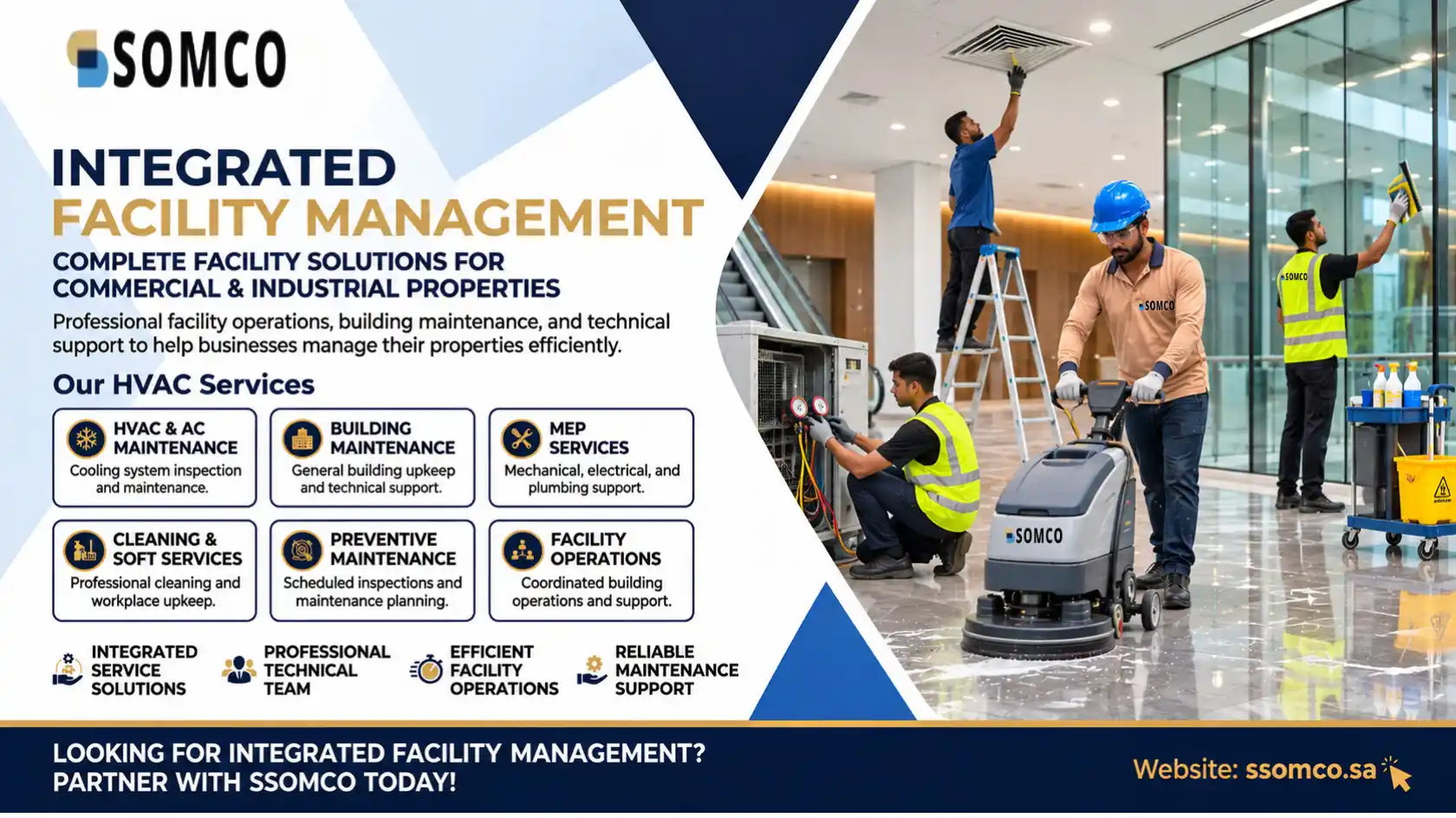
Saudi Specialized Operations & Maintenance Company (SSOMCO) provides maintenance and facility-related service solutions for commercial and business environments.
Managing a facility requires coordination between technical maintenance, building operations, and support services. Businesses should select a service scope that reflects their property, installed equipment, and daily operational requirements.
SSOMCO’s relevant service offerings include:
Technical and maintenance services
- HVAC and air conditioning maintenance.
- HVAC operation and maintenance support.
- Chiller maintenance.
- VRF and VRV system services.
- Building and facility maintenance.
- MEP maintenance-related services.
Cleaning and support services
- Commercial cleaning.
- Janitorial services.
- Air duct cleaning.
- Kitchen hood cleaning.
- Catering and food services.
The final integrated service arrangement should be agreed upon according to the required activities, available resources, and project-specific responsibilities.
For businesses looking to coordinate multiple facility requirements, SSOMCO can discuss the appropriate maintenance and support scope.
Looking for facility management and maintenance support for your business? Contact SSOMCO to discuss your requirements and request a quotation.
Website: https://ssomco.sa/
Frequently Asked Questions About Integrated Facility Management
Integrated Facility Management is an approach that coordinates multiple building maintenance and support services under one management structure, with shared planning, communication, and performance monitoring.
Depending on the contract, IFM can include HVAC maintenance, MEP services, building maintenance, cleaning, housekeeping, janitorial services, waste management, landscaping, catering, and other facility support services.
Traditional facility management may involve managed services and contractors separately. Integrated Facility Management coordinates multiple services through a central management structure and shared performance processes.
Its potential benefits include centralised service coordination, improved communication, better maintenance planning, consolidated reporting and clearer accountability.
Commercial offices, hotels, shopping centres, industrial facilities, healthcare buildings and educational institutions may benefit from integrated facility services.
It can create cost-saving opportunities through improved coordination, reduced administrative duplication, and better resource planning. Actual savings depend on the service scope and contract performance.
An IFM contract is an agreement that defines the services, responsibilities, performance requirements, and reporting arrangements managed by the primary facility management provider.
Performance is commonly evaluated through agreed KPIs and SLAs, including maintenance completion, work order response, equipment downtime, cleaning quality, and service compliance.
Preventive maintenance helps identify developing equipment problems, plan servicing activities, and maintain the condition of building assets.
Businesses should evaluate service capabilities, technical experience, workforce planning, maintenance procedures, reporting, safety practices, and contract transparency.
Conclusion
Integrated Facility Management provides a coordinated way to manage the different services required to operate commercial and industrial buildings.
By bringing technical maintenance, cleaning and other agreed support services under a central management structure, businesses can improve communication, organise maintenance activities and gain better visibility into facility performance.
The most effective IFM arrangement is one that reflects the property’s actual requirements, defines clear service responsibilities and measures performance through meaningful KPIs.
For facility maintenance and coordinated building support, contact SSOMCO to discuss a suitable service arrangement for your business.
