

 Blog
Industrial facilities depend on reliable heating, ventilation and air conditioning (HVAC) systems to maintain suitable working environments, support equipment operation and protect production processes. From manufacturing plants and warehouses to processing facilities and industrial workshops, HVAC systems play an important role in maintaining temperature, humidity, ventilation and indoor air quality.
Unlike ordinary office air conditioning, industrial HVAC requirements can involve larger spaces, higher heat loads, specialised ventilation needs and demanding operating schedules. A poorly maintained system can affect workplace conditions, increase energy consumption, and contribute to unexpected equipment downtime.
Professional industrial HVAC service helps facility managers maintain system performance through planned inspections, preventive maintenance, troubleshooting, and appropriate repair work.
This guide explains industrial HVAC systems, common services, maintenance requirements, operational challenges, and how to select a suitable HVAC service provider.
What Is Industrial HVAC Service?
Industrial HVAC service refers to the inspection, maintenance, repair, installation and operational support of heating, ventilation, and air conditioning systems used in industrial facilities.
These services help maintain the environmental conditions required by industrial buildings, production areas, equipment rooms, and employee workspaces.
Depending on the facility, an industrial HVAC system may need to manage:
- Indoor temperature and humidity.
- Fresh-air supply and air circulation.
- Exhaust ventilation and removal of unwanted heat.
- Air filtration and dust management.
- Cooling requirements for machinery and equipment areas.
- Environmental conditions required for specific manufacturing processes.
The appropriate HVAC solution depends on the facility’s layout, equipment, operating hours, process requirements, and applicable safety standards.
Why Industrial Facilities Need Professional HVAC Services
Industrial environments place different demands on HVAC equipment compared with typical residential or office buildings. Large operating areas, machinery heat loads, airborne contaminants, and extended operating schedules can make system maintenance more demanding.
Professional HVAC services support industrial operations in several ways.
1. Maintain Stable Indoor Conditions
Temperature and humidity can influence manufacturing activities, stored materials, machinery, and employee working conditions. An appropriately maintained HVAC system helps maintain the environmental conditions established for each facility.
2. Support Equipment Reliability
Industrial cooling and ventilation equipment may operate for extended periods. Regular inspection helps identify developing issues such as unusual vibration, airflow restrictions, electrical abnormalities, and cooling performance changes before they contribute to more serious problems.
3. Improve Energy Performance
Poorly maintained equipment can consume more energy than necessary. Dirty filters, incorrect control settings, restricted airflow, and poorly performing components can reduce overall system efficiency.
A structured operation and maintenance programme helps identify opportunities to improve equipment operation and avoid unnecessary energy consumption.
4. Support Workplace Air Quality
Industrial ventilation is important for managing indoor air conditions. Depending on the process, facilities may require suitable filtration, fresh-air supply, exhaust ventilation, or separation between different operational zones.
Specific ventilation and filtration requirements should be assessed by qualified professionals according to the hazards and processes involved.
5. Reduce Unplanned Downtime
Unexpected HVAC breakdowns can affect working conditions and, in some facilities, interrupt temperature-sensitive operations.
Preventive maintenance helps identify equipment deterioration and plan corrective work before failures cause avoidable disruption.
Common Types of Industrial HVAC Systems
Industrial buildings use different HVAC configurations depending on their size, cooling requirements, processes, and operational needs.
1. Chiller Systems
Chillers produce chilled water that can be distributed to air-handling units, fan coil units, or other connected cooling equipment.
They are commonly considered for facilities with substantial cooling requirements, including large commercial-industrial buildings and manufacturing environments.
Typical service activities may include:
- Inspecting chiller operating conditions.
- Checking pumps and associated equipment.
- Inspecting heat-transfer surfaces where applicable.
- Reviewing chilled-water system performance.
- Checking electrical connections and control functions.
- Identifying abnormal operating conditions.
- Reviewing water treatment requirements where relevant.
Chiller maintenance procedures and operating limits must follow the equipment manufacturer’s instructions.
2. Air Handling Units (AHUs)
Air handling units condition and distribute air throughout a building. Depending on the design, they may include fans, filters, heating or cooling coils, dampers, and control components.
Industrial AHU service can involve:
- Inspecting filters and replacing them when required.
- Checking fan and motor operation.
- Inspecting belts, bearings, and drive components.
- Checking dampers and actuators.
- Inspecting cooling and heating coils.
- Reviewing airflow and temperature performance.
- Checking condensate drainage.
3. VRF and VRV Systems
Variable Refrigerant Flow (VRF) and Variable Refrigerant Volume (VRV) systems provide zoned heating and cooling through connected indoor and outdoor units.
They may be suitable for selected industrial offices, administrative buildings, laboratories, and other areas where their design capacity and operating conditions are appropriate.
Maintenance can include inspecting indoor and outdoor units, filters, drainage, electrical connections, controls, and system operating performance.
4. Ventilation and Exhaust Systems
Ventilation systems help supply outdoor air, circulate indoor air, and remove unwanted heat or contaminants where required.
Industrial ventilation requirements vary significantly between facilities. A general comfort ventilation system should not automatically be treated as suitable for hazardous process exhaust or specialist contaminant control.
Service requirements may include fan inspection, duct condition checks, airflow assessment, filter maintenance, and verification of system operation.
5. Packaged and Rooftop HVAC Units
Packaged units combine major cooling and air-handling components in a single assembly. Rooftop units are commonly installed outside buildings to serve designated indoor areas.
Maintenance may include filter inspection, coil cleaning, fan checks, electrical inspection, condensate drainage checks, and operating performance reviews.
Industrial HVAC Services for Different Facilities
Different industrial environments have different heating, cooling, and ventilation priorities.
Facility type | Typical HVAC considerations |
Manufacturing plants | Process heat, ventilation, equipment cooling and employee working conditions |
Warehouses | Temperature management, air distribution and ventilation |
Food processing facilities | Temperature, humidity, hygiene-related air requirements and ventilation |
Industrial workshops | Heat removal, fresh-air supply and suitable exhaust arrangements |
Laboratories | Application-specific temperature, humidity, filtration and ventilation requirements |
Equipment rooms | Cooling capacity, heat loads and reliable equipment operation |
Industrial offices | Employee comfort, ventilation and indoor air quality |
The HVAC system should be assessed according to the facility’s actual requirements rather than applying one standard solution to every industrial building.
What Is Included in Industrial HVAC Maintenance?
A structured industrial HVAC maintenance programme should be developed around the equipment installed, operating conditions, manufacturer recommendations and facility requirements.
Common maintenance activities include the following.
1. HVAC System Inspection
Technicians inspect accessible system components and review operating conditions to identify visible damage, unusual noise, vibration, leakage, or other signs of deterioration.
2. Air Filter Inspection and Replacement
Filters collect airborne particles and help protect HVAC equipment. Their condition should be checked regularly, with replacement based on filter type, operating conditions, and manufacturer recommendations.
Incorrectly fitted filters or damaged seals can allow air to bypass the filtration system.
3. Cooling Coil Cleaning
Dirt accumulation on cooling coils can interfere with heat transfer and airflow. Appropriate inspection and cleaning help maintain system performance.
Cleaning methods should be suitable for the equipment and coil materials.
4. Fan and Motor Inspection
Fans and motors are essential for air circulation. Maintenance may include checking operating noise, vibration, bearings, belts, alignment, and electrical connections.
5. Ductwork Inspection
Ductwork distributes conditioned air throughout the facility. Inspections can help identify visible damage, leakage, contamination, or airflow restrictions.
Duct cleaning should be considered according to the condition of the system and the facility’s requirements.
6. Electrical and Control System Checks
HVAC equipment depends on electrical components, sensors, control panels, and safety devices.
Inspection can help identify loose connections, abnormal electrical conditions, sensor issues, and control faults. Electrical work must be performed by appropriately qualified personnel.
7. Airflow and Performance Assessment
Airflow measurements and system performance checks help determine whether the HVAC equipment is operating in line with its intended design and operating requirements.
Where necessary, air balancing can help address uneven air distribution.
8. Maintenance Reporting
Maintenance reports should document inspections, identified problems, completed work, and recommendations for future action.
These records help facility managers understand equipment condition and plan maintenance activities.
Preventive Maintenance vs Reactive HVAC Maintenance
Industrial HVAC maintenance generally involves two approaches: preventive maintenance and reactive maintenance.
Comparison | Preventive maintenance | Reactive maintenance |
Timing | Planned in advance | After a fault occurs |
Main objective | Reduce the likelihood of equipment failure | Restore operation after a problem |
Equipment condition | Inspected periodically | Often assessed after performance deteriorates |
Work planning | Scheduled around facility operations | May require urgent coordination |
Operational impact | Helps manage maintenance-related disruption | Can involve unexpected downtime |
Cost planning | Easier to plan maintenance expenditure | Repair costs can be less predictable |
Preventive maintenance does not eliminate every breakdown. However, it provides a structured way to monitor equipment condition, identify developing problems and plan corrective work.
For facilities with critical equipment or continuous operating requirements, maintenance schedules should also consider available backup capacity and suitable shutdown windows.
Common Industrial HVAC Problems
Industrial HVAC equipment can experience a range of operational issues depending on system design, equipment age, environmental conditions, and maintenance history.
Insufficient Cooling
Possible causes include restricted airflow, dirty filters, coil contamination, control issues, or equipment faults.
Uneven Air Distribution
Uneven temperatures across a facility may indicate airflow restrictions, ductwork problems, incorrect damper operation, or an unsuitable distribution arrangement.
Unusual Noise and Vibration
Abnormal sounds or vibration may be associated with fan imbalance, loose components, bearing wear, or other mechanical problems. The source should be investigated rather than ignored.
High Energy Consumption
Unexpected increases in HVAC energy use may result from operating schedules, control settings, equipment condition, increased cooling demand, or other building-related factors.
Water Leakage
Condensate drainage problems, blocked drain lines, or component issues can lead to water leakage around HVAC equipment.
Frequent Equipment Shutdowns
Repeated shutdowns may indicate control faults, electrical issues, protection-device activation, or underlying mechanical problems. Proper diagnosis is necessary before replacing components.
How to Improve Industrial HVAC System Efficiency
Improving HVAC efficiency requires more than cleaning equipment. It involves reviewing the complete system and how it operates within the facility.
Consider these practical measures:
- Follow a preventive maintenance schedule: Inspect equipment according to manufacturer guidance and actual operating conditions.
- Maintain clean filters: Use the correct filter specification and replace filters when required.
- Review operating schedules: Avoid running equipment unnecessarily when areas are unoccupied, provided the process and safety requirements allow it.
- Check temperature controls: Review sensors, setpoints and control sequences to identify incorrect operation.
- Inspect ductwork: Address identified leakage, damage and airflow restrictions.
- Monitor equipment performance: Record operating conditions and investigate unusual changes.
- Review insulation: Check accessible insulation on relevant ductwork and chilled-water piping.
- Plan equipment upgrades carefully: Assess lifecycle cost, operating requirements and compatibility before replacing major equipment.
ENERGY STAR highlights the value of equipment tuning, suitable operating schedules and periodic performance checks as part of an effective operation and maintenance programme.
Industrial HVAC Maintenance Checklist
Facility managers can use the following checklist as a starting point when reviewing their maintenance programme.
Maintenance item | What to review |
Air filters | Condition, correct specification and fitting |
Cooling coils | Dirt accumulation and physical condition |
Fans and motors | Noise, vibration and operating condition |
Belts and bearings | Wear and manufacturer-recommended maintenance |
Electrical components | Connections, controls and visible abnormalities |
Ductwork | Visible damage, leakage and contamination |
Drainage | Condensate flow and blockage |
Chillers | Operating conditions and associated components |
Ventilation | Airflow and intended system operation |
Control systems | Sensor readings, schedules and settings |
Maintenance records | Completed tasks, faults and recommendations |
This checklist is not a substitute for the equipment manufacturer’s maintenance instructions or a facility-specific maintenance plan. Inspection frequency should be determined by equipment type, operating hours, environmental conditions, and maintenance history.
How to Choose the Right Industrial HVAC Service Provider
Selecting an appropriate HVAC contractor is important for maintaining industrial equipment and coordinating maintenance around facility operations.
Before appointing a service provider, consider the following factors.
1. Industrial HVAC Experience
Review the provider’s experience with the types of HVAC systems installed at your facility. Experience with similar equipment and operating environments can help ensure that the maintenance approach is appropriate.
2. Range of HVAC Services
Consider whether the provider can support the required activities, such as HVAC maintenance, chiller maintenance, VRF and VRV services, air conditioning installation, duct cleaning, and air balancing.
Confirm the exact service scope before entering into an agreement.
3. Qualified Technical Personnel
Ask about technician qualifications, relevant training, equipment familiarity, and safety procedures.
4. Preventive Maintenance Planning
A suitable provider should be able to explain how inspections, maintenance tasks, reporting, and corrective recommendations will be organised.
5. Documentation and Reporting
Maintenance records help facility managers monitor asset condition, review completed work, and plan future maintenance expenditure.
6. Clear Service Agreements
Before signing an Annual Maintenance Contract (AMC), confirm the included equipment, service frequency, labour, spare parts, exclusions, response arrangements, and additional charges.
7. Safety and Site Coordination
Industrial maintenance work may involve operating equipment, electrical systems, elevated work areas, and restricted-access locations. Confirm that the contractor follows applicable site procedures and coordinates work with facility personnel.
Why Industrial HVAC Maintenance Is Important for Long-Term Operations
Industrial HVAC systems represent an important part of facility infrastructure. Their performance can influence energy use, employee working conditions, equipment operation, and the suitability of the indoor environment for specific processes.
A well-organised maintenance programme helps businesses:
- Monitor the condition of important HVAC assets.
- Identify developing faults.
- Plan maintenance work around operating schedules.
- Maintain suitable airflow and cooling performance.
- Improve maintenance cost visibility.
- Keep equipment documentation organised.
- Make more informed repair and replacement decisions.
The best approach combines appropriate equipment selection, professional installation, regular inspections, and consistent operational monitoring.
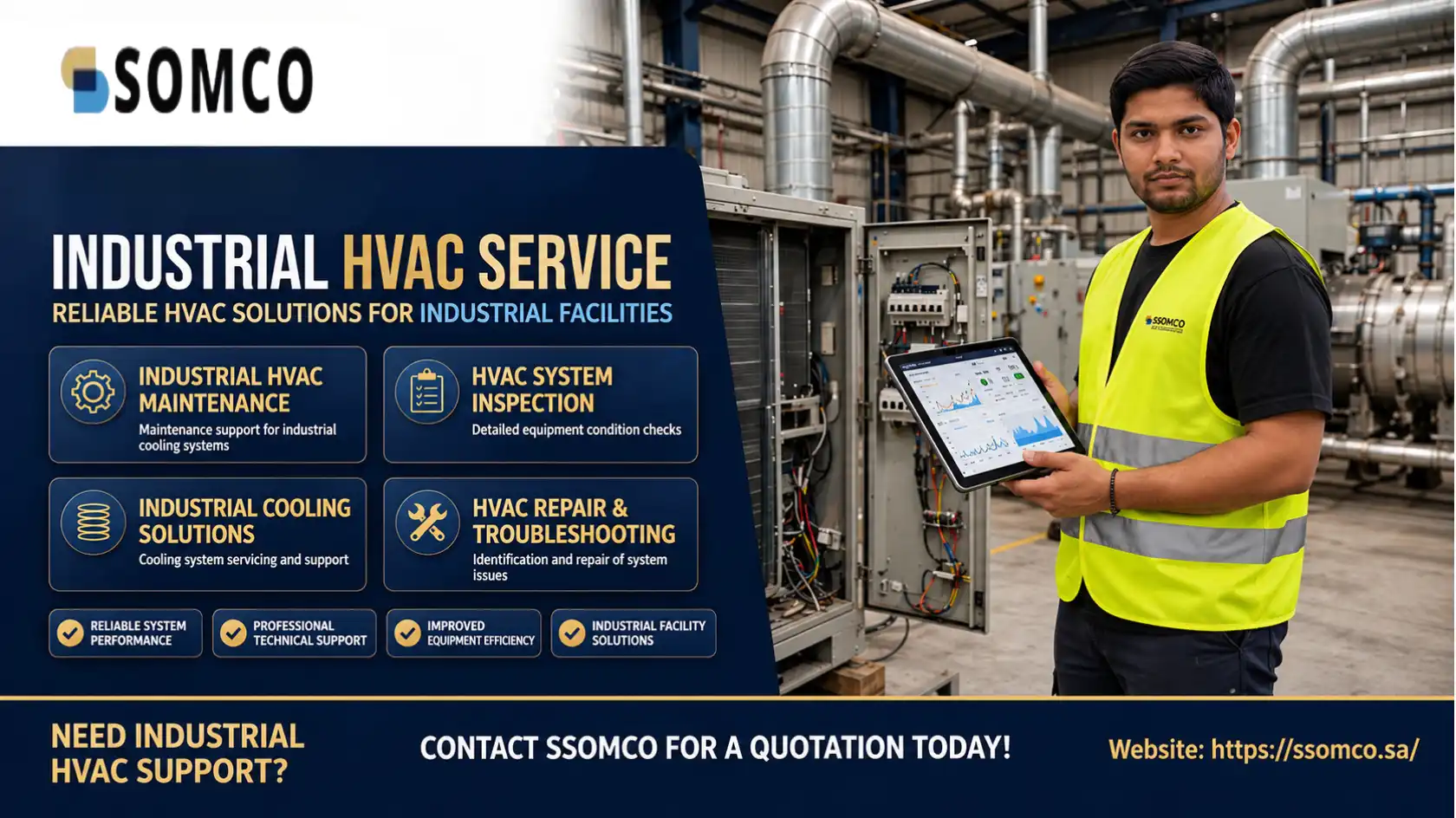
Industrial HVAC Service by SSOMCO
SSOMCO (Saudi Specialized Operations & Maintenance Company) provides HVAC and maintenance-related solutions for business and facility requirements.
For industrial and commercial properties, HVAC needs can involve cooling equipment, air conditioning systems, ventilation, planned maintenance and associated building services.
Depending on the project requirements and confirmed service scope, relevant HVAC support may include:
- HVAC and AC maintenance.
- HVAC operation and maintenance support.
- Chiller installation and maintenance.
- VRF and VRV system installation and maintenance.
- HVAC installation.
- Air duct cleaning.
- Air balancing.
- Building and facility maintenance.
- MEP installation and maintenance.
Every facility has different operating conditions and equipment requirements. A suitable service scope should be established following an assessment of the property, installed systems and maintenance objectives.
Planning industrial HVAC maintenance or an upcoming facility project?
Contact SSOMCO to discuss your HVAC requirements and request a quotation.
Website: https://ssomco.sa/
Frequently Asked Questions About Industrial HVAC Service
Industrial HVAC service includes the inspection, installation, maintenance, troubleshooting and repair of heating, ventilation, and air conditioning systems used in industrial facilities.
Regular maintenance helps monitor equipment condition, maintain suitable indoor conditions, identify developing faults, and support reliable system operation.
Industrial facilities may use chillers, air handling units, packaged units, ventilation systems, exhaust systems, and VRF or VRV systems. The selection depends on facility requirements and engineering design.
There is no single maintenance frequency suitable for every industrial HVAC system. Schedules should consider manufacturer recommendations, operating hours, environmental conditions, equipment type, and maintenance history.
A maintenance contract may include scheduled inspections, filter maintenance, equipment checks, cleaning, performance assessments and maintenance reporting. The exact scope, spare parts, labour, and exclusions should be confirmed in the agreement.
Yes. Appropriate maintenance can identify issues such as restricted airflow, dirty filters, poor control settings and inefficient equipment operation that may contribute to unnecessary energy use.
Commercial HVAC generally focuses on maintaining suitable indoor conditions in offices, retail spaces, hotels, and similar properties. Industrial HVAC may also need to support manufacturing processes, equipment cooling, specialised ventilation and specific environmental requirements.
Yes. Maintenance planning should account for the facility's equipment, operating schedule, environmental conditions, process requirements, and manufacturer recommendations.
Businesses should review relevant technical experience, service capabilities, technician qualifications, preventive maintenance procedures, reporting standards, safety arrangements, and contract terms.
SSOMCO provides HVAC and maintenance-related services, including HVAC and AC maintenance, chiller maintenance, VRF and VRV services, duct cleaning and air balancing. Contact the company to confirm availability and the appropriate scope for your industrial facility.
Conclusion
Industrial HVAC service is an important part of maintaining reliable facility operations. Proper maintenance helps businesses monitor equipment performance, manage energy use, maintain suitable indoor conditions, and identify potential issues before they develop into larger problems.
By choosing an appropriate maintenance strategy and working with a suitable HVAC service provider, industrial facilities can better manage their cooling, ventilation, and air conditioning requirements.
For HVAC maintenance and facility service enquiries, contact SSOMCO to discuss your project requirements and request a quotation.
