

 Blog
Heating, ventilation, and air conditioning (HVAC) systems are essential for maintaining comfortable indoor environments and supporting daily operations in commercial and industrial buildings. Offices, hotels, shopping malls, restaurants, warehouses, and other facilities depend on properly functioning HVAC equipment to maintain suitable temperatures and airflow.
However, HVAC systems can develop technical problems due to continuous operation, component wear, electrical faults, restricted airflow, poor maintenance, or changing operating conditions. When these issues are not addressed promptly, they may affect indoor comfort, equipment performance, and business operations.
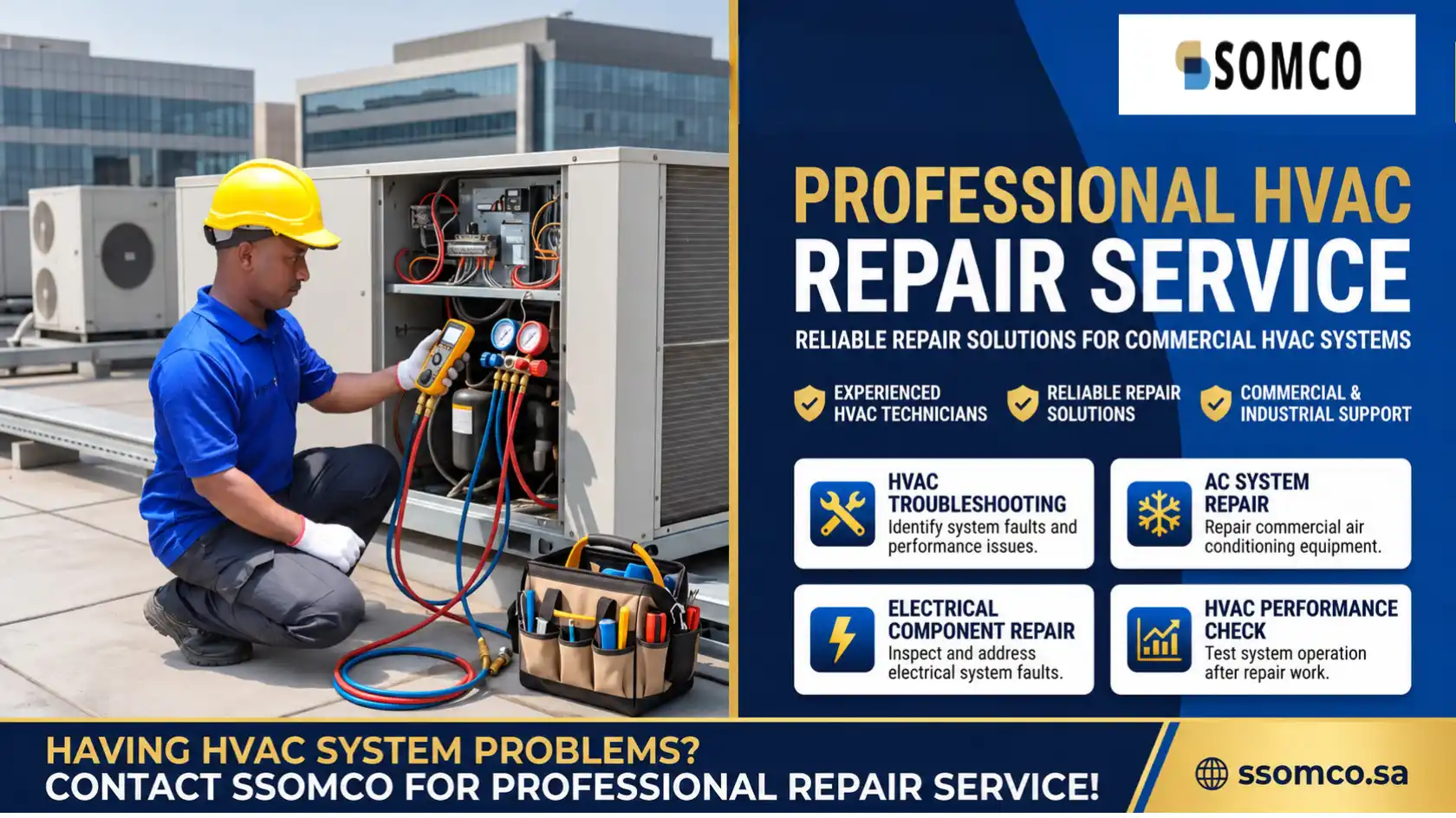
HVAC repair service involves identifying, diagnosing, and correcting faults in heating, ventilation, and air conditioning equipment. Professional repair services help restore system operation, address equipment problems, and support reliable building performance.
In this guide, we explore common HVAC problems, repair procedures, the importance of professional technicians, and how businesses can select an appropriate HVAC repair service provider.
What Is HVAC Repair Service?
HVAC repair service refers to the technical inspection, troubleshooting, diagnosis, and repair of heating, ventilation, and air conditioning systems.
The purpose is to identify the cause of equipment problems and carry out suitable corrective work based on the equipment manufacturer’s recommendations and technical requirements.
Depending on the system and fault, HVAC repair services may include:
- Air conditioning system troubleshooting.
- Electrical fault diagnosis.
- Fan and motor repairs.
- Thermostat and controller troubleshooting.
- Refrigerant circuit inspection and repair.
- Condensate drainage problem correction.
- Compressor and component assessment.
- Chiller system troubleshooting.
- VRF and VRV system fault diagnosis.
- Ventilation equipment repairs.
- Replacement of defective components.
The repair scope depends on the equipment design, fault condition, availability of suitable parts, and manufacturer’s instructions.
Why Is Professional HVAC Repair Important?
A malfunctioning HVAC system can affect more than indoor temperature. It may also interrupt business activities, increase equipment operating stress, and create additional maintenance requirements.
Professional HVAC repair helps address these concerns through appropriate technical diagnosis and corrective work.
1. Restore Proper Cooling and Heating Performance
When an HVAC system cannot maintain the required indoor temperature, occupants may experience discomfort and businesses may face operational difficulties.
Professional troubleshooting helps identify the source of the problem, whether it involves airflow, electrical components, controls, or mechanical equipment.
2. Prevent Further Equipment Damage
Continuing to operate equipment with an unresolved fault may increase the risk of additional component damage.
Professional inspection helps determine whether the system should continue operating or requires corrective attention.
3. Support Business Continuity
Commercial properties often depend on HVAC equipment throughout their operating hours.
Timely diagnosis and appropriate repairs help facility managers address equipment problems and plan corrective work around building operations.
4. Improve Equipment Performance
Replacing defective components, correcting control issues, and addressing airflow restrictions can help restore the intended operation of an HVAC system.
The actual result depends on the condition of the equipment and the underlying cause of the fault.
5. Avoid Unnecessary Repair Expenses
Accurate diagnosis helps identify the actual source of an HVAC problem rather than replacing components without sufficient evidence.
This can help businesses make more informed decisions about repair, maintenance, and equipment replacement.
Common HVAC Problems That Require Professional Repair
HVAC systems can develop different faults depending on their design, operating environment, age, and maintenance history.
The following are common warning signs that may require professional inspection.
1. Air Conditioner Not Cooling Properly
Insufficient cooling is one of the most common reasons businesses request HVAC repair services.
Possible causes include:
- Dirty or restricted air filters.
- Blocked airflow.
- Dirty evaporator or condenser coils.
- Refrigerant circuit problems.
- Faulty sensors or controls.
- Compressor or fan-related faults.
Recommended action: Arrange a professional inspection to identify the underlying issue before deciding on repairs.
2. HVAC System Not Turning On
An HVAC system that does not start may have an electrical, control, or equipment-related problem.
Possible causes include:
- Power supply problems.
- Tripped protective devices.
- Faulty wiring or electrical connections.
- Controller or thermostat issues.
- Equipment safety protection activation.
Recommended action: A qualified technician should inspect the electrical supply, controls, and equipment protection systems.
3. Unusual Noise or Vibration
Unexpected sounds may indicate that a component is not operating correctly.
Possible causes include:
- Loose mechanical components.
- Fan or motor problems.
- Worn bearings.
- Imbalanced rotating equipment.
- Mechanical interference.
Recommended action: The affected equipment should be inspected to identify the source of noise or vibration.
4. Water Leakage From Air Conditioning Units
Water around an indoor air conditioning unit may indicate a condensate drainage problem.
Possible causes include:
- Blocked drainage lines.
- Damaged drain connections.
- Incorrect drainage arrangements.
- Condensate pan problems.
- Excessive condensation under certain operating conditions.
Recommended action: Arrange an inspection of the drainage system and affected components.
5. Weak or Uneven Airflow
Poor airflow can affect cooling distribution and indoor comfort.
Possible causes include:
- Restricted filters.
- Fan or motor problems.
- Blocked air outlets.
- Damper or control issues.
- Air distribution restrictions.
Recommended action: Inspect the filters, fans, air outlets, and accessible air distribution components.
6. HVAC System Frequently Shutting Down
Repeated system shutdowns may indicate that equipment protection controls are responding to an abnormal condition.
Possible causes include:
- Electrical faults.
- Control system problems.
- Equipment overheating.
- Refrigerant circuit issues.
- Faulty sensors.
- Mechanical component problems.
Recommended action: Avoid repeatedly resetting equipment without identifying the fault. Arrange professional troubleshooting.
7. Unusual Energy Consumption
A sudden change in HVAC energy consumption may indicate inefficient operation or an equipment problem.
Possible causes include:
- Restricted airflow.
- Incorrect control settings.
- Equipment operating for longer than necessary.
- Defective components.
- Poor equipment condition.
Recommended action: Review operating conditions and arrange an HVAC performance inspection.
Types of HVAC Repair Services
Different HVAC systems require different diagnostic and repair approaches. The following are common categories of repair work for commercial and industrial facilities.
Air Conditioning Repair Service
Air conditioning repair involves diagnosing and correcting problems affecting cooling equipment.
Typical repair activities may include:
- Indoor and outdoor unit troubleshooting.
- Electrical component inspection.
- Fan and motor fault diagnosis.
- Controller and sensor checks.
- Drainage problem correction.
- Refrigerant circuit inspection.
- Replacement of defective components.
Commercial HVAC Repair
Commercial HVAC repair covers systems serving offices, hotels, retail buildings, restaurants, and other business facilities.
Depending on the installed equipment, repair work may involve:
- Central air conditioning systems.
- Air handling units.
- Packaged HVAC equipment.
- Commercial split systems.
- Ventilation fans.
- HVAC control systems.
Repair planning should consider building occupancy, equipment criticality, and the availability of alternative cooling arrangements.
Chiller Repair Service
Chillers are important components in many centralized cooling systems.
Chiller-related problems may involve compressors, pumps, electrical controls, sensors, water-side components, or other equipment.
Professional chiller troubleshooting may include:
- Reviewing fault codes and operating history.
- Inspecting electrical connections.
- Assessing control system operation.
- Checking relevant operating parameters.
- Inspecting associated pumps and equipment.
- Identifying visible leaks or abnormal vibration.
- Recommending corrective action.
Major repairs should follow the chiller manufacturer’s service procedures and applicable safety requirements.
VRF and VRV System Repair
Variable Refrigerant Flow (VRF) and Variable Refrigerant Volume (VRV) systems use advanced controls to manage multiple indoor units and operating zones.
Common problems may include:
- Communication errors.
- Indoor unit faults.
- Outdoor unit operating problems.
- Controller malfunctions.
- Drainage issues.
- Refrigerant circuit faults.
- Electrical and sensor problems.
Professional diagnosis should use the equipment’s fault codes, service documentation, and manufacturer-approved procedures.
Ventilation System Repair
Ventilation systems support air movement and distribution in commercial facilities.
Repair requirements may involve:
- Ventilation fan problems.
- Motor and electrical faults.
- Damper-related issues.
- Control problems.
- Airflow restrictions.
- Mechanical component replacement.
The repair scope should be based on the actual condition of the ventilation equipment.
HVAC Repair Process: From Diagnosis to System Testing
A structured repair process helps technicians identify faults and verify the results of corrective work.
Step 1: Understand the Reported Problem
The technician gathers information about the equipment, reported symptoms, operating conditions, and any recent maintenance or repair history.
Step 2: Inspect the HVAC Equipment
The affected system is inspected for visible damage, unusual noise, leakage, airflow restrictions, and other warning signs.
Step 3: Diagnose the Fault
Appropriate diagnostic procedures and equipment are used to identify the likely source of the problem.
Step 4: Recommend Corrective Work
The required repair, replacement parts, estimated work scope, and relevant safety considerations are identified.
Step 5: Complete the Approved Repair
Corrective work is performed by appropriately qualified personnel using suitable parts and manufacturer-approved procedures.
Step 6: Test the Equipment
After the repair, the system is checked to confirm that the reported fault has been addressed and that the equipment is operating appropriately.
Step 7: Document the Work
A repair report should record the identified problem, work performed, components replaced, testing observations, and any further recommendations.
HVAC Repair vs Preventive Maintenance: What Is the Difference?
HVAC repair and preventive maintenance serve different purposes.
HVAC Repair | Preventive HVAC Maintenance |
Corrects an identified fault | Helps identify potential problems |
Usually follows a malfunction or performance issue | Performed according to a planned schedule |
May involve component replacement | May involve inspection, cleaning, and adjustment |
Focuses on restoring equipment operation | Focuses on maintaining equipment condition |
Can require unplanned service visits | Usually arranged in advance |
Both activities are important. Preventive maintenance helps monitor equipment condition, while repair services address faults that require corrective work.
When Should You Call an HVAC Repair Technician?
Businesses should consider professional inspection when they notice:
- Air conditioning units are not cooling properly.
- HVAC equipment repeatedly shuts down.
- Unusual noise or vibration develops.
- Water leakage occurs around equipment.
- Airflow becomes weak or inconsistent.
- Temperature controls stop responding correctly.
- Equipment displays repeated fault codes.
- Energy consumption changes unexpectedly.
For electrical burning smells, smoke, suspected refrigerant releases, or other immediate safety concerns, follow site emergency procedures and keep personnel away from affected equipment. Do not attempt internal repairs or handle refrigerants without appropriate training and authorization.
How to Choose the Right HVAC Repair Service Provider
Selecting a suitable HVAC repair contractor is important for commercial property owners and facility managers.
Consider these factors before appointing a service provider.
1. Relevant Technical Experience
Check whether the contractor has experience with the type of HVAC equipment installed at your facility.
Chillers, VRF systems, air handling units, and commercial air conditioning equipment have different technical requirements.
2. Qualified Technicians
Confirm that technicians have appropriate training, technical competence, and authorization for the repair work.
3. Accurate Fault Diagnosis
A reliable repair process should identify the likely cause of the problem before recommending component replacement.
4. Clear Repair Scope
Ask for a written description of the proposed work, including the affected equipment, repair activities, replacement components, and exclusions.
5. Spare Parts Arrangements
Confirm whether replacement components are available and whether they are suitable for the specific equipment model.
6. Testing and Documentation
Ask whether the contractor provides repair reports and records the results of post-repair checks.
7. Maintenance Support
Consider whether the provider can also help establish preventive maintenance arrangements to monitor equipment condition after the repair.
Why Choose SSOMCO for HVAC Repair and Maintenance Requirements?
SSOMCO (Saudi Specialized Operations & Maintenance Company) provides HVAC and maintenance solutions for commercial and industrial facilities.
We understand that HVAC equipment problems can affect indoor comfort and building operations. Identifying equipment requirements and arranging appropriate technical work are important parts of effective facility management.
Our related service portfolio includes:
- HVAC maintenance.
- Air conditioning maintenance.
- HVAC operation and maintenance.
- Chiller installation and maintenance.
- VRF and VRV system services.
- Building maintenance.
- MEP installation and maintenance.
- Related facility maintenance requirements.
Businesses can discuss their HVAC equipment condition, maintenance needs, and project requirements with SSOMCO to determine an appropriate service scope.
Have an HVAC issue or upcoming maintenance project? Contact SSOMCO to discuss your requirements and request a quotation.
Frequently Asked Questions About HVAC Repair Service
HVAC repair service may include troubleshooting, fault diagnosis, electrical inspection, fan and motor repairs, control system checks, drainage correction, refrigerant circuit inspection, and replacement of defective components.
Common problems include restricted airflow, electrical faults, control system issues, defective motors, drainage problems, refrigerant circuit faults, and mechanical component wear.
Warning signs include insufficient cooling, unusual noise, water leakage, repeated shutdowns, weak airflow, unresponsive controls, and unexpected changes in operating performance.
Correcting certain faults, such as airflow restrictions, defective components, or control problems, may help restore more efficient operation. The result depends on the underlying issue and equipment condition.
HVAC repair corrects an identified equipment fault, while preventive maintenance involves scheduled inspection and servicing intended to maintain equipment condition and identify developing problems.
In many cases, an individual component or system fault can be repaired without replacing the complete unit. However, the decision depends on equipment condition, repair feasibility, parts availability, cost, and manufacturer guidance.
These systems have specific components, controls, and manufacturer procedures. Repairs should be performed by technicians with appropriate training and experience with the relevant equipment.
Contact SSOMCO through its website to discuss the equipment type, reported fault, facility requirements, and the scope of technical support needed.
Conclusion
HVAC repair services play an important role in maintaining the operation of air conditioning, ventilation, and heating equipment in commercial and industrial facilities.
From insufficient cooling and electrical faults to chiller and VRF system problems, professional diagnosis helps identify the cause of equipment issues and determine suitable corrective action.
Businesses should choose HVAC service providers with relevant technical experience, qualified personnel, transparent repair scopes, and proper documentation practices.
For HVAC maintenance, chiller services, VRF and VRV systems, and related building maintenance requirements, contact SSOMCO to discuss your facility needs and request a quotation.
SSOMCO – Supporting Reliable HVAC and Facility Operations.
