

 Blog
Heating, ventilation, and air conditioning (HVAC) systems play an essential role in maintaining comfortable, productive, and well-ventilated indoor environments. In commercial buildings, offices, hotels, hospitals, retail spaces, and industrial facilities, properly functioning HVAC equipment supports daily operations and helps maintain suitable indoor conditions.
However, HVAC systems require professional attention to maintain their performance. Without proper inspection, maintenance, and timely repairs, equipment may lose efficiency, break down unexpectedly, deliver inconsistent cooling, and increase operating costs.
Professional HVAC service helps businesses manage these challenges through planned maintenance, technical inspections, troubleshooting, repair, and system performance evaluations.
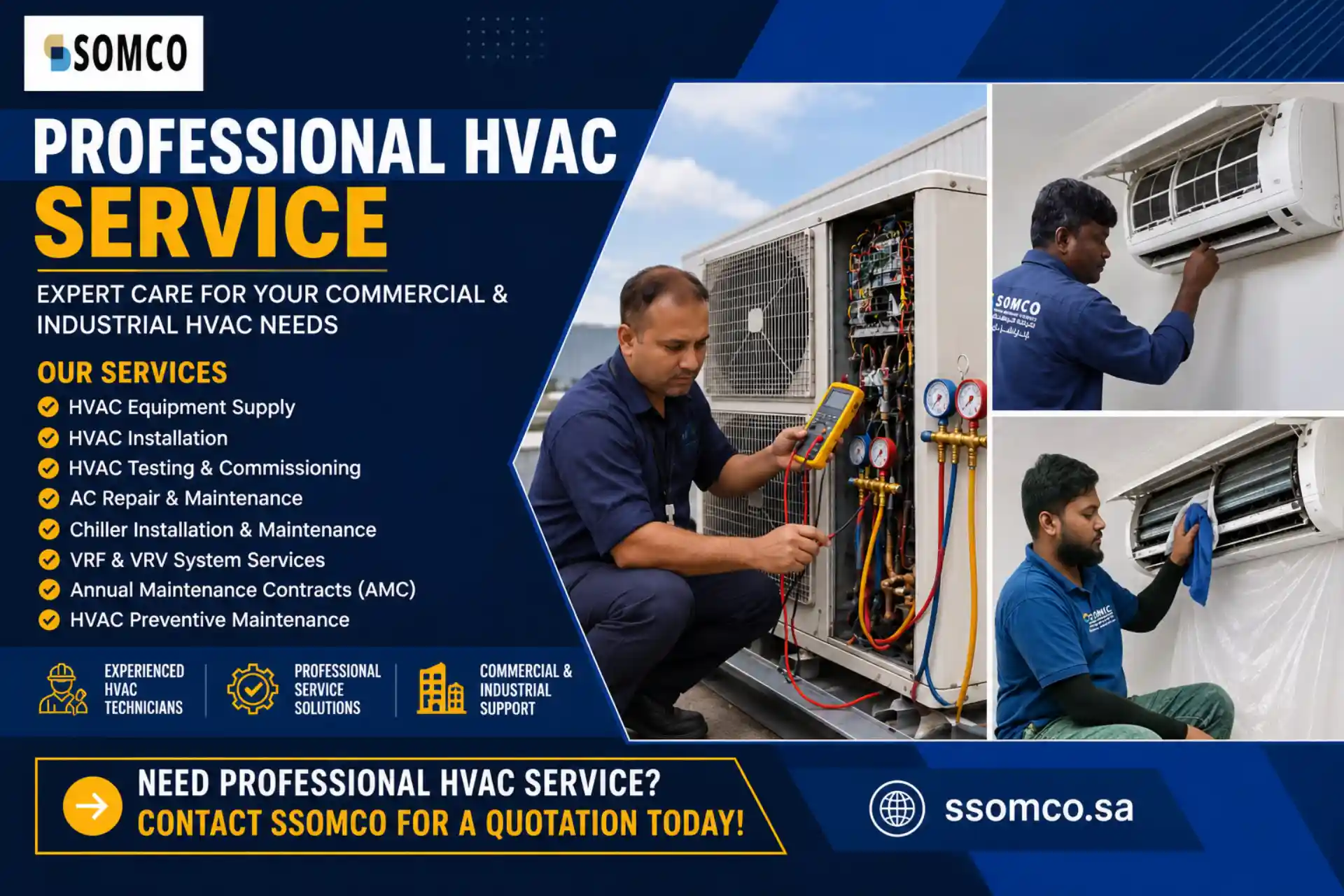
For businesses seeking dependable HVAC support, SSOMCO provides HVAC and maintenance solutions designed to meet commercial and industrial facility requirements.
What Is Professional HVAC Service?
Professional HVAC service refers to the inspection, maintenance, troubleshooting, repair, and servicing of heating, ventilation, and air conditioning systems by qualified service professionals.
The purpose is to help HVAC equipment operate according to its intended design, maintain indoor comfort, and identify potential issues before they develop into more serious problems.
Depending on the equipment and service agreement, professional HVAC services may include:
- HVAC system inspection and condition assessment.
- Air conditioning maintenance and troubleshooting.
- Filter inspection and replacement.
- Evaporator and condenser coil inspection and cleaning.
- Electrical connection and control checks.
- Refrigerant circuit inspection.
- Condensate drainage inspection.
- Chiller maintenance.
- VRF and VRV system maintenance.
- Ventilation and air distribution inspections.
- HVAC performance monitoring and service reporting.
The exact scope depends on the equipment type, manufacturer recommendations, site conditions, and agreed maintenance requirements.
Why Do Businesses Need Professional HVAC Services?
Commercial HVAC systems often operate for extended periods and serve multiple rooms, departments, or building areas. Their performance can directly affect occupant comfort and business operations.
Here are some important reasons to arrange professional HVAC services.
1. Maintain Consistent Indoor Comfort
An HVAC system that is not operating correctly may produce uneven temperatures, insufficient cooling, or inconsistent airflow.
Professional inspection can help identify issues involving filters, coils, fans, controls, airflow, and other system components.
Addressing these issues helps businesses maintain more consistent indoor conditions.
2. Support Energy Efficiency
Dirty filters, restricted airflow, malfunctioning components, and incorrect control settings can affect HVAC performance.
Professional maintenance helps identify conditions that may cause equipment to work harder than necessary. Corrective maintenance can support more efficient operation, although actual energy savings depend on the equipment, building conditions, and operating practices.
3. Reduce Unexpected Equipment Breakdowns
Small equipment problems can develop into larger operational issues when they remain unaddressed.
Routine inspections help identify abnormal noise, vibration, drainage problems, electrical concerns, and other signs that require attention.
Early identification allows facility managers to plan corrective work before a minor issue causes a major disruption.
4. Extend Equipment Service Life
HVAC equipment represents a significant investment for commercial property owners.
Following manufacturer-recommended maintenance procedures and addressing faults appropriately can help reduce unnecessary equipment stress and support its intended service life.
5. Support Indoor Air Quality
HVAC filters, ventilation equipment, air distribution components, and drainage systems influence indoor environmental conditions.
Appropriate inspection, cleaning, and maintenance help manage dust accumulation, airflow restrictions, and other conditions that may affect indoor air quality.
Types of Professional HVAC Services
Different buildings require different HVAC equipment and maintenance approaches. Professional service providers assess the installed systems and recommend work based on operational requirements.
HVAC Installation and Maintenance
HVAC installation involves selecting and installing suitable heating, ventilation, and air conditioning equipment according to project requirements.
Professional installation planning considers:
- Building size and layout.
- Cooling and heating requirements.
- Occupancy and operating schedules.
- Ventilation requirements.
- Equipment capacity and selection.
- Electrical and mechanical requirements.
- Manufacturer installation instructions.
After installation, regular maintenance helps monitor equipment condition and identify developing issues.
Air Conditioning Maintenance
Air conditioning systems are commonly used in commercial buildings to maintain comfortable indoor temperatures.
Professional AC maintenance may include:
- Inspecting air filters.
- Checking indoor and outdoor units.
- Inspecting evaporator and condenser coils.
- Checking condensate drainage.
- Inspecting electrical components.
- Reviewing thermostat and controller operation.
- Checking system performance.
- Identifying abnormal operating conditions.
The maintenance procedure should be appropriate for the specific air conditioning equipment.
Chiller Maintenance Services
Chillers are important components of many commercial and industrial cooling systems.
They provide chilled water for air conditioning and process cooling applications.
Professional chiller maintenance may involve:
- Inspecting the chiller unit.
- Reviewing operating parameters.
- Checking electrical connections and controls.
- Inspecting water-side components.
- Reviewing pumps and associated equipment.
- Checking for unusual vibration or noise.
- Inspecting for visible leakage.
- Reviewing maintenance records.
Chiller maintenance requirements vary depending on the equipment design, manufacturer, operating conditions, and water quality.
VRF and VRV System Maintenance
Variable Refrigerant Flow (VRF) and Variable Refrigerant Volume (VRV) systems are used in buildings requiring flexible zone-based temperature control.
Professional maintenance may include indoor and outdoor unit inspections, filter and coil checks, condensate drainage inspection, controller checks, electrical inspections, and refrigerant circuit assessments.
Service procedures must follow the specific manufacturer’s technical documentation.
Ventilation and Air Distribution Services
Ventilation and air distribution systems help circulate and distribute air throughout a building.
Their condition can influence airflow, occupant comfort, and indoor environmental performance.
Relevant inspection activities may include checking:
- Air distribution outlets.
- Accessible ductwork.
- Ventilation fans.
- Filters.
- Dampers and controls.
- Visible obstructions.
- Airflow-related concerns.
Specialist cleaning, testing, and balancing should be arranged according to the building’s requirements and the service scope.
Common HVAC Problems That Require Professional Attention
Recognizing early warning signs can help facility managers arrange inspections before equipment problems become more disruptive.
HVAC Problem | Possible Causes | Recommended Action |
Insufficient cooling | Dirty filters, airflow restrictions, equipment faults | Arrange system inspection |
Uneven temperatures | Air distribution or control problems | Check airflow and controls |
Unusual noise | Loose components, fan or motor issues | Inspect the affected equipment |
Water leakage | Blocked drainage or condensate issues | Inspect drainage components |
Frequent system shutdowns | Electrical, control, or equipment faults | Arrange professional troubleshooting |
Poor airflow | Restricted filters, fan issues, or duct problems | Inspect air distribution |
Unusual energy consumption | Operating faults or inefficient conditions | Review system performance |
These symptoms do not always indicate the same underlying problem. A qualified technician should inspect the equipment before recommending repairs.
Professional HVAC Maintenance: Preventive and Corrective Approaches
An effective HVAC maintenance programme generally includes both preventive and corrective maintenance.
Preventive HVAC Maintenance
Preventive maintenance involves scheduled inspections and servicing intended to identify potential problems and maintain equipment condition.
Depending on the system, preventive maintenance may include:
- Filter inspection and servicing.
- Coil inspection and cleaning.
- Electrical checks.
- Condensate drainage inspection.
- Fan and motor checks.
- Controller inspection.
- Operating performance reviews.
- Maintenance documentation.
A maintenance schedule should consider manufacturer recommendations, equipment condition, operating hours, building occupancy, and environmental conditions.
Corrective HVAC Maintenance
Corrective maintenance is performed when a fault or performance issue has been identified.
Examples include:
- Repairing faulty electrical connections.
- Addressing drainage problems.
- Replacing defective components.
- Correcting control-related issues.
- Troubleshooting cooling performance.
- Repairing identified mechanical faults.
The required repair should be determined through appropriate technical inspection and diagnosis.
How Often Should Commercial HVAC Systems Be Serviced?
There is no single maintenance frequency that applies to every HVAC system.
The recommended schedule depends on equipment type, manufacturer instructions, operating hours, environmental conditions, occupancy levels, and the condition of the system.
For example, an HVAC system operating continuously in a high-occupancy commercial building may require more frequent attention than equipment used occasionally.
Facility managers should establish a planned maintenance programme that includes:
- Identifying all HVAC equipment within the facility.
- Reviewing manufacturer maintenance requirements.
- Assessing operating conditions and equipment usage.
- Defining inspection and maintenance activities.
- Recording completed maintenance work.
- Reviewing recurring faults and corrective actions.
A documented maintenance programme also helps facility teams understand equipment history and plan future maintenance requirements.
How to Choose the Right Professional HVAC Service Provider
Selecting an appropriate HVAC service provider is important for commercial property owners and facility managers.
Before appointing a contractor, consider the following factors.
1. Relevant Technical Experience
Look for a service provider with experience relevant to your building’s installed HVAC equipment and operational requirements.
2. Qualified Technical Personnel
Confirm that the technicians assigned to the work have appropriate training, experience, and competence for the equipment being serviced.
3. Clearly Defined Service Scope
Understand which activities are included in the maintenance agreement. Confirm inspection frequency, servicing responsibilities, reporting arrangements, repair procedures, and exclusions.
4. Maintenance Planning
A professional contractor should be able to explain how planned maintenance will be organized around equipment requirements and building operations.
5. Documentation and Reporting
Maintenance reports help facility managers understand completed work, identified issues, recommended corrective actions, and equipment condition.
6. Transparent Commercial Terms
Before signing an agreement, review pricing, spare parts responsibilities, labour coverage, response arrangements, and any additional charges.
Comparing written proposals helps businesses understand the actual value and scope of each service offering.
Professional HVAC Services for Commercial and Industrial Facilities
Different types of facilities have different cooling, ventilation, and operational requirements.
Offices and Corporate Buildings
Office environments require dependable air conditioning and suitable ventilation to support occupant comfort and daily business activities.
Hotels and Hospitality Facilities
Hotels operate HVAC systems across guest rooms, lobbies, restaurants, meeting areas, and other spaces. Planned maintenance helps facility teams manage equipment across multiple building zones.
Shopping Malls and Retail Properties
Retail buildings may contain large air conditioning systems serving shops, common areas, and other occupied spaces. Maintenance planning helps support consistent indoor conditions.
Industrial Facilities
Industrial environments may require HVAC systems for employee comfort, equipment rooms, and specific operational areas. Maintenance must account for equipment duty, environmental conditions, and facility requirements.
Restaurants and Commercial Kitchens
Restaurants require suitable cooling and ventilation arrangements. HVAC maintenance should be coordinated with the separate requirements of kitchen exhaust and grease management systems where applicable.
Why Choose SSOMCO for Professional HVAC Service?
SSOMCO (Saudi Specialized Operations & Maintenance Company) provides HVAC and maintenance solutions for commercial and industrial facilities.
Our approach focuses on understanding facility requirements, identifying maintenance needs, and supporting dependable building operations through relevant technical services.
Businesses can discuss their requirements for:
- HVAC maintenance.
- Air conditioning maintenance.
- HVAC operation and maintenance.
- Chiller installation and maintenance.
- VRF and VRV system services.
- Building maintenance.
- MEP installation and maintenance.
- Related facility maintenance requirements.
Whether you manage an office, commercial property, hospitality facility, or industrial building, the appropriate maintenance scope should be planned around your equipment and operational needs.
Have an RFQ or upcoming project? Contact SSOMCO to discuss your HVAC requirements and request a quotation.
Frequently Asked Questions About Professional HVAC Service
Professional HVAC service can include equipment inspection, preventive maintenance, troubleshooting, repairs, filter and coil servicing, electrical checks, drainage inspection, and performance assessment. The exact scope depends on the installed system and service agreement.
Professional maintenance helps identify developing faults, maintain equipment condition, support efficient operation, and reduce the risk of unexpected breakdowns.
Maintenance frequency depends on the equipment manufacturer's recommendations, operating hours, environmental conditions, occupancy, and system condition. A suitable maintenance schedule should be established for each facility.
HVAC maintenance involves planned inspections and servicing to maintain equipment condition. HVAC repair involves diagnosing and correcting an identified fault or equipment problem.
Offices, hotels, shopping malls, restaurants, hospitals, warehouses, and industrial buildings may require professional HVAC services depending on their installed systems and operational requirements.
Yes. Identifying and correcting issues such as restricted airflow, dirty components, and malfunctioning controls may improve system efficiency. Actual energy savings depend on the equipment and building conditions.
You can contact SSOMCO through its website to discuss your facility requirements, equipment type, maintenance needs, and project scope.
Conclusion
Professional HVAC service is an important part of managing commercial and industrial facilities. Regular inspection, planned maintenance, timely repairs, and suitable equipment servicing help businesses maintain indoor comfort and support reliable building operations.
Choosing a service provider with relevant technical experience, a clearly defined maintenance scope, and proper reporting practices can make HVAC management more organized and effective.
For HVAC maintenance, chiller services, VRF and VRV systems, and related building maintenance requirements, contact SSOMCO to discuss your project and request a quotation.
SSOMCO – Supporting Reliable HVAC and Facility Operations.
