

 Blog
HVAC systems play an essential role in maintaining comfortable, productive, and healthy indoor environments. In commercial buildings, offices, hotels, shopping centres, hospitals, industrial facilities, and other large properties, heating, ventilation, and air conditioning equipment must operate reliably to support daily activities.
However, installing an HVAC system is only one part of managing a building’s indoor environment. Regular HVAC operation and maintenance are equally important for maintaining system performance, reducing unexpected breakdowns, managing energy consumption,n and extending equipment service life.
A structured operation and maintenance programme helps facility managers monitor HVAC equipment, identify developing problems, and ensure that systems operate according to building requirements.
In this guide, we explain what HVAC operation and maintenance involve, why they matter, which activities should be included, and how businesses can select the right HVAC maintenance partner.
What Is HVAC Operation and Maintenance?
HVAC operation and maintenance refers to the activities required to operate, monitor, inspect, service, and maintain heating, ventilation, and air conditioning systems.
It combines two important responsibilities:
- HVAC operation: Managing equipment, controls, temperature settings, ventilation schedules, and system performance to meet the building’s operational requirements.
- HVAC maintenance: Inspecting, cleaning, adjusting, servicing, and repairing equipment to maintain reliable performance and reduce the risk of equipment failure.
Both activities work together. Even well-maintained equipment may waste energy if it operates unnecessarily or uses unsuitable control settings. Similarly, efficient operating schedules cannot compensate for neglected filters, damaged components, or poorly maintained equipment.
An effective programme should consider the equipment manufacturer’s recommendations, building usage, operating hours, environmental conditions, and maintenance history.
Why Is HVAC Operation and Maintenance Important?
Commercial HVAC systems often operate for extended periods, particularly in buildings with high occupancy or continuous operational requirements. Without appropriate maintenance and monitoring, equipment performance can deteriorate over time.
Here are some important benefits of a structured HVAC operation and maintenance programme.
1. Improves HVAC System Reliability
Regular inspections help technicians identify unusual operating conditions, damaged components, and early signs of equipment problems.
Addressing these issues before they develop into major failures can reduce unexpected interruptions and support more reliable building operations.
2. Supports Energy Efficiency
Incorrect temperature settings, poorly maintained components, and unnecessary operating hours can increase energy consumption.
Reviewing equipment schedules, control settings, and operating performance helps facility managers identify opportunities to improve energy efficiency.
3. Extends Equipment Service Life
HVAC systems contain several mechanical, electrical, and control components that require appropriate care.
Scheduled servicing helps reduce avoidable wear and allows technicians to identify components that need adjustment, repair, or replacement.
4. Helps Maintain Indoor Comfort
A properly operated HVAC system helps maintain suitable indoor temperatures and ventilation conditions.
Regular checks can help identify problems such as inconsistent cooling, insufficient airflow, unusual noise, and temperature variations between different areas.
5. Reduces Unexpected Repair Costs
Preventive maintenance helps identify potential equipment problems before they result in more extensive repairs.
Although maintenance requires planned investment, it can help businesses manage maintenance budgets and reduce the likelihood of costly emergency work.
6. Supports Better Facility Management
Documented maintenance activities provide facility managers with useful information about equipment condition, service history, recurring faults, and outstanding maintenance requirements.
This makes it easier to plan maintenance activities and evaluate contractor performance.
Key Components of Commercial HVAC Operation and Maintenance
An HVAC system consists of multiple components that must work together. The maintenance requirements depend on the equipment type, system design, and building operating conditions.
The following are common areas included in commercial HVAC operation and maintenance programmes.
1. Air Conditioning Units
Air conditioning equipment is responsible for maintaining indoor cooling conditions.
Typical maintenance activities may include:
- Inspecting indoor and outdoor units.
- Checking air filters and replacing them when required.
- Inspecting evaporator and condenser coils.
- Checking condensate drainage.
- Inspecting electrical connections and controls.
- Monitoring operating temperatures and performance.
- Checking for unusual noise or vibration.
2. Chiller Systems
Chillers are commonly used in large commercial and industrial buildings to provide chilled water for cooling applications.
Depending on the equipment and manufacturer’s instructions, maintenance activities may include:
- Inspecting chiller operating conditions.
- Monitoring chilled-water temperatures.
- Checking pumps and associated equipment.
- Inspecting electrical and control systems.
- Reviewing operating alarms and fault history.
- Checking water-side components and associated connections.
- Reviewing equipment performance trends.
Specialist chiller maintenance should follow the manufacturer’s procedures and the requirements of the specific installation.
3. Air Handling Units (AHUs)
Air handling units circulate and condition air throughout a building.
Their maintenance may include:
- Inspecting and servicing air filters.
- Checking fan and motor operation.
- Inspecting belts and pulleys where fitted.
- Checking dampers and actuators.
- Inspecting coils and drain pans.
- Checking airflow and temperature conditions.
- Reviewing control and sensor operation.
4. Ventilation Systems
Ventilation systems help distribute fresh air and remove indoor air according to building design and occupancy requirements.
Maintenance activities may include:
- Inspecting ventilation fans.
- Checking air intake and exhaust points.
- Inspecting accessible ductwork and connections.
- Checking dampers and ventilation controls.
- Reviewing airflow conditions.
- Identifying obstructions or visible damage.
5. HVAC Controls and Thermostats
Controls help regulate equipment operation and maintain suitable indoor conditions.
Common checks include:
- Reviewing thermostat settings.
- Checking temperature sensors.
- Inspecting control panels.
- Reviewing operating schedules.
- Checking control signals and alarms.
- Identifying incorrect or inconsistent settings.
HVAC Preventive Maintenance Activities
Preventive maintenance involves carrying out planned inspections and servicing to reduce the risk of equipment failure.
Rather than waiting for a system to stop working, maintenance teams follow an organised schedule based on manufacturer recommendations, equipment condition, operating hours and site requirements.
Typical preventive maintenance activities include:
Maintenance area | Common activities |
Air filters | Inspect, clean or replace as required |
Cooling coils | Inspect and clean according to equipment requirements |
Condensate drainage | Check drains and identify blockages |
Fans and motors | Inspect operation, noise, and vibration |
Belts and pulleys | Inspect condition and alignment where applicable |
Electrical components | Inspect connections and controls safely |
Thermostats | Verify settings and sensor operation |
Ventilation | Check fans, dampers, and airflow conditions |
Chillers | Review operating parameters and equipment condition |
Control systems | Review schedules, alarms,s and system responses |
The maintenance frequency should not be identical for every building. It should be determined by the equipment manufacturer’s instructions, operating conditions, environmental exposure, occupancy and applicable maintenance standards.
HVAC Operation and Maintenance Schedule
A maintenance schedule helps facility managers organise activities and monitor whether essential tasks are completed.
The following is an illustrative planning framework. It is not a universal service interval: the final frequency should be established through equipment manuals, site inspections and the agreed maintenance contract.
Daily or Routine Operational Checks
Depending on the building and monitoring arrangements:
- Review HVAC alarms and reported faults.
- Monitor indoor temperature complaints.
- Check equipment operating status.
- Identify unusual sounds or visible leaks.
- Review operating schedules where necessary.
Monthly Checks
Where appropriate to the equipment and maintenance plan:
- Inspect accessible air filters.
- Review equipment performance records.
- Check visible condensate drainage issues.
- Inspect accessible electrical and mechanical components.
- Review recurring faults and occupant complaints.
Quarterly or Periodic Checks
Depending on equipment requirements:
- Conduct more detailed equipment inspections.
- Review fan and motor condition.
- Inspect coils and ventilation components.
- Review control settings and operating schedules.
- Evaluate recurring performance issues.
Annual or Major Scheduled Maintenance
Based on manufacturer instructions and the maintenance contract:
- Conduct comprehensive equipment condition assessments.
- Review the maintenance history.
- Evaluate recurring failures and repair requirements.
- Assess the condition of major system components.
- Review the effectiveness of the maintenance programme.
- Identify recommended improvements or replacement requirements.
A professional maintenance provider should document completed tasks, inspection findings, outstanding defects, and recommended corrective actions.
Difference Between HVAC Operation, Preventive Maintenance and Corrective Maintenance
These terms are related but describe different activities.
Type | Main purpose | Example |
HVAC operation | Manage system performance during normal use | Adjusting operating schedules and monitoring temperatures |
Preventive maintenance | Reduce the likelihood of equipment failure | Scheduled filter inspection and component servicing |
Corrective maintenance | Resolve an identified defect or failure | Repairing a faulty fan motor |
Predictive maintenance | Use equipment condition and performance information to anticipate maintenance needs | Reviewing vibration or temperature trends |
A well-planned HVAC programme combines suitable operating practices with preventive and corrective maintenance. Predictive maintenance may also be appropriate for critical equipment where condition-monitoring data is available.
Common HVAC Problems Caused by Poor Maintenance
Neglecting HVAC operation and maintenance can affect equipment performance, occupant comfort, and building operating costs.
Some common problems include:
Poor Cooling Performance
Dirty filters, restricted airflow, equipment faults, or incorrect control settings may contribute to insufficient cooling.
Unusual Equipment Noise
Loose components, worn bearings, fan problems, or vibration may produce unusual operating sounds. A qualified technician should check these conditions.
Water Leakage
Blocked condensate drains, damaged drain connections, or other equipment problems may cause water leakage around air conditioning units.
Uneven Indoor Temperatures
Incorrect airflow distribution, sensor issues, control problems, or fsbrxlxvnhlcp equipment performance issues may create temperature differences across building areas.
High Energy Consumption
Equipment running longer than necessary, poor control strategies, and deteriorating system performance may contribute to unnecessary energy use.
Frequent Equipment Breakdown
Repeated failures may indicate underlying problems with maintenance planning, operating conditions, component condition, or equipment suitability.
Identifying the root cause is important. Repeatedly repairing the same symptom without investigating the underlying issue may increase long-term maintenance costs.
How to Improve HVAC Energy Efficiency Through Better Operation
Energy efficiency is not determined by equipment condition alone. How HVAC systems are operated also influences energy consumption.
Businesses can consider the following practices:
Review operating schedules: Ensure equipment operates according to actual building occupancy and operational requirements.
Check temperature settings: Use appropriate set points based on building requirements, occupant comfort, and equipment design.
Maintain filters and coils: Follow the recommended inspection and servicing requirements to help maintain suitable airflow and heat transfer.
Monitor system performance: Review available temperatures, operating hours, alarms, and energy consumption data to identify unusual changes.
Use building management controls effectively: Where installed, review available control strategies and ensure they reflect actual operating needs.
Address recurring faults: Investigate repeated alarms, temperature complaints, and abnormal operating conditions rather than relying only on temporary adjustments.
ENERGY STAR highlights equipment scheduling, controls optimisation,n and performance monitoring as important parts of effective building operation and maintenance.
HVAC Operation and Maintenance for Different Commercial Facilities
Different buildings have different HVAC requirements. Maintenance programmes should reflect the type of facility, occupancy patterns and operational priorities.
Office Buildings
Office buildings require suitable cooling and ventilation to support employees, visitors, and daily business activities.
Maintenance planning should consider working hours, occupancy levels, meeting rooms, server rooms, and areas with different cooling requirements.
Hotels and Hospitality Facilities
Hotels may have different operating requirements across guest rooms, restaurants, kitchens, meeting spaces, and common areas.
Maintenance schedules should account for guest comfort, operating hours, and the need to coordinate service work with hotel operations.
Shopping Malls and Retail Buildings
Retail properties often contain multiple occupied areas with varying cooling loads.
HVAC operation and maintenance should consider public operating hours, tenant requirements, ventilation, and the performance of shared equipment.
Industrial Facilities
Industrial facilities may require HVAC systems for employee comfort, equipment rooms, production support, or specific environmental conditions.
Maintenance requirements should reflect the industrial process, equipment design and site safety procedures.
Healthcare and Specialised Facilities
Healthcare and other specialised environments may have specific requirements for ventilation, filtration, pressure relationships, temperature and humidity.
These facilities need maintenance programmes designed around their applicable standards, equipment specifications and operational requirements.
How to Choose an HVAC Operation and Maintenance Company
Selecting an appropriate HVAC maintenance provider is an important decision for building owners and facility managers.
Before entering into a maintenance agreement, consider the following factors.
1. Relevant Technical Experience
Evaluate whether the provider has experience with the equipment installed at your facility, such as chillers, air handling units, packaged units, split systems, or VRF/VRV systems.
2. Clearly Defined Maintenance Scope
The service agreement should identify the equipment covered, inspection activities, maintenance frequency, reporting requirements, and responsibilities of each party.
3. Preventive Maintenance Planning
Ask whether the contractor provides a documented maintenance schedule and tracks completed activities.
4. Qualified Maintenance Personnel
Confirm that technicians have the appropriate training, experience, and safety awareness for the equipment and tasks involved.
5. Maintenance Reporting
Reports should clearly identify completed work, equipment condition, faults, outstanding recommendations, and corrective actions.
6. Transparent Commercial Terms
Review the contract carefully, including labour, spare parts, consumables, exclusions, additional repairs, and any emergency support arrangements.
7. Communication and Coordination
A reliable maintenance partner should communicate inspection findings, service requirements, and equipment issues clearly to the facility management team.
What Should an HVAC Operation and Maintenance Contract Include?
An HVAC operation and maintenance contract, often referred to as an HVAC maintenance agreement or annual maintenance contract (AMC), should define the services and responsibilities agreed between the customer and service provider.
Depending on the project scope, an agreement may include:
- Equipment inventory and asset identification.
- Preventive maintenance schedule.
- Inspection and servicing responsibilities.
- Corrective maintenance procedures.
- Equipment condition reporting.
- Maintenance documentation and service history.
- Labour and spare-parts responsibilities.
- Response arrangements and service hours.
- Exclusions and additional work procedures.
- Performance review and contract reporting.
Businesses should confirm whether replacement parts, refrigerants, specialist repairs, after-hours attendance, and major component replacement are included or charged separately.
A clearly defined contract helps reduce misunderstandings and makes maintenance performance easier to evaluate.
Why Businesses Choose Professional HVAC Maintenance Services
Professional HVAC maintenance support helps businesses manage complex building systems through planned inspections, technical servicing, and documented maintenance activities.
A suitable maintenance partner can help organisations:
- Plan maintenance around building operating hours.
- Monitor the condition of important HVAC assets.
- Identify developing equipment issues.
- Coordinate preventive and corrective maintenance.
- Maintain equipment service records.
- Review operating performance.
- Plan maintenance budgets and future requirements.
The right service arrangement depends on the building’s requirements, equipment inventory, operating priorities, and agreed maintenance scope.
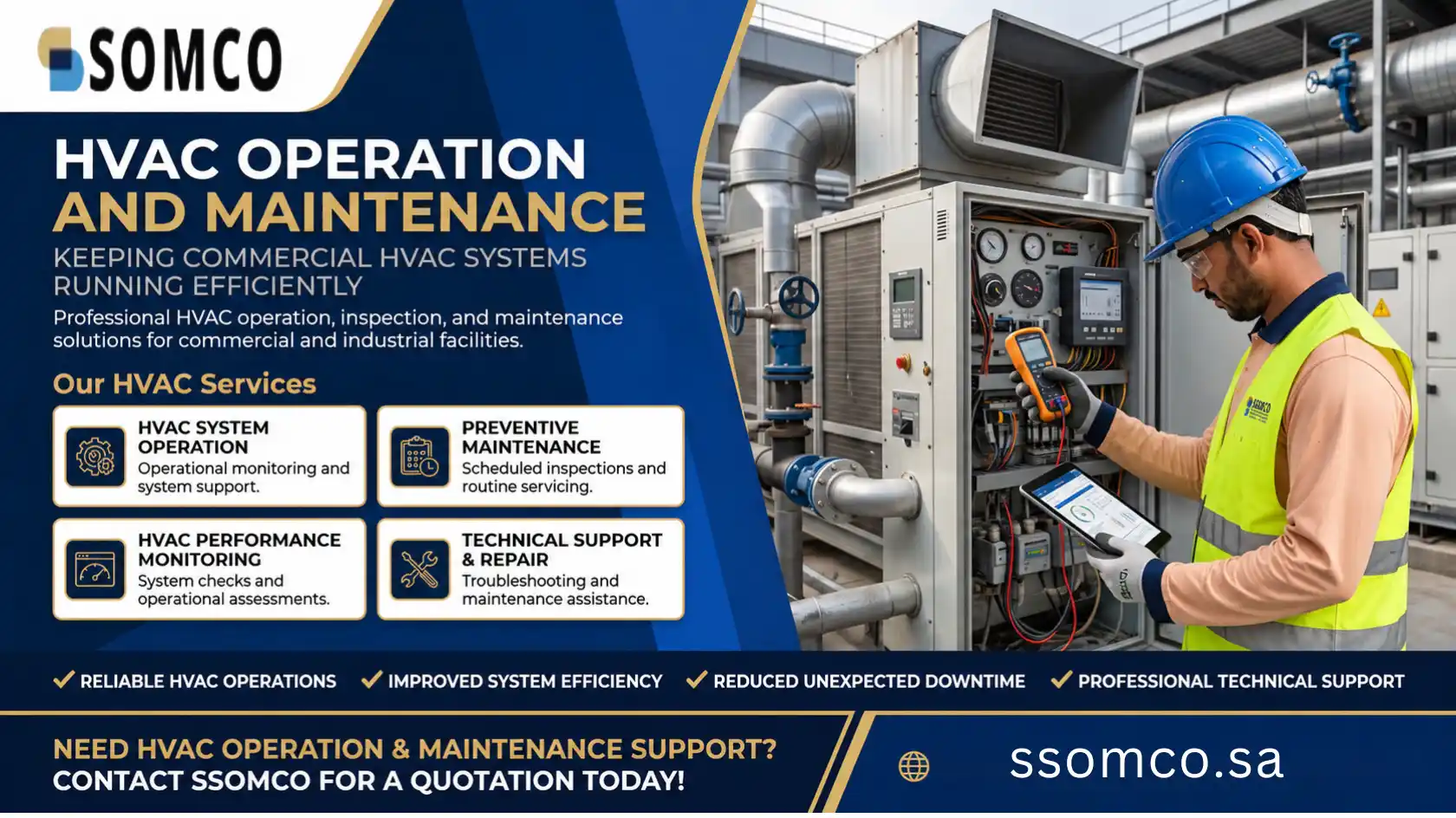
HVAC Operation and Maintenance Services by SSOMCO
Saudi Specialized Operations & Maintenance Company (SSOMCO) provides building operations and maintenance-related solutions for commercial and facility environments.
Effective HVAC management requires more than occasional repairs. It involves understanding equipment requirements, planning maintenance activities, and monitoring system performance.
Businesses looking for HVAC and facility maintenance support can explore SSOMCO’s service offerings and discuss their building requirements with the team.
Whether your facility requires HVAC maintenance, air conditioning servicing, chiller support, VRF/VRV system maintenance, or broader building maintenance, the appropriate service scope should be established according to the installed equipment and project requirements.
Have an HVAC maintenance requirement or an upcoming project? Contact SSOMCO to discuss your requirements and request a quotation.
Website: https://ssomco.sa/
Frequently Asked Questions About HVAC Operation and Maintenance
HVAC operation and maintenance involves managing, monitoring, inspecting, servicing, and repairing heating, ventilation, and air conditioning systems to support reliable performance, indoor comfort, and efficient building operation.
It helps reduce the risk of equipment breakdowns, maintain system performance, support indoor comfort, manage energy consumption, and extend equipment service life.
Preventive maintenance may include filter inspection, coil cleaning, condensate drainage checks, fan and motor inspections, electrical checks, control system reviews, and equipment performance monitoring.
Maintenance frequency depends on equipment type, manufacturer recommendations, operating hours, environmental conditions, and building requirements. A site-specific maintenance schedule is more appropriate than using one frequency for every system.
HVAC operation involves managing how and when equipment runs, including controls and schedules. HVAC maintenance involves inspecting, cleaning, adjusting, servicing, and repairing equipment.
An HVAC annual maintenance contract is an agreement between a customer and a service provider covering specified maintenance activities over an agreed period. Its scope, frequency, exclusions, and commercial terms should be clearly documented.
Yes. Appropriate maintenance, suitable equipment settings, efficient operating schedules, and regular performance reviews can help reduce avoidable energy consumption.
Offices, hotels, shopping malls, hospitals, retail buildings, warehouses, and industrial facilities can all benefit from HVAC operation and maintenance programmes tailored to their equipment and operational requirements.
Conclusion
HVAC operation and maintenance are essential parts of effective commercial building management. Regular inspections, preventive servicing, appropriate operating schedules, and performance monitoring help businesses maintain reliable HVAC systems and manage long-term maintenance requirements.
By establishing a structured maintenance programme and working with an experienced service provider, facility managers can improve equipment oversight, identify potential problems, and support comfortable indoor environments.
For commercial HVAC and building maintenance requirements, contact SSOMCO to discuss a suitable service arrangement for your facility.

Integrated Facility Management | Complete FM Solutions
November 12, 2026 1:58 pm[…] HVAC operation and maintenance. […]