

 Blog
Commercial buildings, hotels, hospitals, shopping centres, and industrial facilities often depend on chiller systems to meet their cooling requirements. These systems are important components of commercial HVAC infrastructure, and their performance can affect indoor comfort, equipment operation, and daily business activities.
Choosing a reliable chiller service company helps businesses organize equipment inspections, preventive maintenance, troubleshooting, and necessary repairs. Regular servicing can also help identify developing faults, monitor operating conditions, and plan maintenance before equipment problems become more disruptive.
For facility managers, selecting the right chiller maintenance provider involves understanding the installed equipment, maintenance requirements, technical capabilities, and expected service scope.
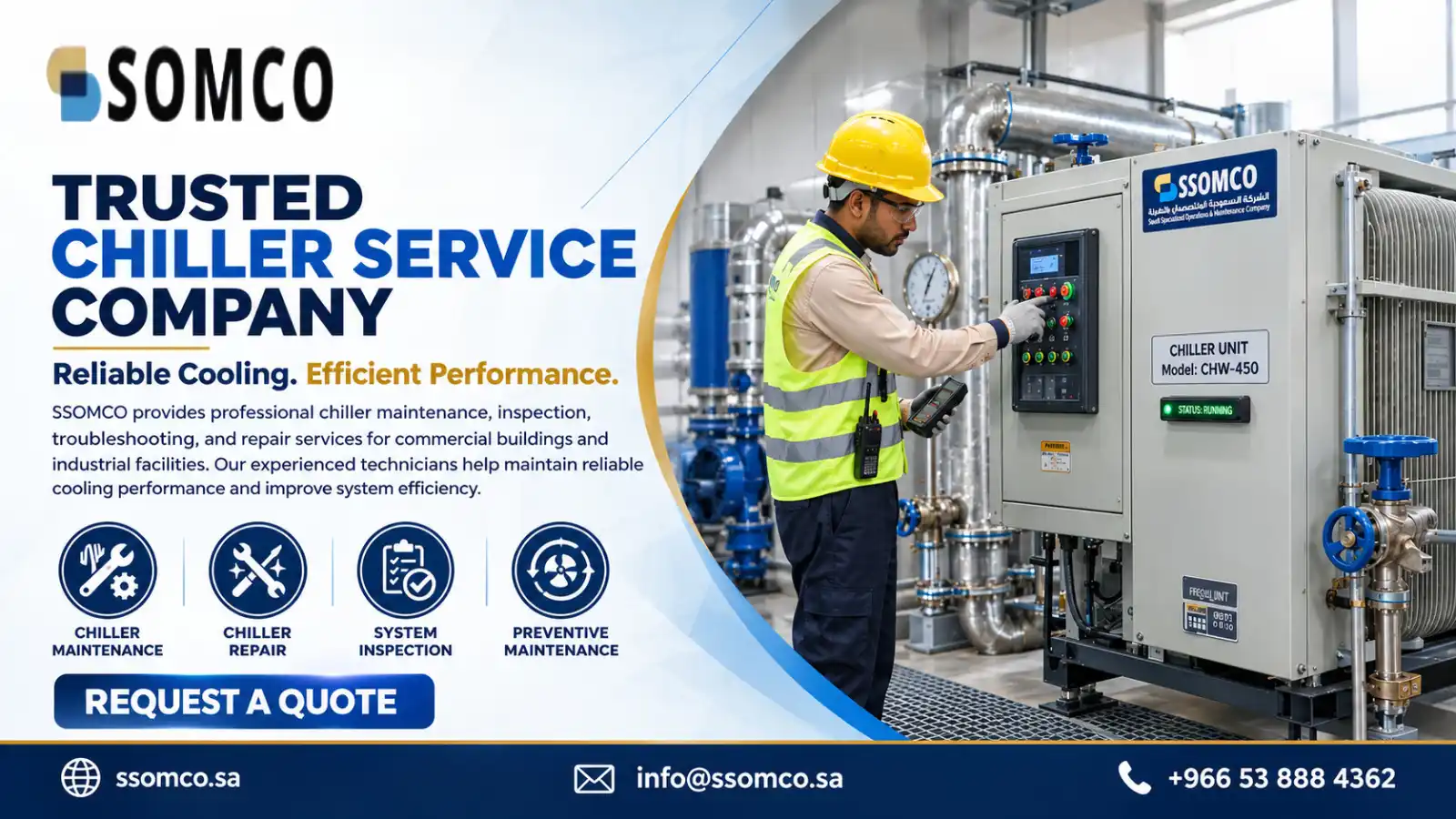
SSOMCO provides HVAC, chiller maintenance, and operation and maintenance solutions for commercial and operational requirements. This guide explains chiller servicing, common equipment problems, preventive maintenance, and how businesses can evaluate a suitable service provider.
What Does a Chiller Service Company Do?
A chiller service company provides technical services related to commercial and industrial chiller systems. Depending on its capabilities and the agreed service scope, these services may include inspection, preventive maintenance, troubleshooting, performance assessment, and corrective repairs.
A commercial chiller system may contain compressors, heat exchangers, refrigerant circuits, pumps, valves, sensors, and control equipment. Water-cooled systems may also operate with cooling towers and associated condenser-water equipment.
A suitable maintenance programme may include:
- Commercial chiller maintenance
- Chiller inspection and troubleshooting
- Preventive maintenance planning
- Air-cooled chiller maintenance
- Water-cooled chiller maintenance
- Chiller control and sensor inspection
- Cooling performance assessment
- Related HVAC maintenance
- Maintenance reporting and repair recommendations
The exact scope depends on the chiller type, manufacturer requirements, operating conditions, and the service agreement.
Why Is Professional Chiller Maintenance Important?
Chillers can operate under demanding conditions in commercial and industrial environments. Maintenance helps businesses monitor equipment condition and identify problems that may affect cooling performance.
1. Maintain Cooling Performance
A chiller must operate with the appropriate water flow, heat transfer, controls, and operating parameters to meet the system’s cooling requirements.
Problems involving dirty heat exchangers, restricted flow, faulty sensors, or other components may affect performance.
Professional inspection helps identify potential causes and determine which corrective measures are appropriate.
2. Identify Equipment Problems Early
Unusual vibration, abnormal operating readings, recurring alarms, and inconsistent chilled-water temperatures can indicate developing equipment problems.
A maintenance provider can investigate these symptoms, review operating information, and recommend corrective work where necessary.
Early identification does not guarantee that equipment failures can be prevented, but it can help businesses make better maintenance decisions.
3. Support Energy Efficiency
Chiller performance depends on factors such as heat exchanger condition, operating temperatures, water flow, control settings, and cooling demand.
Appropriate maintenance can help identify operating conditions that may be reducing efficiency. Actual energy performance depends on the equipment, system design, building requirements, and operating conditions.
4. Improve Maintenance Planning
A structured maintenance programme helps facility managers plan inspections, document faults, and prioritize repairs.
Maintenance records can also help identify recurring problems and support decisions about equipment upgrades or replacement.
5. Support Business Continuity
A chiller problem can affect cooling across the areas served by the system.
Planned maintenance helps businesses identify equipment concerns and organize servicing around operational requirements. The appropriate maintenance approach depends on the criticality of the facility and the consequences of an interruption.
Types of Chiller Systems Requiring Maintenance
Different chiller systems have different operating principles and maintenance requirements. Understanding the installed equipment helps businesses define an appropriate service scope.
Air-Cooled Chiller Maintenance
Air-cooled chillers reject heat through air-cooled condenser coils and fans.
These systems are used in various commercial and industrial applications. Their maintenance requirements depend on equipment design, operating conditions, and manufacturer recommendations.
Typical inspection activities may include:
- Checking condenser coils for dirt or obstruction
- Inspecting condenser fans and motors
- Reviewing operating temperatures and pressures
- Checking accessible electrical components
- Reviewing system alarms and controls
- Investigating unusual noise or vibration
- Checking for visible signs of leakage
Keeping condenser coils clear of dirt and debris can support proper heat transfer and airflow.
Water-Cooled Chiller Maintenance
Water-cooled chillers transfer heat through a water-cooled condenser and commonly operate alongside a cooling tower.
Maintenance may involve inspecting heat exchangers, reviewing water flow, checking relevant controls, and coordinating cooling tower maintenance where included in the service scope.
Depending on the system, maintenance activities may include:
- Inspecting condenser and evaporator heat exchangers
- Reviewing chilled-water and condenser-water conditions
- Checking pumps, valves, and strainers
- Assessing water treatment arrangements
- Reviewing chiller operating parameters
- Inspecting sensors and controls
- Documenting identified maintenance issues
Water quality and heat exchanger condition are important considerations because scale and fouling can interfere with heat transfer.
Centrifugal Chiller Maintenance
Centrifugal chillers are commonly used in large cooling installations where substantial cooling capacity is required.
Their maintenance involves equipment-specific procedures and may include reviewing compressor operation, controls, heat exchanger performance, electrical components, and other relevant systems.
Servicing should follow the manufacturer’s instructions and be carried out by appropriately qualified personnel.
Screw Chiller Maintenance
Screw chillers use screw compressors to provide cooling.
Maintenance requirements depend on the equipment design and operating conditions. Depending on the model, inspections may involve reviewing compressor parameters, electrical components, controls, heat exchangers, and refrigerant-related operating conditions.
A suitable service plan should follow the manufacturer’s recommendations.
What Is Included in Commercial Chiller Servicing?
A professional chiller service visit should be planned according to the equipment type and reported operating conditions.
Equipment Inspection
The technician reviews the equipment’s condition and looks for visible damage, leakage, corrosion, unusual noise, or other signs requiring investigation.
Operating Parameter Checks
Relevant operating readings may be compared with the manufacturer’s guidance, system design information, and previous records.
These readings can help identify changes that require further investigation.
Heat Exchanger Inspection
Heat exchanger condition affects the transfer of heat within the chiller system.
Inspection and appropriate cleaning may be recommended where scale, dirt, or other contamination affects performance.
Electrical and Control Checks
Electrical components, sensors, control settings, alarms, and safety devices may require inspection according to the equipment’s maintenance requirements.
Electrical testing and repairs should be performed by qualified personnel using appropriate safety procedures.
Refrigerant System Assessment
For applicable systems, technicians may assess refrigerant-related operating conditions and investigate suspected leaks according to manufacturer guidance and applicable requirements.
Refrigerant handling should be carried out by appropriately qualified personnel.
Maintenance Reporting
A useful service report should document:
- Inspection activities completed
- Operating issues identified
- Corrective work performed
- Outstanding faults
- Recommended repairs
- Further maintenance requirements
These records help facility managers track equipment condition and plan subsequent work.
Common Chiller Problems and Warning Signs
Recognizing unusual operating conditions can help businesses arrange an inspection before problems cause additional disruption.
Insufficient Cooling
A chiller may struggle to meet cooling demand because of heat transfer problems, restricted water flow, equipment faults, incorrect controls, or other system conditions.
The underlying cause should be investigated before repairs are selected.
Frequent Alarms or Shutdowns
Repeated alarms may indicate operating conditions outside the expected range, control problems, electrical faults, or equipment protection mechanisms being activated.
Alarm codes and operating records can help qualified technicians investigate the issue.
Unusual Noise or Vibration
Unexpected noise or vibration may indicate a mechanical problem or another abnormal operating condition.
The equipment should be inspected to establish the cause and determine whether corrective action is necessary.
Water Flow Problems
Inadequate or unstable water flow may affect chiller operation.
Potential causes can include pump problems, blocked strainers, valve issues, or control faults. The appropriate checks depend on the system configuration.
Increased Energy Consumption
Changes in energy consumption may result from increased cooling demand, operating schedule changes, heat exchanger fouling, control problems, or other factors.
Comparing operating data and energy use with an appropriate baseline can help identify areas for investigation.
Refrigerant or Oil Leakage
Signs of leakage require appropriate investigation. Refrigerant-related work must follow applicable safety requirements and equipment-specific procedures.
How Often Should a Commercial Chiller Be Serviced?
There is no single maintenance schedule suitable for every chiller.
The appropriate frequency depends on the manufacturer’s recommendations, operating hours, environmental conditions, equipment condition, system criticality, and maintenance history.
A maintenance programme may combine routine operational monitoring with scheduled professional inspections and more detailed servicing when required.
Facility managers should consider:
- Manufacturer maintenance requirements
- Chiller operating hours and cooling demand
- Previous equipment faults
- Operating readings and alarm history
- Heat exchanger and water system condition
- Consequences of an unexpected shutdown
A qualified service provider can help establish a maintenance plan that reflects the installed equipment and operational needs.
How to Choose the Right Chiller Service Company
Selecting a suitable chiller maintenance provider is important for commercial facilities that depend on reliable cooling equipment.
Check Relevant Technical Experience
Confirm that the provider has experience with your chiller type and the equipment installed at your property.
Requirements may differ between air-cooled, water-cooled, centrifugal, and screw chiller systems.
Define the Required Services
Clarify whether you need preventive maintenance, troubleshooting, corrective repairs, performance assessment, or a broader HVAC operation and maintenance arrangement.
Make sure the quotation clearly identifies the services included.
Review Maintenance Procedures
Ask how equipment inspections will be documented, how identified faults will be reported, and how recommended repairs will be prioritized.
Confirm Service Availability
Discuss the provider’s service coverage for your property location and the arrangements available for urgent maintenance requirements.
Any response times or service commitments should be confirmed in the agreement.
Understand the Quotation
Review the commercial terms carefully, including labour, spare parts, consumables, specialist work, and exclusions.
A clear quotation helps businesses understand the expected scope and associated costs.
Request Service Documentation
Maintenance reports and equipment records help facility managers track work history, recurring faults, and outstanding recommendations.
Why Consider SSOMCO for Chiller Maintenance Services?
SSOMCO provides HVAC, air conditioning, operation and maintenance, and related building maintenance solutions for commercial and operational requirements.
Businesses can contact SSOMCO to discuss their requirements for chiller maintenance and associated HVAC services.
Depending on the property’s equipment and agreed service scope, relevant maintenance requirements may involve:
- Chiller maintenance
- HVAC preventive maintenance
- Commercial AC maintenance
- HVAC operation and maintenance
- HVAC installation
- Air duct cleaning
- Air balancing
- Related building maintenance
The appropriate service arrangement depends on the installed equipment, property location, operational requirements, and confirmed service availability.
For facility managers responsible for commercial cooling systems, discussing equipment details and maintenance priorities can help establish a suitable service scope.
Request a Chiller Maintenance Quotation
If you manage a commercial building, hotel, office, retail facility, or industrial property, understanding your chiller maintenance requirements is an important step toward organizing suitable technical support.
When requesting a quotation, provide the following information:
- Property location and type
- Chiller manufacturer and model, if available
- Chiller type and capacity, if known
- Current operating problems or alarms
- Required maintenance activities
- Existing maintenance arrangements
- Preferred servicing schedule
These details help the service provider understand the equipment and discuss an appropriate scope of work.
Looking for a chiller service company for your commercial facility? Contact SSOMCO to discuss your chiller maintenance requirements and request a quotation.
Phone: +966 538884362 | +966 508811196
Email: info@ssomco.sa
Website: https://ssomco.sa/
Frequently Asked Questions
A chiller service company may provide equipment inspections, preventive maintenance, troubleshooting, performance assessment, and corrective repairs. The available services depend on the provider's technical capabilities and the agreed scope of work.
Commercial chiller maintenance helps monitor equipment condition, identify developing faults, assess operating performance, and plan corrective work.
Air-cooled chillers reject heat through air-cooled condenser coils and fans. Water-cooled chillers transfer heat through a water-cooled condenser and commonly use a cooling tower or another heat-rejection arrangement.
Warning signs may include insufficient cooling, unusual noise, recurring alarms, unstable operating conditions, visible leakage, and changes in energy consumption.
Appropriate maintenance can help identify conditions such as heat exchanger fouling, control problems, and unsuitable operating conditions that may affect efficiency. Results depend on the equipment and the problems identified.
Evaluate the provider's experience with your equipment, service scope, maintenance reporting, availability, safety procedures, and quotation terms.
Contact SSOMCO with your property location, chiller details, and maintenance requirements to discuss relevant services and request a quotation.
Conclusion
Choosing the right chiller service company helps commercial facility managers organize inspections, monitor equipment condition, and plan appropriate maintenance activities.
From air-cooled and water-cooled chillers to larger commercial cooling installations, each system requires maintenance based on its design, operating conditions, and manufacturer’s recommendations.
For chiller maintenance, HVAC servicing, and related building maintenance requirements, contact SSOMCO to discuss your facility’s needs and request a quotation.
