

 Blog
Properly designed and maintained ductwork is an essential part of an efficient heating, ventilation, and air conditioning system. Ductwork distributes conditioned air throughout a building, helping maintain comfortable indoor temperatures and appropriate ventilation.
For commercial buildings, industrial facilities, hospitals, hotels, offices, shopping centers, restaurants, and other large properties, poorly designed or damaged ductwork can affect airflow, indoor air quality, energy efficiency, and HVAC performance.
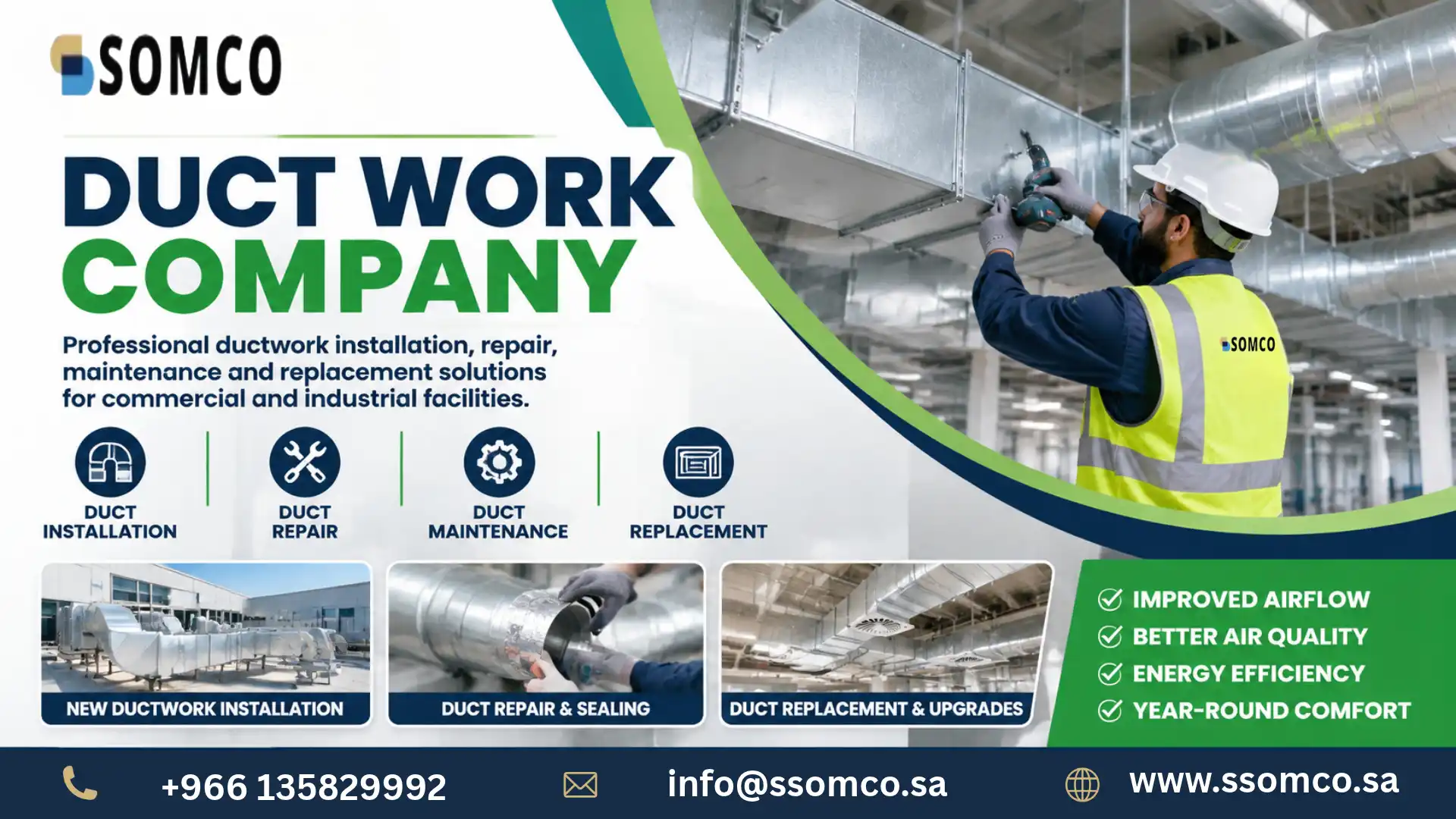
Choosing an experienced duct work company in Saudi Arabia can help businesses design, install, inspect, repair, and maintain ductwork according to the requirements of their building and HVAC system.
In this guide, we explain ductwork systems, common services, different types of ductwork, maintenance requirements, and how to choose the right ductwork contractor in Saudi Arabia.
What Is HVAC Ductwork?
HVAC ductwork is a network of passages used to transport conditioned or ventilated air between an air handling unit, HVAC equipment, and different areas of a building.
Depending on the system, ductwork can transport:
- Supply air
- Return air
- Fresh air
- Exhaust air
- Conditioned air
- Ventilation air
A complete ductwork system may include ducts, fittings, dampers, grilles, diffusers, access panels, insulation, flexible connections, and other components.
The design of these components must work together with the building’s HVAC equipment and layout.
Why Is Professional Ductwork Important?
Ductwork is more than simply a pathway for air. Its design, installation, insulation, sealing, and maintenance can influence the performance of the entire HVAC system.
1. Efficient Air Distribution
Properly designed ductwork helps distribute air to the required areas of a building.
Incorrect sizing, excessive bends, poor connections, or inadequate balancing can create uneven airflow between rooms and zones.
2. HVAC System Performance
An HVAC system depends on appropriate airflow to operate effectively.
Restricted or leaking ducts can increase the workload on air-handling equipment and may affect overall system performance.
3. Indoor Air Quality
Duct systems can transport air throughout occupied spaces.
Keeping ductwork and associated HVAC components clean and properly maintained can help support good indoor environmental conditions.
4. Energy Efficiency
Air leakage and excessive resistance within a duct system can contribute to energy losses.
Proper sealing, insulation, sizing, and balancing can help reduce unnecessary losses.
5. Building Comfort
Commercial buildings often contain multiple rooms and zones with different occupancy patterns.
A properly designed duct system helps deliver the required airflow to different areas and supports more consistent indoor conditions.
Duct Work Services in Saudi Arabia
A professional ductwork contractor may provide a range of services depending on the building and HVAC requirements.
Ductwork Design
Ductwork design is an important stage of any new HVAC project or major modification.
Design considerations may include:
- Building layout
- Required airflow
- HVAC equipment capacity
- Duct dimensions
- Air velocity
- Pressure losses
- Number and location of diffusers
- Return-air requirements
- Fresh-air requirements
- Access for maintenance
- Insulation requirements
Proper coordination with architectural, electrical, plumbing, and mechanical systems is essential.
Ductwork Installation
Duct installation involves manufacturing, assembling, supporting, sealing, insulating, and connecting duct sections according to the approved design.
Installation quality is important because poorly connected or inadequately supported ducts can develop leakage, vibration, noise, or other operational problems.
Ductwork Repair
Existing duct systems can develop problems due to age, physical damage, corrosion, poor installation, or modifications to the building.
Ductwork repair may involve:
- Repairing damaged sections
- Sealing leaks
- Replacing insulation
- Repairing connections
- Replacing damaged flexible ducts
- Repairing supports
- Correcting damaged fittings
- Replacing defective dampers
The appropriate repair method depends on the condition and construction of the existing system.
Ductwork Replacement
Sometimes repairing an existing duct is not practical.
Severely damaged, corroded, poorly designed, or outdated duct sections may need to be replaced.
Replacement can also be required during major building renovations when the HVAC layout is being modified.
Duct Insulation
Insulation is an important part of many HVAC duct systems.
Proper insulation can help reduce heat transfer and condensation risks where applicable.
The appropriate insulation material and thickness depend on the system design, location, operating conditions, and applicable project specifications.
Air Duct Sealing
Duct leakage can reduce the amount of air reaching its intended destination.
Professional sealing can address leakage around:
- Joints
- Flanges
- Connections
- Access panels
- Fittings
- Other duct-system interfaces
Sealing requirements should be determined according to the duct system and applicable project standards.
Duct Cleaning
Over time, dust and other particles can accumulate inside duct systems depending on building conditions and HVAC operation.
Professional duct cleaning can help remove accumulated contaminants where cleaning is appropriate.
Cleaning requirements should be assessed rather than assuming every duct system requires the same cleaning frequency.
Types of HVAC Ductwork
Different buildings may use different duct materials and configurations.
1. Galvanized Steel Ductwork
Galvanized steel is widely used in commercial HVAC applications.
It offers durability and can be fabricated into a wide range of duct shapes and fittings.
2. Stainless Steel Ductwork
Stainless steel may be selected for environments requiring particular corrosion resistance or hygiene characteristics.
Its suitability depends on the application and project specifications.
3. Aluminum Ductwork
Aluminum ductwork can be useful where lightweight construction and corrosion resistance are important considerations.
4. Flexible Ductwork
Flexible ducts are commonly used for certain connections between main duct systems and air terminals.
They can be convenient for specific applications but should be installed appropriately to avoid excessive bends, compression, or airflow restrictions.
5. Fabric Duct Systems
Fabric air distribution systems can be used in selected commercial and industrial environments.
Their application depends on airflow requirements, building use, interior design considerations, and system specifications.
Ductwork for Commercial Buildings
Commercial properties often have complex HVAC requirements because they contain different occupancy areas and operating schedules.
Professional ductwork services may be required for:
- Office buildings
- Shopping centers
- Hotels
- Restaurants
- Hospitals
- Schools
- Universities
- Retail stores
- Warehouses
- Business centers
The duct system should be coordinated with the building layout, ceiling systems, lighting, fire protection, electrical services, and other MEP installations.
Industrial Ductwork Services
Industrial facilities may have more specialized ventilation requirements than conventional office buildings.
Depending on the facility, ductwork can be used for:
- General ventilation
- Fresh-air distribution
- Exhaust systems
- Process ventilation
- Heat removal
- Industrial air movement
- Specialized extraction systems
Industrial applications require careful evaluation of the operating environment, materials, temperatures, contaminants, and safety requirements.
Specialized exhaust or process systems should be designed according to the applicable engineering requirements rather than treated as standard comfort-air ductwork.
Ductwork for Restaurants and Commercial Kitchens
Commercial kitchens require carefully planned ventilation and exhaust systems.
Kitchen exhaust ductwork transports grease-laden air away from cooking equipment and is therefore subject to specialized design, cleaning, inspection, and fire-safety considerations.
A commercial kitchen may require:
- Exhaust ductwork
- Fresh-air systems
- Make-up air
- Exhaust fans
- Kitchen hoods
- Grease management
- Access for inspection and cleaning
Kitchen exhaust systems should be handled according to applicable safety and fire requirements.
Common Ductwork Problems
Several problems can affect HVAC duct systems.
Air Leakage
Leaks at joints and connections can reduce the amount of air reaching occupied spaces.
Poor Insulation
Inadequate or damaged insulation can contribute to unwanted heat transfer and condensation under certain operating conditions.
Restricted Airflow
Blocked ducts, excessive bends, damaged flexible ducts, or poorly designed systems can restrict airflow.
Damaged Ducts
Physical impact, corrosion, construction activity, or aging can damage duct sections.
Poor Air Balancing
If a system is not properly balanced, some areas may receive too much air while others receive insufficient airflow.
Dirty Ductwork
Accumulated dust and debris can affect system cleanliness and may require professional assessment and cleaning.
Damaged Dampers
Dampers control or regulate airflow in many HVAC systems. Damaged or incorrectly positioned dampers can affect air distribution.
Signs Your Building May Need Ductwork Inspection
Facility managers should consider professional inspection when they notice:
- Uneven temperatures between rooms.
- Weak airflow from diffusers.
- Unusual HVAC noise.
- Visible damage to ducts.
- Damaged insulation.
- Persistent dust around supply outlets.
- Unexpected increases in HVAC operating requirements.
- Condensation around ductwork.
- Airflow problems after building renovations.
- Repeated HVAC performance complaints.
A professional inspection can help determine whether the problem originates from the duct system or another part of the HVAC installation.
Ductwork Maintenance Checklist
Regular inspection can help facility teams identify problems before they become more serious.
Component | Inspection / Maintenance Activity |
Duct surfaces | Check for physical damage |
Joints | Inspect for visible leakage |
Insulation | Check for damage or deterioration |
Dampers | Check operation and condition |
Flexible ducts | Inspect for compression or damage |
Access panels | Check condition and sealing |
Diffusers | Inspect and clean as appropriate |
Grilles | Check cleanliness and condition |
Supports | Inspect for damage or looseness |
Internal surfaces | Assess cleanliness where appropriate |
The actual inspection frequency should depend on building type, HVAC usage, environmental conditions, system design, and maintenance requirements.
How to Choose a Duct Work Company in Saudi Arabia
Choosing the right ductwork contractor matters for both new installations and existing HVAC systems.
1. Check Technical Experience
Choose a company with experience relevant to your property type and HVAC system.
2. Review Previous Projects
Ask about comparable commercial, industrial, hospitality, healthcare, or institutional projects.
3. Evaluate Engineering Capability
The contractor should understand duct sizing, airflow, pressure losses, insulation, sealing, balancing, and coordination with other MEP systems.
4. Ask About Installation Standards
Duct fabrication, installation, supports, insulation, sealing, and testing should follow the approved project specifications and applicable standards.
5. Consider Maintenance Capability
A contractor capable of supporting the system after installation can be valuable for long-term facility operations.
6. Request a Detailed Proposal
The proposal should clearly identify:
- Scope of work
- Materials
- Duct specifications
- Insulation
- Equipment
- Labor
- Testing
- Commissioning
- Exclusions
- Project schedule
7. Verify Safety Procedures
Ductwork installation and maintenance can involve working at height, lifting equipment, electrical systems, and active building environments.
Proper site safety procedures should therefore be part of the project.
Ductwork and HVAC Maintenance
Ductwork should not be considered separately from the wider HVAC system.
An effective HVAC maintenance program may include inspection of:
- Air handling units
- Ductwork
- Filters
- Fans
- Dampers
- Diffusers
- Grilles
- Insulation
- Controls
- Ventilation systems
Coordinating these components helps facility teams identify whether airflow or comfort problems originate from the duct system, HVAC equipment, controls, or another part of the installation.
Duct Work Services Across Saudi Arabia
Saudi Arabia’s commercial and industrial facilities operate in a wide range of environments, from major metropolitan areas to industrial and developing regions.
Businesses may require ductwork services for new construction, renovation projects, HVAC upgrades, maintenance programs, or facility management contracts.
Depending on project requirements and service availability, ductwork and HVAC support may be required across major Saudi markets including:
- Riyadh
- Jeddah
- Dammam
- Al Khobar
- Dhahran
- Jubail
- Al Ahsa
- Makkah
- Madinah
- Yanbu
- Tabuk
- Abha
- Khamis Mushait
- Jazan
- Qassim
Service availability should always be confirmed based on the project’s location and requirements.
SSOMCO HVAC and Facility Maintenance Services
SSOMCO provides specialized operations and maintenance solutions for commercial, industrial, and other facilities in Saudi Arabia.
Ductwork is an important part of the wider HVAC system, and its performance should be considered alongside air conditioning, ventilation, preventive maintenance, and facility operations.
SSOMCO’s HVAC and facility management capabilities can support businesses that require structured maintenance and operational support for their building systems.
Depending on the project scope, services can include HVAC maintenance, preventive maintenance, facility management, air duct cleaning, and related building services.
For facilities experiencing airflow problems, HVAC performance issues, or ductwork-related concerns, a professional assessment can help identify the appropriate corrective or maintenance requirements.
Contact SSOMCO to discuss your facility’s HVAC and ductwork requirements.
Frequently Asked Questions About Ductwork Services in Saudi Arabia
A ductwork company can design, fabricate, install, inspect, repair, seal, insulate, replace, and maintain HVAC duct systems depending on its service scope.
There is no universal frequency for every building. Inspection requirements depend on building use, environmental conditions, HVAC operation, system condition, and the facility's maintenance program.
Common causes include poorly sealed joints, damaged connections, deteriorated materials, physical damage, and inadequate installation.
Yes. Duct leakage, restrictions, poor insulation, or damaged components can affect airflow and HVAC performance.
Not necessarily. The need for duct cleaning should be determined through appropriate inspection and assessment of the system's condition and building environment.
Ductwork refers to the physical network used to distribute or exhaust air. Duct cleaning is a maintenance activity intended to remove accumulated dust or other contaminants from appropriate parts of the system.
In many cases, damaged sections can be repaired. However, replacement may be more appropriate when damage is extensive, the system is poorly designed, or the affected component cannot be effectively restored.
Duct insulation can help reduce heat transfer and, under appropriate conditions, reduce condensation risks. The correct insulation specification depends on the system and project requirements.
Conclusion
Ductwork is a critical component of commercial and industrial HVAC systems. Proper design, installation, sealing, insulation, inspection, and maintenance can support efficient air distribution and reliable building operation.
For businesses searching for a duct work company in Saudi Arabia, it is important to select a contractor with appropriate technical experience, project capabilities, safety procedures, and understanding of HVAC systems.
SSOMCO provides HVAC, facility management, and related maintenance solutions for facilities across Saudi Arabia, helping businesses maintain reliable building operations.
Need professional HVAC or ductwork support? Contact SSOMCO to discuss your project requirements and request a service assessment.
