

 Blog
Managing a commercial or industrial property requires careful coordination of building systems, maintenance activities and daily operational requirements. From air conditioning and electrical systems to cleaning and general building maintenance, every facility needs appropriate management to support its day-to-day operations.
This is why businesses rely on professional facility management companies to help maintain their buildings, manage maintenance requirements and create functional environments for employees, customers and visitors.
Whether you manage an office, hotel, shopping centre, warehouse or industrial facility, selecting the right facility management partner can make a significant difference to building operations.
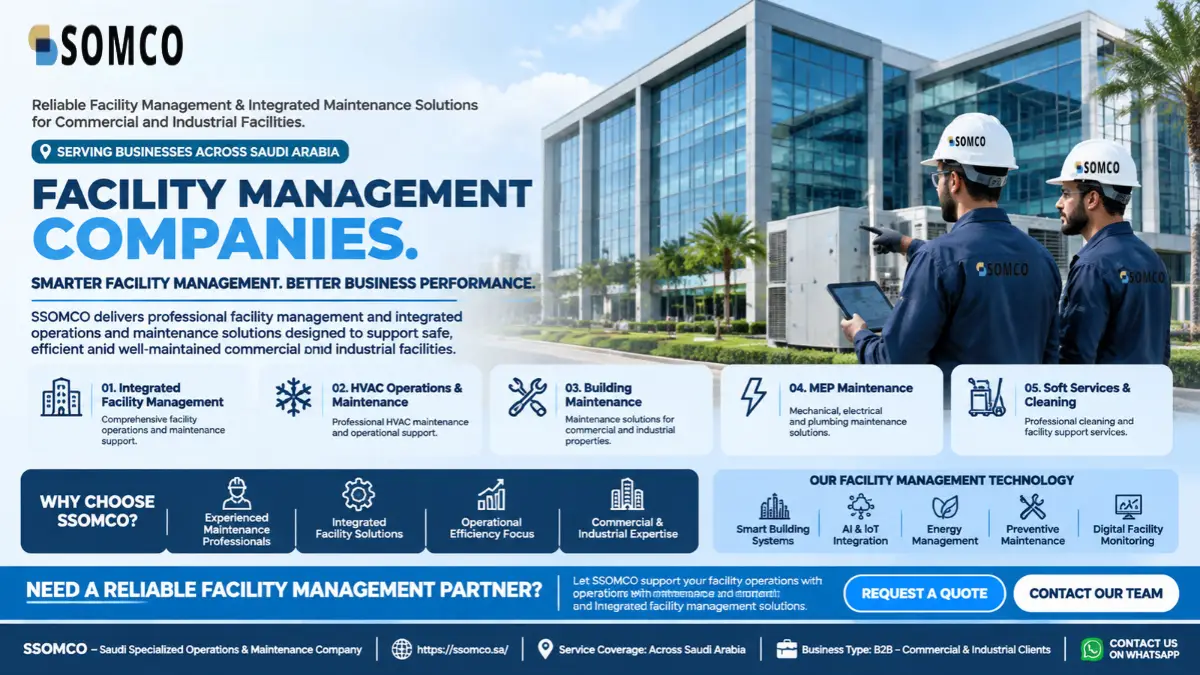
SSOMCO (Saudi Specialized Operations & Maintenance Company) provides HVAC and maintenance solutions for commercial and industrial facilities. Understanding facility management services and the responsibilities of a service provider can help businesses make informed decisions.
What Are Facility Management Companies?
Facility management companies help organizations manage and maintain their buildings, equipment and related services.
Their responsibilities may include technical maintenance, building operations, cleaning, workplace support and other services required to maintain a functional property.
Facility management generally covers two main categories:
- Hard Facility Management: Technical services involving building infrastructure, equipment and engineering systems.
- Soft Facility Management: Services that support cleanliness, comfort and the daily experience of building occupants.
The exact responsibilities depend on the service provider, property type and agreed contract.
Types of Facility Management Services
Different facilities have different operational requirements. Facility management services can be arranged according to the building’s size, equipment, and business activities.
1. Hard Facility Management Services
Hard facility management focuses on the physical infrastructure and technical systems of a building.
Common areas include:
- Air conditioning maintenance.
- Electrical system maintenance.
- Plumbing and drainage maintenance.
- Mechanical equipment maintenance.
- Building infrastructure inspections.
- Preventive and corrective maintenance.
These services help maintain the condition and operation of essential building systems.
2. Soft Facility Management Services
Soft facility management focuses on services that support the cleanliness, usability and comfort of a property.
Depending on the provider and contract, these services may include:
- Commercial cleaning.
- Janitorial services.
- Housekeeping.
- Waste management.
- Landscaping.
- Pest control.
- Reception and workplace support.
Not every facility management company provides every soft service. Businesses should confirm the actual service scope before entering into an agreement.
3. Integrated Facility Management
Integrated facility management combines multiple building management services under a coordinated service arrangement.
Instead of managing several separate contractors independently, a business may work with one provider responsible for coordinating an agreed range of services.
An integrated approach may help organizations:
- Coordinate maintenance activities.
- Manage service providers.
- Establish consistent reporting procedures.
- Monitor service performance.
- Organize operational responsibilities.
- Improve communication between facility teams.
The success of an integrated arrangement depends on clearly defined responsibilities and measurable service expectations.
Why Do Businesses Need Professional Facility Management?
Commercial and industrial properties require regular attention to maintain their systems and support daily operations.
Professional facility management can help organizations manage these requirements through structured maintenance and service arrangements.
1. Better Building Maintenance
Regular inspections and planned maintenance help identify equipment issues and building-related problems before they become more serious.
2. Improved Operational Coordination
Facility management can bring different maintenance activities together under an organized process.
This helps property managers coordinate maintenance schedules, service requests and contractor responsibilities.
3. Equipment Condition Management
HVAC systems, mechanical equipment and other building assets require appropriate maintenance.
A planned approach helps businesses monitor equipment conditions and organize necessary servicing.
4. Cleaner and More Functional Workplaces
Appropriate cleaning and support services contribute to a more organized environment for employees, visitors and customers.
5. More Effective Maintenance Planning
A structured maintenance program helps facility teams plan inspections, document completed activities and prioritize identified problems.
6. Clearer Service Accountability
A well-defined contract establishes which services the provider is responsible for delivering and how performance will be reviewed.
Industries That Require Facility Management Services
Facility management requirements vary according to building type and business activities.
Corporate Offices
Offices require suitable HVAC maintenance, building support and cleaning arrangements to maintain a comfortable and functional workplace.
Hotels and Hospitality Facilities
Hotels operate multiple areas, including guest rooms, reception spaces, restaurants, and common facilities. Their maintenance requirements involve coordination across different building systems.
Shopping Malls and Retail Properties
Retail buildings require organized maintenance of common areas, HVAC systems, and other essential building components.
Industrial Facilities
Industrial properties may require technical maintenance for installed equipment, ventilation systems, and building infrastructure.
Warehouses and Logistics Centres
Warehouses depend on suitable building maintenance and operational support to maintain functional storage and working environments.
Educational and Institutional Buildings
Schools, colleges, and institutional properties require maintenance planning and support services according to their building usage and operational needs.
Facility Management vs. Building Maintenance
Facility management and building maintenance are closely related, but they are not exactly the same.
Facility Management | |
Covers broader building operations and support services | Focuses on maintaining building components and systems |
May include hard and soft services | Mainly involves inspections, servicing and repairs |
Coordinates different operational requirements | Addresses specific maintenance activities |
May include asset and service management | Focuses on building and equipment condition |
Building maintenance is often one important part of a wider facility management arrangement.
How to Choose the Right Facility Management Company
Selecting a facility management provider requires careful evaluation. Businesses should consider the following factors before making a decision.
1. Understand Your Facility Requirements
Start by identifying the type of property, its operating hours, installed equipment and required services.
An office building may have different requirements from a warehouse or industrial facility.
2. Review Service Capabilities
Check whether the company offers the services your facility needs.
If technical maintenance is important, review its experience with HVAC systems, mechanical equipment and building maintenance.
3. Evaluate Relevant Experience
Look for experience with similar property types and operational environments.
A provider familiar with commercial buildings may understand requirements that differ from those of industrial facilities.
4. Review the Maintenance Approach
Ask how the company plans inspections, preventive maintenance and corrective work.
A suitable proposal should explain maintenance activities and how identified problems will be handled.
5. Check Staff and Technical Resources
Understand how the provider manages its workforce, technical supervision, equipment and subcontractors where applicable.
6. Review Reporting and Communication
Maintenance reports and service records help businesses monitor completed work and outstanding requirements.
Ask how service requests, maintenance activities, and performance information will be communicated.
7. Compare Contracts and Quotations
Do not compare providers on price alone.
Review the service scope, maintenance frequency, responsibilities, exclusions, materials, spare parts and commercial terms.
What Should a Facility Management Contract Include?
A clear agreement helps both the property owner and service provider understand their responsibilities.
Important contract elements include:
- Description of included services.
- Building and equipment details.
- Preventive maintenance schedule.
- Corrective maintenance procedures.
- Service-level expectations.
- Reporting requirements.
- Health and safety responsibilities.
- Labour and supervision arrangements.
- Spare parts and material responsibilities.
- Contract duration and commercial conditions.
- Exclusions and additional services.
Businesses should ensure that the agreed scope reflects their actual operational requirements.
The Role of Preventive Maintenance in Facility Management
Preventive maintenance is an important part of managing building equipment and systems.
Instead of waiting for equipment to develop a fault, preventive maintenance involves planned inspections and servicing based on manufacturer recommendations, operating conditions and equipment history.
Common preventive maintenance activities may include:
- HVAC equipment inspections.
- Air conditioning filter checks.
- Chiller system inspections.
- Mechanical equipment assessments.
- Electrical system inspections.
- Drainage system checks.
- Maintenance record updates.
A suitable maintenance schedule helps facility teams monitor equipment conditions and identify issues that require attention.
How Technology Supports Modern Facility Management
Technology can help facility managers organize building operations and maintenance activities.
Depending on the provider’s systems and the property’s requirements, digital tools may support:
Computer-Aided Facility Management (CAFM): Helps manage assets, maintenance requests, work orders and service records.
Building Management Systems (BMS): Allow monitoring and control of compatible building systems, including HVAC and other connected equipment.
Digital Maintenance Records: Help maintain information about inspections, equipment history and completed maintenance activities.
Performance Reporting: Supports the review of maintenance progress and service delivery against agreed requirements.
Technology should support an effective maintenance strategy rather than replace qualified technical inspections.
How SSOMCO Supports Facility Maintenance Requirements
SSOMCO – Saudi Specialized Operations & Maintenance Company – provides HVAC and maintenance solutions for commercial and industrial facilities.
Our service portfolio includes:
- HVAC maintenance.
- Air conditioning maintenance.
- VRF and VRV system services.
- Building maintenance.
- Commercial kitchen hood cleaning.
- HVAC installation and related services.
Every property has different operational requirements. Our team can discuss the facility, installed equipment and required maintenance scope to identify suitable service options.
For businesses evaluating facility management companies, understanding the technical maintenance capabilities of a provider is an important part of selecting the right partner.
Request Facility Maintenance Support for Your Business
Are you managing an office, commercial building, hotel, retail property or industrial facility?
SSOMCO can discuss your HVAC and maintenance requirements and help you understand the appropriate service scope.
When contacting our team, share the following information:
- Company and facility name.
- Building location.
- Type of property.
- Installed HVAC equipment.
- Required maintenance services.
- Current maintenance challenges.
- Project or service requirements.
Contact SSOMCO today to discuss your commercial and industrial maintenance requirements and request a quotation.
Website: https://ssomco.sa/
Frequently Asked Questions About Facility Management Companies
Facility management companies help businesses manage building operations, technical maintenance and support services. Their responsibilities depend on the agreed contract and may include HVAC maintenance, building maintenance, cleaning and other facility-related services.
The main categories are hard facility management, soft facility management and integrated facility management. Hard services focus on building infrastructure and equipment, while soft services support cleanliness and workplace functionality.
Facility management focuses on building operations, maintenance and workplace services. Property management generally focuses on managing real estate assets, tenant relationships, leases and property-related commercial responsibilities.
Preventive maintenance helps identify potential equipment issues, organize planned servicing and maintain building systems according to equipment requirements.
Common sectors include commercial offices, hotels, shopping centers, healthcare facilities, educational institutions, warehouses and industrial properties.
Businesses should review the provider's service capabilities, relevant experience, maintenance procedures, workforce arrangements, reporting methods, contract scope and commercial terms.
Integrated facility management combines multiple facility services under a coordinated management arrangement. It can help businesses manage different operational requirements through a single agreed service structure.
Many facility management providers offer HVAC maintenance as part of their hard facility management services. However, businesses should confirm the provider's technical capabilities and the exact equipment included in the contract.
Costs depend on facility size, equipment condition, service scope, operating hours, maintenance requirements and contract terms. A detailed assessment is necessary to prepare an appropriate quotation.
Businesses can contact SSOMCO through its website and share their facility location, equipment details and required services to discuss suitable maintenance solutions and quotation arrangements.
