

 Blog
A reliable chiller system is essential for maintaining comfortable indoor environments and supporting temperature-sensitive operations in commercial and industrial facilities. When a chiller develops a fault, cooling performance can decline, energy consumption may increase, and business operations can be disrupted.
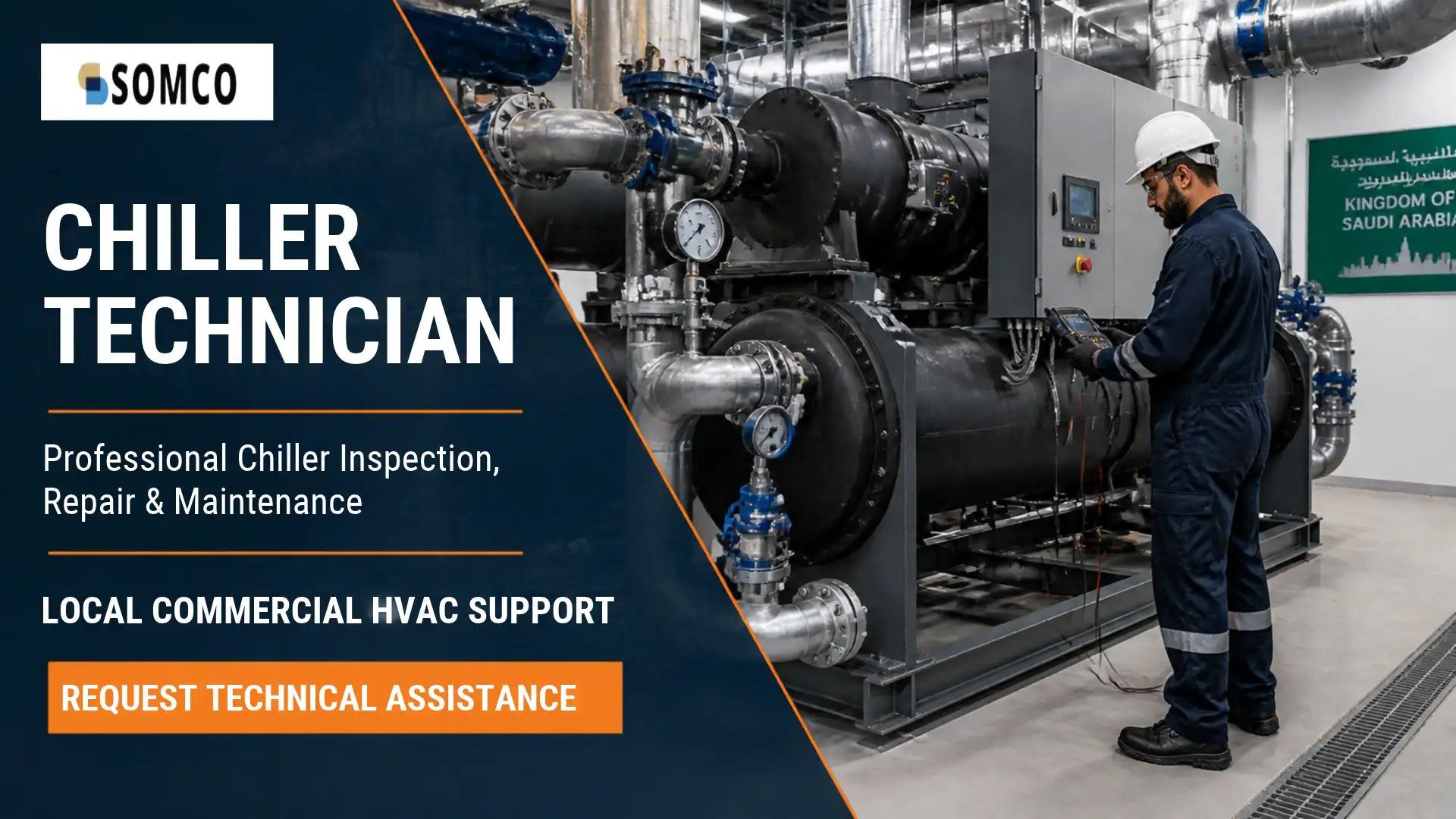
If you are searching for a chiller technician near me, choosing an experienced professional is important. A qualified technician can inspect the cooling system, identify potential faults, assess equipment performance, and recommend suitable repair or maintenance solutions.
For businesses in Saudi Arabia, chiller maintenance requires particular attention to operating conditions, equipment load, condenser performance, and regular inspections. SSOMCO supports commercial and industrial maintenance requirements through its building maintenance and HVAC service capabilities. Contact the team to discuss your chiller service requirements and confirm the appropriate scope.
Why Businesses Need a Professional Chiller Technician
Commercial chillers operate under demanding conditions. Offices, hotels, shopping centres, factories, healthcare facilities and other large buildings may depend on consistent cooling to support daily operations.
An experienced chiller technician can help businesses:
- Identify cooling problems before they develop into major equipment failures.
- Inspect compressors, pumps, motors, and heat exchangers.
- Assess refrigerant-related issues and system operating conditions.
- Check electrical connections, sensors, and control settings.
- Improve system reliability through planned maintenance.
- Investigate unusual noise, vibration, and temperature fluctuations.
- Recommend corrective action based on inspection findings.
Professional attention is especially important when a chiller serves critical building operations or operates for extended periods.
Common Signs That Your Chiller Needs Technical Attention
Recognising early warning signs can help facility managers arrange an inspection before a minor issue becomes a larger operational problem.
1. Insufficient Cooling
If the chiller cannot maintain the required chilled-water temperature, the problem may involve heat transfer, water flow, compressor performance, controls, or other system components.
2. Unusual Noise or Vibration
Unexpected sounds or vibration may indicate mechanical wear, loose components, pump issues or compressor-related problems. A technician should investigate the source rather than simply treating the noise.
3. Increasing Energy Consumption
A noticeable rise in electricity consumption may be associated with poor heat transfer, incorrect operating settings, restricted airflow or water flow, and inefficient equipment operation.
4. Frequent System Shutdowns
Repeated shutdowns or alarm notifications can indicate protection-system activation, electrical faults, high operating temperatures, or other equipment problems.
5. Water Leakage or Condensation
Unusual water accumulation around the equipment should be inspected. Possible causes include drainage problems, damaged connections, insulation issues, or leakage within the system.
Types of Chillers a Technician May Service
The technician’s experience should match the equipment installed at your facility. Different chiller configurations have different operating requirements and maintenance considerations.
Chiller type | Typical application |
Air-cooled chiller | Commercial buildings and facilities where heat is rejected through air-cooled condensers |
Water-cooled chiller | Larger cooling installations using a cooling-water circuit and heat-rejection equipment |
Packaged chiller | Integrated cooling equipment used in commercial and industrial applications |
Screw chiller | Facilities using screw-compressor technology |
Centrifugal chiller | Large-capacity cooling applications |
Scroll chiller | Commercial and smaller-capacity cooling systems |
Before arranging a service visit, provide the equipment manufacturer, model, capacity and available fault information. This helps establish whether the technician has relevant experience with the installed system.
What Does a Professional Chiller Technician Inspect?
A proper inspection should consider the complete cooling system rather than focusing on a single component.
Compressor Inspection
The compressor is a critical part of the refrigeration cycle. Depending on the equipment, a technician may review operating conditions, temperature readings, electrical performance, vibration, and abnormal noise.
Condenser Inspection
Condenser condition affects heat rejection. Inspection may include checking for dirt accumulation, restricted airflow, water-side issues, or other conditions that reduce heat-transfer performance.
Evaporator and Heat Exchanger Inspection
The evaporator transfers heat from the chilled-water circuit to the refrigerant. A technician may examine operating temperatures, water flow, pressure readings, and signs of fouling or freezing.
Refrigerant Circuit Assessment
The refrigerant circuit should be assessed using the manufacturer’s procedures and appropriate instruments. Any suspected refrigerant leakage or abnormal operating pressure should be investigated by appropriately qualified personnel.
Electrical and Control System Checks
Electrical terminals, sensors, protection devices, control panels and operating settings may be reviewed to identify faults that affect safe and reliable operation.
Pumps and Water Flow
The chilled-water and condenser-water circuits, where applicable, should be checked for suitable flow conditions, leaks, unusual vibration, and pump performance.
Chiller Repair vs Preventive Maintenance
Businesses often contact a technician only after cooling performance has deteriorated. However, planned maintenance can help identify developing problems before they cause unexpected interruptions.
Chiller repair | Preventive chiller maintenance |
Responds to an identified fault | Focuses on planned inspections |
Investigates equipment malfunction | Reviews equipment condition |
Restores affected operation | Helps reduce avoidable failures |
May be required unexpectedly | Can be scheduled around operations |
Addresses specific repair needs | Supports ongoing equipment reliability |
A suitable maintenance programme should follow the manufacturer’s recommendations, equipment condition, operating hours and facility requirements.
How to Choose the Right Chiller Technician Near You
Choosing a service provider involves more than finding the nearest available technician. Businesses should consider technical experience, equipment knowledge, safety practices, and the ability to support their facility’s requirements.
Consider these points before confirming a service appointment:
- Relevant technical experience: Ask whether the technician has worked with your chiller type and model.
- Equipment knowledge: Confirm familiarity with the installed compressor, controls, and refrigeration system.
- Inspection process: Ask what checks will be included in the visit.
- Safety procedures: Confirm that work will follow applicable safety requirements and manufacturer instructions.
- Service scope: Clarify whether the requirement involves inspection, troubleshooting, repair, or planned maintenance.
- Quotation details: Request a clear breakdown of the proposed work, parts, and any additional charges.
- Service coverage: Confirm that the provider can attend your facility’s actual location.
These checks help procurement teams and facility managers make a more informed decision.
Chiller Maintenance Considerations in Saudi Arabia
Chillers serving facilities in Saudi Arabia may operate under demanding outdoor temperatures and extended cooling requirements. Equipment condition, installation environment and operating load can influence maintenance needs.
Facility managers should pay particular attention to:
- Condenser cleanliness and heat-rejection performance.
- Airflow around air-cooled equipment.
- Cooling-water quality and water-side maintenance, where applicable.
- Chilled-water flow and pump condition.
- Insulation and condensation control.
- Electrical connections and control-system operation.
- Equipment alarms, operating temperatures and pressure readings.
- Maintenance records and recurring fault history.
A maintenance schedule should be developed around the actual equipment and operating environment rather than relying on a one-size-fits-all checklist.
When Should You Request a Chiller Inspection?
Do not wait for a complete system breakdown if your equipment shows signs of deteriorating performance.
Consider arranging an inspection when:
- Cooling output is below the required level.
- The system repeatedly displays alarms.
- Electricity consumption has increased unexpectedly.
- The compressor or pump produces unusual noise.
- The chiller frequently shuts down.
- Equipment has been operating without a recent condition assessment.
- You are preparing a facility for a higher cooling load.
If the equipment shows signs of unsafe operation, follow the manufacturer’s shutdown and safety procedures and arrange assessment by qualified personnel.
Chiller Technician Services for Commercial and Industrial Facilities
Different facilities have different cooling requirements. A suitable service scope should reflect the type of building, installed equipment, and operational priorities.
Facility | Common cooling requirements |
Office buildings | Reliable comfort cooling and planned equipment inspections |
Hotels | Consistent cooling for guest rooms and shared spaces |
Shopping centres | Cooling support for large occupied areas |
Factories | Cooling for building environments and relevant industrial processes |
Hospitals and healthcare facilities | Equipment reliability and careful maintenance planning |
Warehouses | Cooling requirements based on stored products and operating conditions |
Before appointing a contractor, confirm that the proposed team can support the specific equipment and service requirements at your facility.
Why Discuss Your Chiller Requirements with SSOMCO?
Managing commercial and industrial buildings requires a coordinated approach to maintenance. HVAC equipment should be considered as part of the wider facility infrastructure, including electrical systems, pumps, controls, and other building services.
SSOMCO works with businesses to understand their facility maintenance requirements and identify suitable service arrangements within its available scope.
Whether you require an initial equipment assessment, support with a recurring chiller issue or a discussion about planned HVAC maintenance, share your equipment details and operational requirements with the team.
Request a Chiller Service Consultation
Contact SSOMCO to discuss your commercial or industrial chiller requirements and request a quotation.
Website: https://ssomco.sa/
Services: https://ssomco.sa/our-services/
Frequently Asked Questions
Look for a technician or service provider with experience in your chiller type, relevant technical knowledge, clear inspection procedures, and appropriate safety practices. Confirm service coverage for your facility before booking.
A chiller technician inspects, troubleshoots, and services cooling equipment. Depending on qualifications and service scope, the work may include compressor checks, condenser and evaporator inspections, electrical diagnostics, control checks and maintenance.
Maintenance frequency depends on the manufacturer's recommendations, equipment type, operating hours, site conditions, and maintenance history. A planned programme should be established for the individual installation.
Possible causes include restricted airflow, condenser or evaporator fouling, insufficient water flow, control faults, refrigerant-circuit problems, and compressor-related issues. Proper diagnosis is required to identify the actual cause.
Technicians may work with different chiller configurations, but experience varies. Always confirm their knowledge of your specific equipment, manufacturer, and model before arranging a visit.
Yes. Planned inspections can help identify developing equipment problems, review operating conditions, and support more reliable cooling operations. Maintenance should follow manufacturer guidance and site requirements.
You can contact SSOMCO to discuss your commercial or industrial HVAC requirements, share your equipment details, and confirm the relevant service scope and availability.
Conclusion
Finding the right chiller technician near me is an important step in maintaining reliable cooling for commercial and industrial facilities. The right technical support can help identify equipment faults, assess system condition, and recommend appropriate maintenance or repair work.
Instead of waiting for an unexpected breakdown, businesses should monitor equipment performance, maintain service records, and arrange inspections based on operating conditions.
Contact SSOMCO to discuss your facility’s HVAC and chiller maintenance requirements and request a suitable service quotation.
