

 Blog
Commercial buildings depend on reliable heating, ventilation, and air conditioning systems to maintain comfortable indoor environments and support daily operations. From corporate offices and hotels to shopping malls, restaurants, warehouses, and industrial facilities, HVAC systems play an important role in building performance.
Unlike residential air conditioning, commercial HVAC systems often serve larger spaces, multiple zones, and complex equipment configurations. They may include chillers, air handling units, rooftop units, VRF systems, ventilation equipment, and centralized controls.
Without appropriate maintenance and professional technical support, these systems may experience cooling problems, restricted airflow, unexpected breakdowns, and increased operating costs.
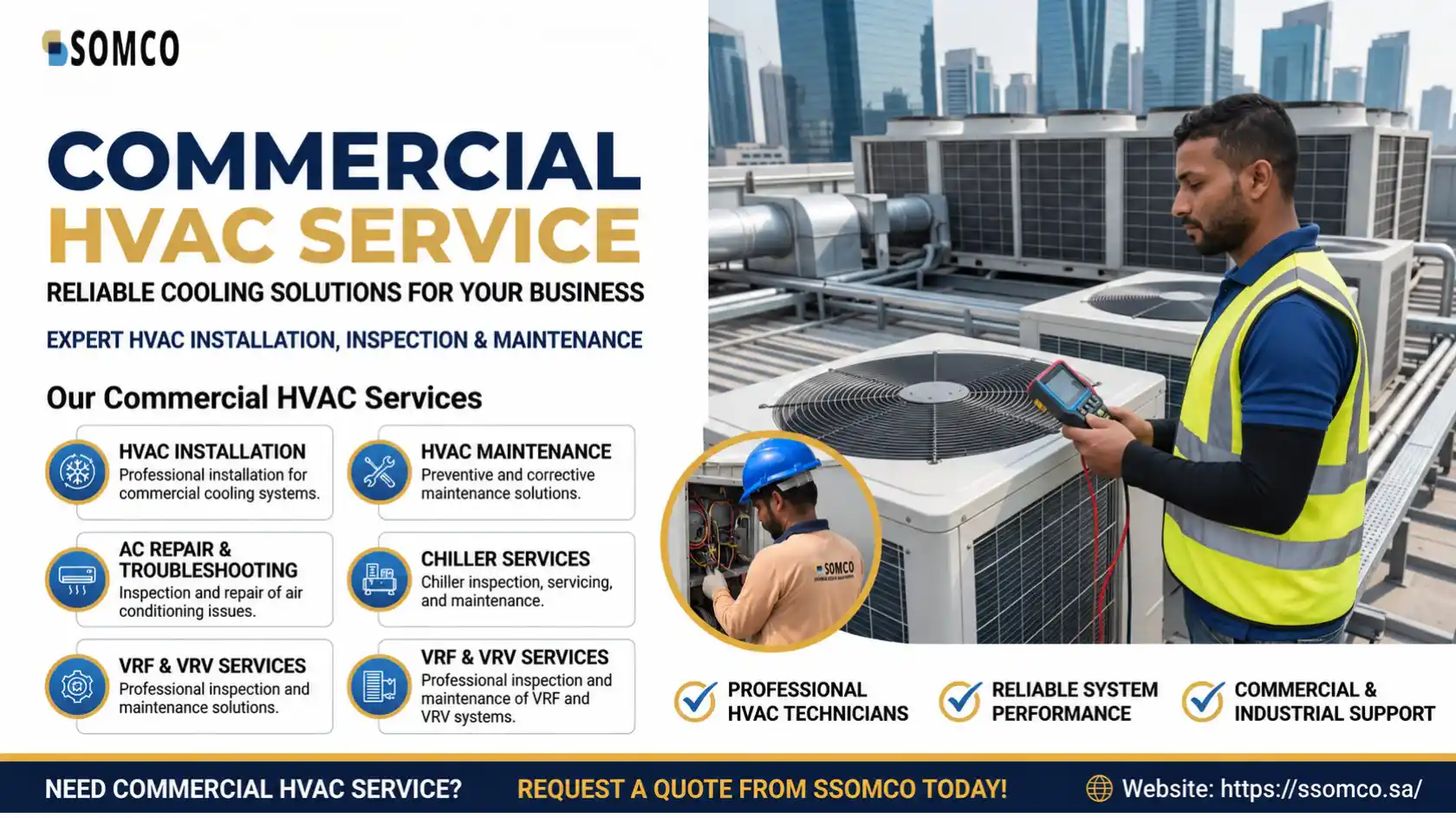
Commercial HVAC service helps businesses manage their heating, ventilation, and air conditioning equipment through planned maintenance, technical inspections, troubleshooting, repairs, and installation support.
In this guide, we explain the main types of commercial HVAC services, their benefits, common equipment problems, and how businesses can choose the right HVAC service provider.
What Is Commercial HVAC Service?
Commercial HVAC service refers to the professional installation, inspection, maintenance, troubleshooting, and repair of heating, ventilation, and air conditioning systems used in non-residential buildings.
These services are designed around the equipment requirements, building layout, occupancy, operating schedules, and environmental conditions of commercial properties.
Depending on the project and service agreement, commercial HVAC services may include:
- Commercial air conditioning installation and maintenance.
- HVAC preventive and corrective maintenance.
- Chiller installation and maintenance.
- VRF and VRV system installation and maintenance.
- Air handling unit inspection.
- Ventilation system inspection.
- Air filter and coil servicing.
- Electrical and control system inspection.
- Condensate drainage checks.
- HVAC performance assessment.
- Equipment troubleshooting and repairs.
The scope of work should be determined according to the installed equipment, manufacturer recommendations, and facility requirements.
Why Is Commercial HVAC Service Important?
Commercial HVAC systems are essential to the daily operation of many businesses. Their condition can influence indoor comfort, equipment performance, and building operating expenses.
Here are some important reasons to invest in professional commercial HVAC services.
1. Maintain Comfortable Indoor Conditions
Employees, customers, visitors, and building occupants expect comfortable indoor temperatures.
Poor cooling performance, uneven airflow, and malfunctioning temperature controls can create uncomfortable conditions in different areas of a building.
Professional HVAC inspection helps identify potential problems involving filters, coils, fans, controls, and air distribution.
2. Support Energy-Efficient Operation
Commercial HVAC systems can consume a significant amount of a building’s operational energy.
Dirty filters, restricted airflow, poorly maintained components, and incorrect control settings can affect equipment performance.
Regular maintenance helps identify these conditions and supports more efficient system operation. Actual energy savings depend on the building, equipment, operating practices, and corrective actions taken.
3. Reduce Unexpected Equipment Failures
An equipment problem that remains unnoticed may develop into a larger failure.
Preventive maintenance helps identify warning signs such as unusual vibration, abnormal noise, drainage issues, electrical concerns, and inconsistent cooling.
Early identification allows businesses to plan repairs and reduce the likelihood of avoidable operational disruption.
4. Support HVAC Equipment Longevity
Commercial HVAC equipment represents a considerable investment.
Regular inspection, appropriate cleaning, and timely corrective maintenance help maintain equipment condition and reduce unnecessary operating stress.
Following manufacturer-recommended maintenance procedures also helps protect equipment performance over time.
5. Support Indoor Air Quality
HVAC systems contribute to indoor air conditions through filtration, ventilation, and air distribution.
Inspecting filters, ventilation equipment, accessible duct components, and condensate drainage can help identify conditions that may affect indoor environmental quality.
Types of Commercial HVAC Services
Different commercial properties require different HVAC equipment and maintenance strategies. A professional service provider should assess the building’s systems before recommending a suitable maintenance or repair programme.
1. Commercial HVAC Installation
Commercial HVAC installation involves planning and installing heating, ventilation, and air conditioning equipment according to building and project requirements.
The process may involve:
- Reviewing building layout and technical requirements.
- Assessing cooling and heating loads.
- Selecting suitable HVAC equipment.
- Planning equipment placement.
- Reviewing ventilation and air distribution requirements.
- Coordinating electrical and mechanical connections.
- Following manufacturer installation procedures.
- Testing and commissioning the installed system.
Proper installation planning helps ensure that equipment is suitable for the intended application.
2. Commercial HVAC Maintenance
Commercial HVAC maintenance focuses on maintaining equipment condition through planned inspections and servicing.
Typical activities may include:
- Checking air filters.
- Inspecting evaporator and condenser coils.
- Checking fans and motors.
- Inspecting electrical connections.
- Reviewing thermostat and controller operation.
- Checking condensate drainage.
- Inspecting visible refrigerant circuit conditions.
- Reviewing operating performance.
- Recording maintenance observations.
The maintenance schedule should be based on equipment type, operating hours, environmental conditions, and manufacturer guidance.
3. Commercial Air Conditioning Service
Air conditioning systems are used across offices, retail properties, hotels, restaurants, and other commercial buildings.
Commercial AC services may include:
- Air conditioning system inspection.
- Filter servicing.
- Indoor and outdoor unit inspection.
- Coil cleaning where required.
- Drainage inspection.
- Electrical checks.
- Cooling performance assessment.
- Fault identification and repair.
Regular servicing helps facility managers identify issues before they cause more significant cooling problems.
4. Commercial Chiller Maintenance
Chillers are commonly used in large commercial buildings and facilities requiring centralized cooling.
Professional chiller maintenance may include:
- Chiller equipment inspection.
- Operating parameter review.
- Electrical and control checks.
- Water-side component inspection.
- Pump and associated equipment checks.
- Inspection for visible leaks.
- Abnormal noise and vibration assessment.
- Maintenance reporting.
Chiller maintenance procedures vary according to chiller design, manufacturer instructions, operating conditions, and water quality.
5. VRF and VRV System Services
Variable Refrigerant Flow (VRF) and Variable Refrigerant Volume (VRV) systems are designed to provide flexible cooling and heating across multiple indoor zones.
These systems are suitable for various commercial applications where individual area control is required.
Professional VRF and VRV services may include:
- Indoor unit inspection.
- Outdoor unit inspection.
- Air filter and coil servicing.
- Condensate drainage inspection.
- Electrical and communication checks.
- Controller inspection.
- Refrigerant circuit assessment.
- System performance evaluation.
All technical procedures must follow the relevant equipment manufacturer’s documentation.
6. Ventilation and Air Distribution Services
Commercial ventilation systems help supply and distribute air throughout occupied spaces.
Their performance depends on suitable equipment condition, airflow, filtration, and control operation.
Inspection may include:
- Ventilation fan checks.
- Filter condition assessment.
- Air outlet and return grille inspection.
- Accessible ductwork inspection.
- Damper and control checks.
- Identification of visible airflow obstructions.
- Review of air distribution concerns.
Specialist duct cleaning, air balancing, and testing should be included only where they are specifically required and agreed within the service scope.
Commercial HVAC Systems Used in Business Buildings
Understanding the equipment installed in a commercial property helps facility managers select appropriate service and maintenance requirements.
HVAC Equipment | Main Function | Typical Applications |
Chiller System | Produces chilled water for cooling | Large commercial buildings and facilities |
Air Handling Unit (AHU) | Conditions and distributes air | Offices, hotels, malls |
VRF/VRV System | Provides zoned temperature control | Offices, hotels, commercial spaces |
Rooftop HVAC Unit | Provides packaged heating or cooling | Retail and commercial buildings |
Split Air Conditioning | Cools individual areas | Offices and smaller commercial spaces |
Ventilation Fans | Support air movement and exhaust | Kitchens, washrooms, and other facilities |
The appropriate equipment depends on building design, cooling demand, occupancy, and operational requirements.
Common Commercial HVAC Problems and Their Solutions
Commercial HVAC equipment may experience different performance problems depending on its age, operating environment, maintenance history, and equipment design.
Common Problem | Possible Cause | Recommended Action |
Insufficient cooling | Restricted airflow, dirty coils, equipment faults | Arrange professional inspection |
Uneven temperatures | Air distribution or control issues | Review airflow and zone controls |
Unusual equipment noise | Fan, motor, or loose component issues | Inspect affected equipment |
Water leakage | Condensate drainage problems | Check drainage components |
Frequent shutdowns | Electrical, control, or mechanical faults | Arrange technical troubleshooting |
High energy consumption | Inefficient operation or equipment problems | Review system performance |
Poor ventilation | Fan, filter, or airflow restrictions | Inspect ventilation equipment |
A professional diagnosis is important because similar symptoms can have different underlying causes.
Preventive vs Corrective Commercial HVAC Maintenance
Commercial HVAC maintenance generally includes preventive and corrective activities.
Preventive Maintenance
Preventive maintenance involves planned inspection and servicing intended to maintain equipment condition and identify potential issues.
Examples include:
- Scheduled equipment inspections.
- Filter servicing.
- Coil inspection and cleaning.
- Electrical connection checks.
- Condensate drainage inspection.
- Fan and motor inspection.
- Control system checks.
- Maintenance records and reporting.
Corrective Maintenance
Corrective maintenance is carried out when equipment faults or performance problems are identified.
It may involve:
- Repairing faulty components.
- Addressing electrical problems.
- Correcting drainage issues.
- Troubleshooting cooling problems.
- Replacing defective parts.
- Restoring equipment operation.
An effective maintenance programme should define how identified faults are reported, prioritized, approved, and corrected.
How Often Should Commercial HVAC Systems Be Serviced?
There is no universal service interval for every commercial HVAC system.
Maintenance frequency depends on:
- Equipment type and manufacturer.
- Building occupancy.
- Daily operating hours.
- Environmental conditions.
- Equipment age and condition.
- Maintenance history.
- Operational requirements.
For example, an HVAC system operating for extended hours in a busy commercial facility may require more frequent attention than equipment used occasionally.
A suitable maintenance programme should include an equipment inventory, manufacturer-recommended procedures, scheduled inspections, service records, and a process for reviewing recurring problems.
Facility managers can use recognized industry guidance, including ASHRAE Standard 180 for inspection and maintenance of commercial building HVAC systems, when developing maintenance programmes.
Commercial HVAC Service for Different Industries
Different business environments have different cooling, ventilation, and operating requirements.
Office Buildings
Offices require comfortable indoor conditions to support employees, meetings, and daily business activities.
Commercial HVAC maintenance helps facility managers monitor air conditioning equipment, ventilation, temperature controls, and air distribution.
Hotels and Hospitality Properties
Hotels contain multiple HVAC zones, including guest rooms, reception areas, restaurants, meeting rooms, and common spaces.
A coordinated maintenance programme helps manage equipment across these different areas.
Shopping Malls and Retail Properties
Shopping malls and retail buildings may contain centralized cooling systems, air handling units, ventilation equipment, and individual tenant systems.
Regular inspections help identify issues that may affect indoor comfort and building operations.
Restaurants and Commercial Kitchens
Restaurants require suitable air conditioning and ventilation for dining areas, kitchens, and other occupied spaces.
HVAC maintenance should be coordinated with the separate requirements of kitchen exhaust and grease management systems. These services should not be assumed to be included in a standard HVAC maintenance agreement.
Hospitals and Healthcare Facilities
Healthcare buildings may have specialized ventilation and environmental requirements depending on the area and its intended use.
Maintenance and technical work must follow applicable facility requirements, relevant standards, and equipment specifications.
Warehouses and Industrial Facilities
Warehouses and industrial buildings may require HVAC systems for occupied spaces, administrative areas, equipment rooms, or specific operational needs.
Maintenance planning should consider the equipment’s operating duty and environmental conditions.
How to Choose the Right Commercial HVAC Service Provider
Choosing a suitable commercial HVAC contractor is an important decision for building owners, facility managers, and business operators.
Consider the following factors before selecting a provider.
1. Experience With Commercial HVAC Equipment
Check whether the contractor has relevant experience with the equipment installed at your facility, such as chillers, VRF systems, air handling units, and commercial air conditioning equipment.
2. Technical Qualifications
Confirm that the assigned technicians have appropriate technical training and competence for the equipment and tasks involved.
3. Clear Maintenance Scope
Ask for a written description of the services included in the proposal.
This should explain inspection activities, maintenance frequency, repair responsibilities, and exclusions.
4. Maintenance Documentation
Service reports help facility managers understand completed tasks, identified problems, and recommended corrective work.
5. Spare Parts and Repair Arrangements
Clarify whether spare parts, replacement components, labour, and additional repair work are included in the contract or charged separately.
6. Response and Coordination Arrangements
Understand how service requests, breakdown reports, approvals, and maintenance visits will be coordinated.
7. Transparent Pricing
Compare proposals based on the actual equipment coverage and service scope rather than price alone.
A clearly defined agreement helps avoid misunderstandings during the maintenance period.
Why Choose SSOMCO for Commercial HVAC Service?
SSOMCO (Saudi Specialized Operations & Maintenance Company) provides HVAC and maintenance solutions for commercial and industrial facilities.
We understand that different buildings require different maintenance approaches depending on their installed equipment, operating conditions, and facility requirements.
Our service portfolio includes relevant solutions such as:
- HVAC maintenance.
- Commercial air conditioning maintenance.
- HVAC operation and maintenance.
- Chiller installation and maintenance.
- VRF and VRV system services.
- Building maintenance.
- MEP installation and maintenance.
- Related facility maintenance requirements.
Whether you manage an office building, hotel, retail property, restaurant, or industrial facility, understanding your HVAC requirements is the first step toward developing an appropriate service plan.
Have an RFQ or upcoming project? Contact SSOMCO to discuss your commercial HVAC requirements and request a quotation.
Frequently Asked Questions About Commercial HVAC Service
Commercial HVAC service may include system installation, preventive maintenance, equipment inspection, troubleshooting, repairs, air conditioning servicing, chiller maintenance, VRF system maintenance, and ventilation inspection.
Commercial HVAC systems generally serve larger or more complex non-residential buildings and may involve centralized equipment, multiple zones, chillers, air handling units, and specialized controls. Residential systems typically serve individual homes or smaller living spaces.
Preventive maintenance helps identify potential equipment issues, maintain system condition, support efficient operation, and reduce the risk of unexpected breakdowns.
Maintenance frequency depends on equipment specifications, manufacturer recommendations, building conditions, operating hours, and equipment condition. Each facility should have a suitable maintenance schedule.
Offices, hotels, shopping malls, restaurants, healthcare facilities, warehouses, and industrial buildings may require commercial HVAC services based on their installed systems and operating requirements.
A maintenance contract should clearly define covered equipment, inspection frequency, maintenance tasks, repair responsibilities, spare parts arrangements, reporting, response procedures, exclusions, and commercial terms.
Appropriate maintenance can help identify inefficient operating conditions, prevent avoidable faults, and support equipment performance. Actual cost reductions depend on the condition of the system and the actions taken.
Businesses can contact SSOMCO through its website to discuss their facility requirements, equipment types, maintenance needs, and project scope.
Conclusion
Commercial HVAC service is essential for managing the performance and condition of heating, ventilation, and air conditioning systems in business facilities.
From installation and preventive maintenance to troubleshooting and equipment repairs, professional HVAC support helps businesses manage their building systems and maintain suitable indoor conditions.
Choosing an experienced service provider with a clearly defined maintenance scope, appropriate technical personnel, and proper reporting practices can make facility management more organized.
For commercial HVAC maintenance, chiller services, VRF and VRV systems, and related building maintenance requirements, contact SSOMCO to discuss your project and request a quotation.
SSOMCO – Supporting Reliable HVAC and Facility Operations.

HVAC Repair Service For Optimal Equipment Performance - Best Air Duct And Kitchen Hood Cleaning Service Provider In KSA
November 10, 2026 1:36 pm[…] diagnosis helps identify the actual source of an HVAC problem rather than replacing components without sufficient […]