

 Blog
Commercial buildings rely on HVAC systems to maintain comfortable indoor temperatures, support proper ventilation, and create a suitable environment for employees, customers, and visitors. Offices, hotels, shopping centres, restaurants, warehouses, and industrial facilities all depend on properly functioning heating, ventilation, and air conditioning equipment.
However, continuous operation, dust accumulation, blocked filters, dirty coils, electrical issues, and drainage problems can gradually affect HVAC performance. Without regular inspections, minor equipment issues may develop into unexpected breakdowns, increased operating costs, and interruptions to business activities.
This is why businesses should follow a structured HVAC preventive maintenance checklist. Regular maintenance helps facility managers monitor equipment condition, identify potential problems early, and organise servicing before major issues occur.
In this guide, we cover the essential HVAC preventive maintenance tasks, equipment inspections, maintenance schedules, and practical recommendations businesses can use to manage their commercial HVAC systems.
What Is HVAC Preventive Maintenance?
HVAC preventive maintenance is a planned process of inspecting, cleaning, testing, and servicing heating, ventilation, and air conditioning equipment to help maintain reliable operation.
Rather than waiting for a system to stop working, maintenance teams carry out scheduled inspections to identify developing faults and address maintenance requirements.
A typical preventive maintenance programme includes:
- Inspecting and replacing air filters.
- Cleaning evaporator and condenser coils.
- Checking electrical connections and components.
- Inspecting fans, motors, and belts.
- Checking thermostats and control systems.
- Inspecting condensate drains and drain pans.
- Reviewing airflow and ventilation performance.
- Checking refrigerant-system condition.
- Inspecting chillers and air handling units.
- Recording maintenance activities and equipment condition.
The maintenance requirements depend on the type of HVAC equipment, manufacturer recommendations, operating hours, and environmental conditions.
Why Is HVAC Preventive Maintenance Important for Businesses?
Commercial HVAC equipment often operates for long periods and serves large indoor areas. A maintenance problem can affect building comfort, equipment performance, and daily operations.
Here are the main benefits of following a preventive maintenance programme.
1. Helps Prevent Unexpected Breakdowns
Routine inspections can identify early warning signs such as unusual noise, vibration, restricted airflow, water leakage, and abnormal operating conditions.
Addressing these issues early can reduce the likelihood of unexpected equipment failures and unplanned interruptions.
2. Supports Energy Efficiency
Dirty filters, blocked coils, and airflow restrictions can affect HVAC performance. Equipment may need to operate longer or work harder to maintain the required indoor temperature.
Regular cleaning, inspection, and adjustment help support more efficient system operation.
3. Extends HVAC Equipment Service Life
Commercial HVAC systems are important building assets. Regular maintenance helps identify wear, deterioration, and operating issues before they develop into more serious problems.
Following manufacturer recommendations and maintaining accurate service records also supports better equipment management.
4. Improves Indoor Comfort
Poor airflow, malfunctioning thermostats, and dirty filters can contribute to inconsistent cooling and uncomfortable indoor conditions.
Preventive maintenance helps identify these issues and supports more consistent temperature and airflow throughout occupied spaces.
5. Supports Indoor Air Quality
Air filters, coils, ventilation components, and drain pans require appropriate inspection and cleaning. Neglected components can contribute to dust accumulation and moisture-related problems.
A suitable maintenance programme helps keep relevant HVAC components clean and supports the building’s indoor environmental requirements.
6. Improves Maintenance Planning
A planned maintenance schedule allows businesses to organise inspections, servicing, labour requirements, and replacement parts.
Instead of relying entirely on emergency repairs, facility managers can use maintenance reports to identify recurring issues and plan maintenance expenditure.
Complete HVAC Preventive Maintenance Checklist for Businesses
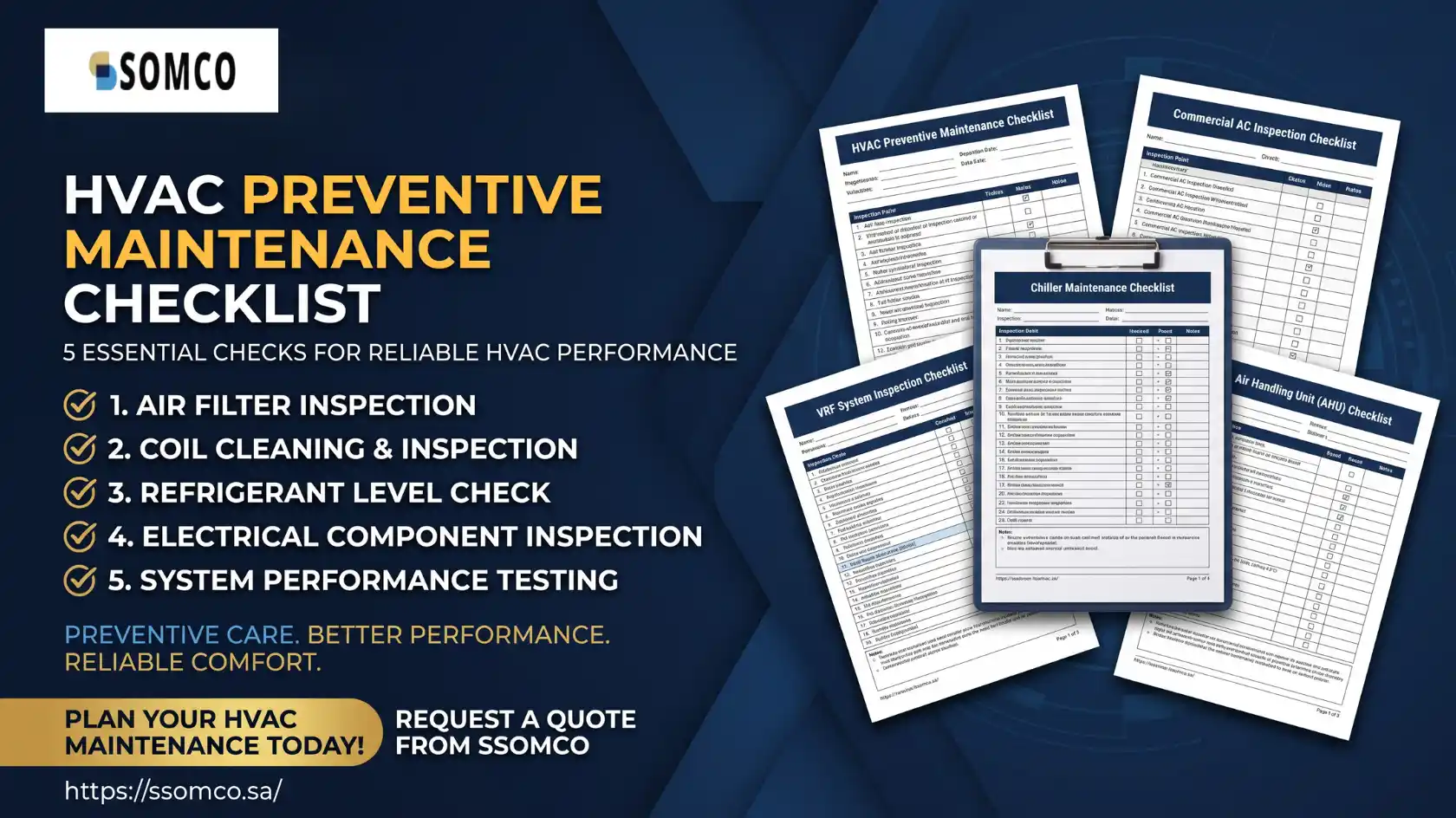
The following checklist provides a practical starting point for commercial building maintenance teams. It should be adapted to the installed equipment and manufacturer instructions.
1. Air Filter Inspection and Replacement
Air filters capture airborne particles before they enter sensitive HVAC components and circulate through the building.
Maintenance checklist:
- Inspect filters for dust and debris accumulation.
- Check filters for physical damage or moisture.
- Confirm the correct filter size and type.
- Replace disposable filters when required.
- Clean reusable filters according to manufacturer instructions.
- Check filter access panels and seals.
- Record filter inspection and replacement dates.
Why it matters: Restricted filters can reduce airflow and affect system performance. Replacement intervals should depend on filter type, operating conditions, and manufacturer recommendations.
2. Evaporator and Condenser Coil Inspection
Coils transfer heat during the cooling process. Dirt and debris can interfere with heat transfer and affect equipment performance.
Maintenance checklist:
- Inspect evaporator coils for dirt and dust.
- Check condenser coils for external debris.
- Look for signs of corrosion or physical damage.
- Inspect coil surfaces for unusual moisture.
- Clean coils using suitable approved methods.
- Check surrounding airflow paths.
- Record any damage or unusual conditions.
Why it matters: Dirty coils can reduce heat-transfer performance and increase operating demand. Cleaning should follow equipment manufacturer recommendations.
3. Electrical Connections and Components
Electrical components support HVAC equipment operation and control. Inspections should be performed by qualified personnel using appropriate safety procedures.
Maintenance checklist:
- Inspect accessible electrical connections.
- Check wiring insulation for visible deterioration.
- Inspect contactors and relays for wear.
- Check control-panel condition.
- Inspect circuit protection components.
- Look for overheating or corrosion.
- Verify electrical readings where required.
- Record faults and corrective actions.
Why it matters: Damaged or overheating electrical components can cause unreliable operation and equipment damage.
4. Fan, Motor, and Belt Inspection
Fans and motors maintain air circulation and support heat rejection in many HVAC systems.
Maintenance checklist:
- Inspect fan blades for dirt and damage.
- Check motor condition and mounting.
- Listen for unusual operating noise.
- Inspect belts for cracks and wear.
- Check belt tension and pulley alignment where applicable.
- Inspect bearings for abnormal noise or vibration.
- Confirm protective covers and guards are secure.
- Review fan operation and airflow.
Why it matters: Worn belts, damaged fan blades, and motor problems can reduce airflow and affect equipment reliability.
5. Thermostat and Control System Inspection
Thermostats and control systems regulate HVAC operation according to building requirements.
Maintenance checklist:
- Confirm that thermostats display correctly.
- Check temperature settings and operating modes.
- Inspect sensor condition and placement.
- Check control wiring and connections.
- Test heating and cooling commands where applicable.
- Review programmed operating schedules.
- Check communication between connected controls.
- Record unusual readings or fault codes.
Why it matters: Incorrect settings or faulty sensors can cause inconsistent indoor temperatures and unnecessary equipment operation.
6. Condensate Drainage Inspection
Air conditioning systems produce condensate during cooling. Drainage components must remain clear and function correctly.
Maintenance checklist:
- Inspect drain pans for standing water.
- Check drain lines for blockage or leakage.
- Inspect visible pipe connections.
- Check drain traps where fitted.
- Look for water overflow or staining.
- Clean drainage components using approved procedures.
- Test drainage where appropriate.
- Record recurring drainage problems.
Why it matters: Blocked drainage can cause water leakage, moisture damage, and operational interruptions.
7. Refrigerant-System Inspection
Refrigerant circuits are essential to cooling performance. Refrigerant-related work should be handled by appropriately qualified technicians.
Maintenance checklist:
- Review system operating pressures and temperatures where applicable.
- Check for visible signs of refrigerant leakage.
- Inspect accessible refrigerant piping and insulation.
- Look for oil staining around joints and connections.
- Check relevant safety and control devices.
- Review abnormal operating readings.
- Investigate performance issues before adding or removing refrigerant.
- Document corrective work.
Why it matters: Refrigerant leakage or abnormal system conditions can reduce cooling performance and damage equipment. Refrigerant should not be added simply to compensate for poor cooling without diagnosing the underlying cause.
8. Airflow and Ventilation Inspection
Proper airflow is important for indoor comfort and ventilation performance.
Maintenance checklist:
- Inspect supply-air and return-air grilles.
- Check accessible ductwork for visible damage.
- Inspect dampers and ventilation components.
- Check fan operation and airflow direction.
- Look for blocked or restricted air outlets.
- Review reported hot and cold spots.
- Check ventilation equipment operation.
- Measure airflow where required by the maintenance scope.
Why it matters: Airflow restrictions and ventilation problems can affect comfort and overall system performance.
9. Air Handling Unit (AHU) Inspection
Air handling units combine several components that support air circulation, filtration, and temperature control.
Maintenance checklist:
- Inspect AHU casing and access panels.
- Check filters and filter seals.
- Inspect cooling and heating coils.
- Check drain pans and condensate lines.
- Inspect fan and motor assemblies.
- Check dampers and actuators.
- Look for corrosion, leakage, or insulation damage.
- Inspect accessible internal surfaces for dirt.
- Record abnormal vibration, noise, or operating conditions.
Why it matters: AHUs serve important building areas and require coordinated inspection of filtration, airflow, drainage, and controls.
10. Chiller System Inspection
Chillers are commonly used in commercial and industrial buildings that require centralised cooling. Maintenance requirements vary between air-cooled and water-cooled systems.
Maintenance checklist:
- Review chiller operating temperatures and readings.
- Inspect the equipment exterior for visible damage.
- Check for abnormal vibration or noise.
- Inspect accessible electrical connections.
- Review control-panel alarms and fault history.
- Check refrigerant-system indicators where applicable.
- Inspect condenser condition and airflow on air-cooled units.
- Review condenser-water and chilled-water conditions on water-cooled systems.
- Inspect accessible piping, valves, and insulation.
- Check for visible water or refrigerant leakage.
- Review operating logs and previous service reports.
Why it matters: Chiller performance affects the cooling capacity of the wider building system. Maintenance should follow manufacturer requirements and equipment-specific procedures.
11. VRF and VRV System Inspection
Variable Refrigerant Flow (VRF) and Variable Refrigerant Volume (VRV) systems provide zoned cooling and heating for many commercial and residential properties.
Maintenance checklist:
- Inspect indoor units for visible dirt and damage.
- Check air filters and clean or replace them as required.
- Inspect outdoor units for obstructions.
- Check fan operation and unusual noise.
- Inspect accessible refrigerant piping and insulation.
- Review controller settings and operating modes.
- Check system error codes and fault history.
- Review communication between indoor and outdoor units.
- Investigate recurring temperature or performance complaints.
- Record equipment-specific observations.
Why it matters: VRF and VRV systems contain multiple connected components. A fault in one area can affect individual zones or the wider system.
HVAC Preventive Maintenance Schedule for Commercial Buildings
A maintenance schedule helps businesses organise inspections throughout the year. The following is an illustrative planning guide, not a universal service interval. Actual frequency should reflect manufacturer recommendations, equipment condition, operating hours, and site requirements.
Frequency | Suggested maintenance activities |
Daily or during routine operation | Review alarms, unusual noise, temperature complaints, and visible leakage |
Weekly | Check accessible equipment areas and visible obstructions |
Monthly | Inspect filters, drainage, and general equipment condition |
Quarterly | Review coils, fans, belts, controls, and airflow |
Every six months | Conduct a broader equipment inspection and review recurring faults |
Annually | Complete a planned system assessment and review the maintenance programme |
Equipment operating continuously or in dusty, humid, high-temperature, or demanding industrial environments may require more frequent inspections.
HVAC Preventive Maintenance Checklist by Equipment Type
Different HVAC systems require different inspection activities. Facility managers should ensure the maintenance programme covers all equipment installed at their properties.
Equipment | Key maintenance areas |
Split and packaged AC units | Filters, coils, drainage, fans, controls, and performance |
Air handling units | Filters, coils, fans, motors, dampers, and drain pans |
Chillers | Operating readings, controls, electrical components, heat exchangers, and associated water systems |
VRF/VRV systems | Indoor units, outdoor units, filters, controls, piping, and fault codes |
Ventilation fans | Fan blades, motors, bearings, belts, mounting, and airflow |
Ductwork | Visible condition, insulation, access points, obstruction, and cleanliness |
Thermostats and controls | Sensors, settings, schedules, communication, and control response |
How to Create an Effective HVAC Preventive Maintenance Programme
A checklist is useful, but businesses need an organised programme to make preventive maintenance consistent.
Step 1: Prepare an HVAC Equipment Inventory
Start by listing all HVAC equipment installed at the property.
Include:
- Equipment name and identification number.
- Equipment type and location.
- Manufacturer and model.
- Installation date, if available.
- Operating hours.
- Service history.
- Warranty information, where available.
An accurate equipment inventory helps maintenance teams plan inspections and track individual assets.
Step 2: Review Manufacturer Recommendations
Different HVAC systems have different maintenance requirements. Review the relevant operation and maintenance manuals to identify inspection procedures, service intervals, replacement parts, and safety requirements.
Step 3: Set Inspection Frequencies
Create a maintenance calendar based on equipment criticality, operating conditions, and manufacturer guidance.
Equipment operating continuously in demanding environments may need more frequent inspections than equipment used occasionally.
Step 4: Assign Qualified Maintenance Personnel
Assign tasks according to their technical requirements. Routine visual checks may be suitable for trained facility personnel, while electrical testing, refrigerant handling, and specialist chiller servicing should be performed by appropriately qualified professionals.
Step 5: Use a Standardised Maintenance Checklist
Use a consistent checklist for every scheduled visit. Each task should include:
- Equipment identification.
- Inspection date.
- Task description.
- Observed condition.
- Work completed.
- Parts replaced, if applicable.
- Technician details.
- Follow-up requirements.
Step 6: Record Maintenance Findings
Maintenance reports should identify completed work, outstanding issues, and recommendations. Accurate records help facility managers understand equipment history and identify recurring faults.
Step 7: Review and Improve the Programme
Review maintenance records regularly to identify repeated issues such as filter blockage, drainage problems, abnormal energy use, or frequent equipment alarms.
Use these findings to adjust inspection priorities and plan future maintenance activities.
Common HVAC Preventive Maintenance Mistakes Businesses Should Avoid
Even businesses with maintenance contracts can experience problems when inspections are incomplete or poorly documented.
1. Waiting Until Equipment Fails
Reactive maintenance can lead to operational disruption and unplanned costs. Scheduled inspections help identify developing issues earlier.
2. Ignoring Filter Condition
Filters should be checked according to actual operating conditions. Leaving dirty filters in place can restrict airflow and affect performance.
3. Overlooking Drainage Problems
Condensate drainage issues may initially appear minor but can lead to water leakage and moisture damage if neglected.
4. Using One Schedule for All Equipment
A chiller, AHU, split AC, and VRF system have different maintenance requirements. The maintenance plan should reflect each equipment type.
5. Failing to Document Completed Work
Without accurate service records, facility managers may struggle to identify recurring problems, verify completed inspections, and plan replacement activities.
6. Using Unqualified Personnel for Technical Work
Electrical testing, refrigerant handling, and specialist equipment servicing require appropriate training and qualifications. Improper maintenance can create safety risks and damage equipment.
7. Treating Cleaning as Complete Maintenance
Cleaning filters and coils is important, but preventive maintenance also involves inspecting controls, electrical components, airflow, drainage, and overall equipment performance.
What Should Businesses Look for in an HVAC Maintenance Company?
Choosing a suitable HVAC maintenance provider is important for maintaining commercial building systems.
Before appointing a contractor, businesses should evaluate:
- Experience with the relevant HVAC equipment.
- Ability to support the building’s maintenance requirements.
- Availability of qualified technical personnel.
- Inspection and reporting procedures.
- Preventive maintenance planning.
- Equipment-specific servicing knowledge.
- Clear quotations and defined service scope.
- Documentation of completed work.
- Corrective maintenance recommendations.
- Contract terms, exclusions, and response arrangements.
Businesses should also confirm whether the proposed maintenance scope includes labour, consumables, spare parts, specialist servicing, emergency support, and any additional charges.
HVAC Preventive Maintenance Checklist for Facility Managers
Use this summary as a quick reference during maintenance planning.
Inspection item | Status | Remarks |
Air filters inspected | ☐ | |
Evaporator coils inspected | ☐ | |
Condenser coils inspected | ☐ | |
Electrical components checked | ☐ | |
Fans and motors inspected | ☐ | |
Belts and pulleys checked, where applicable | ☐ | |
Thermostats and controls checked | ☐ | |
Condensate drainage inspected | ☐ | |
Refrigerant system reviewed by qualified personnel | ☐ | |
Airflow and ventilation checked | ☐ | |
AHU components inspected | ☐ | |
Chiller operating condition reviewed, where applicable | ☐ | |
VRF/VRV components inspected, where applicable | ☐ | |
Equipment condition and safety reviewed | ☐ | |
Maintenance report completed | ☐ | |
Follow-up actions recorded | ☐ |
This checklist is a general reference. It does not replace manufacturer procedures, equipment-specific service manuals, risk assessments, or stat
Frequently Asked Questions About HVAC Preventive Maintenance
HVAC preventive maintenance commonly includes filter inspection, coil cleaning, electrical checks, fan and motor inspection, drainage checks, thermostat testing, airflow review, and equipment performance monitoring. The exact scope depends on the installed systems and manufacturer recommendations.
Maintenance frequency depends on equipment type, operating hours, environmental conditions, and manufacturer guidance. Some checks may be required weekly or monthly, while more detailed servicing may be planned quarterly, twice a year, or annually.
Preventive maintenance helps identify developing equipment problems, support efficient operation, improve indoor comfort, reduce unexpected breakdown risks, and improve maintenance planning.
Preventive maintenance is planned work intended to reduce the likelihood of equipment problems. Corrective maintenance is performed after a fault or defect has been identified and requires repair or adjustment.
Not necessarily. Filter replacement depends on filter type, dust levels, operating hours, and manufacturer recommendations. Filters should be inspected regularly and replaced when their condition or specified service interval requires it.
A commercial checklist may cover split AC units, packaged units, AHUs, chillers, VRF/VRV systems, ventilation fans, ductwork, thermostats, and building control components.
A well-managed maintenance programme can help reduce avoidable energy waste and unplanned repair costs by addressing issues such as restricted airflow, dirty coils, and faulty controls. Actual savings depend on equipment condition, building usage, and maintenance quality.
An HVAC Annual Maintenance Contract (AMC) is an agreement between a service provider and a customer for planned maintenance over a defined period. The included equipment, number of visits, labour, spare parts, emergency support, exclusions, and response arrangements should be clearly specified in the contract.
Routine visual inspections may be carried out by trained facility personnel. Technical servicing, electrical testing, refrigerant-related work, and specialist equipment maintenance should be assigned to appropriately qualified technicians.
Businesses should provide equipment lists, previous maintenance records, access to plant rooms, details of reported problems, and relevant equipment manuals. This helps the maintenance team plan inspections and understand the property's requirements.
Conclusion
HVAC preventive maintenance is an important part of responsible commercial facility management. A structured checklist helps businesses monitor filters, coils, electrical components, fans, drainage, controls, chillers, ventilation systems, and other essential equipment.
An effective programme involves more than completing individual inspection tasks. Businesses should maintain an accurate equipment inventory, follow manufacturer recommendations, assign qualified personnel, document maintenance findings, and review recurring issues.
With a planned maintenance approach, facility managers can improve equipment oversight, support reliable HVAC operation, and make better-informed maintenance decisions.
Keep Your Commercial HVAC Systems Properly Maintained with SSOMCO
SSOMCO (Saudi Specialized Operations & Maintenance Company) supports businesses with HVAC and maintenance-related service requirements. For commercial properties planning HVAC inspections, servicing, or ongoing maintenance, a clearly defined maintenance scope is an important starting point.
Whether your facility uses air conditioning units, chillers, VRF/VRV systems, or air handling equipment, discuss your equipment requirements and maintenance objectives with the SSOMCO team.
Have an upcoming HVAC maintenance requirement or RFQ? Contact SSOMCO to discuss your project and request a quotation.
Website: https://ssomco.sa/

Common HVAC Problems And Their Solutions Explained
November 9, 2026 3:10 pm[…] priorities: HVAC equipment inspection, ventilation checks, appropriate filtration maintenance, and separate kitchen exhaust […]